

Perfume for Men Expensive: What You Actually Pay For
Two eau de parfum bottles stand on the same shelf. Both hold 100ml. Both open with a bright citrus lift, and for the first five minutes the cheaper one smells just as good. Three hours later, on the way home through traffic, only one of them is still doing anything.
That gap is what you're buying when you pay more, and the price tag doesn't guarantee it. A bottle of men's fragrance bundles six separate costs, and only two of them change how the scent behaves on your skin. The rest change what you hand over at the counter. In a country where heat and humidity push a perfume through its stages faster than a cool climate does, that distinction decides whether an expensive bottle feels like an upgrade or a mistake.
Table of Contents
- What Drives an Expensive Men's Perfume Price and Which Myths to Drop
- Concentration and Longevity, Explained
- How to Test an Expensive Perfume on Your Skin
- Label and Batch Checks That Prove Authenticity
- Quality Alternatives at Each Budget
- Choose Your Budget and Check the Label Before You Buy
What Drives an Expensive Men's Perfume Price and Which Myths to Drop
Say one bottle sells for ₱2,500 and another for ₱6,000, both labelled eau de parfum and both holding 100ml. The second may be the richer liquid. It may also be the same grade of juice in heavier glass, shipped through an extra middleman, and priced to sit under a designer name. The number on its own tells you nothing about which.
Sorting the price into its parts fixes that. Six costs sit inside every bottle, and only two of them reach your skin.
Six costs, two of which reach your skin
| Cost driver | What it changes | How to check it |
|---|---|---|
| Concentration (EDP, parfum) | Longevity and projection | Read the label or ask the seller for the stated concentration |
| Raw materials (oud, amber, natural extracts) | Depth, complexity and dry-down | Check the ingredient list and whether the fragrance is declared as perfume or fragrance |
| Brand heritage and marketing | Price only, not scent quality | Compare the same accord across brands at different prices |
| Bottle and packaging | Presentation only | Judge the liquid by a skin test, not the bottle |
| Import and retail markup | Price only | Compare the same batch code and seller details across shops |
| Batch control and authenticity | Whether the bottle is genuine | Match the batch or lot number and check the responsible company's name and address |
Concentration and raw materials are the only lines that affect wear. Raise the oil percentage and the scent lasts longer and projects further. Spend more on oud, amber, resins or quality natural extracts and the dry-down gets deeper and more layered. Neither improvement is guaranteed by a higher price, but both are things you can choose to pay for.
The other four are easier to spot once you know to look. Packaging is the plainest example. A thick-walled flacon with a magnetic cap inside a rigid gift box costs more to make, ship and store than a plain bottle, and none of that touches the liquid. Brand heritage and marketing work the same way. A house that has spent decades on advertising and counter space charges for that history, which is why two fragrances built on similar accords can sit hundreds of pesos apart.
Import and retail markup explains the most confusing case: the identical bottle, same batch, same size, priced differently in two shops. One seller absorbed freight and duties differently, runs a thinner margin, or throws in a tester. Batch control isn't about price at all. It's about whether the bottle in front of you is what the box claims.
The concentration line is where most buyers start, and it's worth understanding why eau de parfum commands a higher price before comparing two bottles on a shelf. The word "expensive" also says nothing about the proportion of aromatic materials, the volatility profile or the expected wear time. Those are formulation decisions, and formulation is what you're testing when you try a scent on skin.
Three beliefs worth dropping
That a high price means longer wear. It doesn't. A well-built eau de toilette with a heavy base can outlast a thinly made extrait, and a moderately priced eau de parfum routinely beats a costly eau de toilette on a humid afternoon. Concentration sets a ceiling on wear. It never sets a floor.
That a niche label means a better blend. Niche and exclusive lines change who sells the bottle and how many exist. They don't rebalance the composition, and they don't make a scent suit your skin, your office or your climate.
That heavy sillage means quality. A fragrance that fills a room is over-applied or overdosed, not better made. In an air-conditioned office or a packed jeepney, projection is the fastest way to make an expensive bottle unwearable.
The jeepney rule: if the person beside you can name your fragrance without leaning in, you've oversprayed, not upgraded.
Buyers shopping for perfume for men expensive enough to feel like a real step up get stuck at exactly this point, because the parts of the price that matter aren't printed next to the parts that don't. The label is where they separate: stated concentration, ingredients in descending order, and a batch code that matches between box and bottle. Everything else is decoration.
Concentration and Longevity, Explained
Brew one teaspoon of tea leaves in a cup and you get a light infusion you finish in one sitting. Steep three teaspoons in the same cup and the liquid turns dense enough that you'd stretch it with hot water before drinking. Perfume follows the same logic. The aromatic oil is the tea, the alcohol and water are the water, and the concentration is the ratio between them.
Higher concentration usually means a denser, longer dry-down, because the materials that cling to skin longest are the heavy ones: woods, musks, amber-style notes, resins. It also means less alcohol to flash off in the first minute, so the opening feels softer and the scent arrives with less of a citrus spike.

Four strengths cover almost everything sold in the Philippines. The percentages overlap in practice, because each house defines its own bands, but the pattern holds.
| Concentration | Typical oil content | Typical wear time | Best use |
|---|---|---|---|
| Eau de cologne (EDC) | 2-4% | 1-3 hours | Quick refresh on hot days |
| Eau de toilette (EDT) | 5-15% | 3-5 hours | Office and daytime wear |
| Eau de parfum (EDP) | 15-20% | 5-8 hours | Everyday wear and humid days |
| Parfum (extrait) | 20-40% | 8 hours or more | Evenings and special occasions |
The local market already leans this way. The Euromonitor fragrances report for the Philippines notes that eau de parfum is expected to stay popular because consumers perceive it as able to withstand the country's humid climate, and it recorded double-digit growth in both retail volume and retail value during 2024. That tells you something practical. In a hot, wet market, the concentration that survives the commute is the one worth paying for.
Here's how the labels translate into real wear on skin.
Where the numbers stop being reliable
You can't read wear time off a label like a fuel gauge. A balanced eau de toilette built on woods and resins can outlast a thin extrait that leans on sharp, bright materials, because the base does the work, not the percentage. Balance matters more than the headline number, and balance is only visible after a few hours on your skin.
Pay for concentration when you wear the same scent daily, or when your day includes heat, sweat and a long commute. Pay less for a lighter strength when you want a short refresh before dinner and nothing more. If you want to see the difference in format terms, this comparison of eau de parfum versus perfume extract breaks down the two ends of the scale.
If you want a low-risk way to test the eau de parfum format on your own skin, Rayhaan Aquatica 100ML EDP is a fresh aquatic eau de parfum in a 100ml bottle, built around clean aromatic notes and positioned for daily wear. That makes it a sensible first test rather than a blind splurge.
The concentration is normally printed near the volume on the front or the base of the box. If it's missing entirely, ask the seller before you pay, because a missing figure usually means the listing is repeating a supplier description.
How to Test an Expensive Perfume on Your Skin
The first spray is the least useful part of a perfume. Top notes are the lightest, most volatile materials in the formula, and they burn off fastest in heat, which is why the citrus opening you loved at the counter is often gone by the time you reach the car park. Judging a bottle on that first minute is like judging a song by its opening chord.
A proper test takes a day and costs nothing but patience. Run it on two candidates at a time, one per forearm, so both face the same weather. Philippine FDA guidance treats a product intended mainly for perfuming the body as a cosmetic under Bureau Circular No. 05 s. 2004, which is a reminder that wear comes from the formula and how you apply it, not from the price on the box.
Six steps, one day
- Start on clean, moisturised, unscented skin. Dry skin holds fragrance badly, and scented lotion rewrites the opening with its own notes. The common slip is testing straight out of the shower, on skin still tight from soap.
- Spray once or twice on the inner forearm. The forearm is easier to smell through the day than the wrist, which brushes against everything. Don't rub it in. Rubbing crushes the top notes and pushes the scent forward before you've registered the start.
- Note the opening after 15 minutes. Write one word, not a paragraph: sharp, sweet, soapy, smoky. You're recording a baseline, not reviewing a novel.
- Check again at two hours. This is the heart stage, where florals, spices and soft woods should be leading. If the scent has already flattened into one flat note, the middle isn't carrying its weight.
- Check at four to six hours, when the base takes over. Woods, musks, amber and resins are the slow materials. If nothing is left by hour four, the bottle isn't built for your day, whatever it cost.
- Repeat the same day indoors and on your commute. Heat and humidity speed evaporation, so a fragrance that sits politely in air-conditioning can collapse in afternoon traffic.
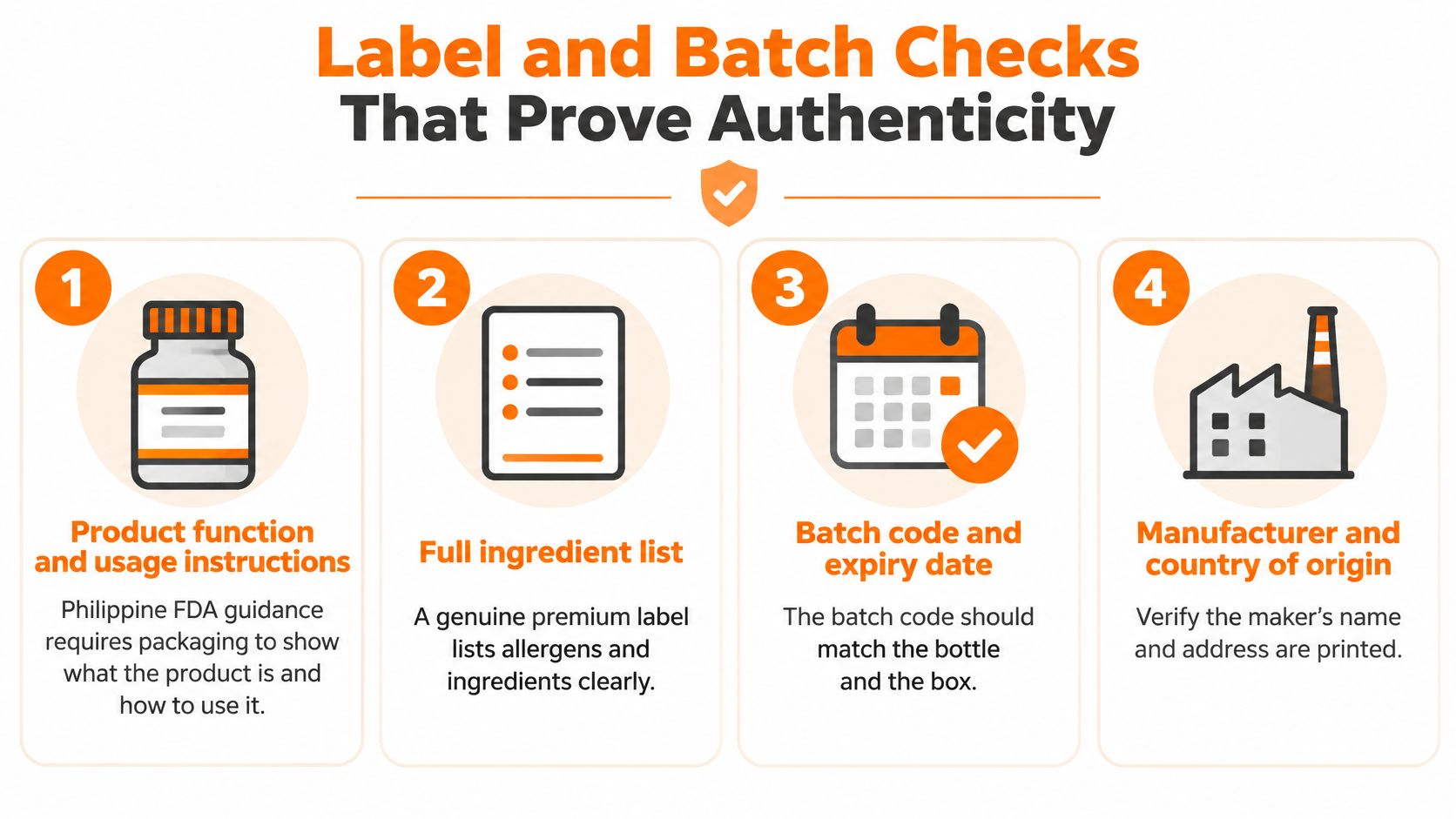
One condition sits outside the test itself. A skin test on a counterfeit tells you about the wrong liquid, so confirm the bottle is genuine before you spend a day on it. The four checks in this graphic are the ones to run first.
What a pass looks like
A pass isn't "I can still smell it". It's a scent that still has layers at six hours: something clean on top of the dry-down, something warm underneath, and no single sharp note shouting over the rest. That balance is what you're paying for, and skin is the only place you can confirm it.
Test on paper and you learn about the top notes. Test on a scarf and you learn how the fabric holds alcohol. Test on skin, twice, in two different environments, and you learn what the bottle will do for you.
Label and Batch Checks That Prove Authenticity
On a premium bottle, the label is evidence, not decoration. It's the one part of the purchase a seller can't fake convincingly across a whole shipment, and it's what to read before money changes hands.
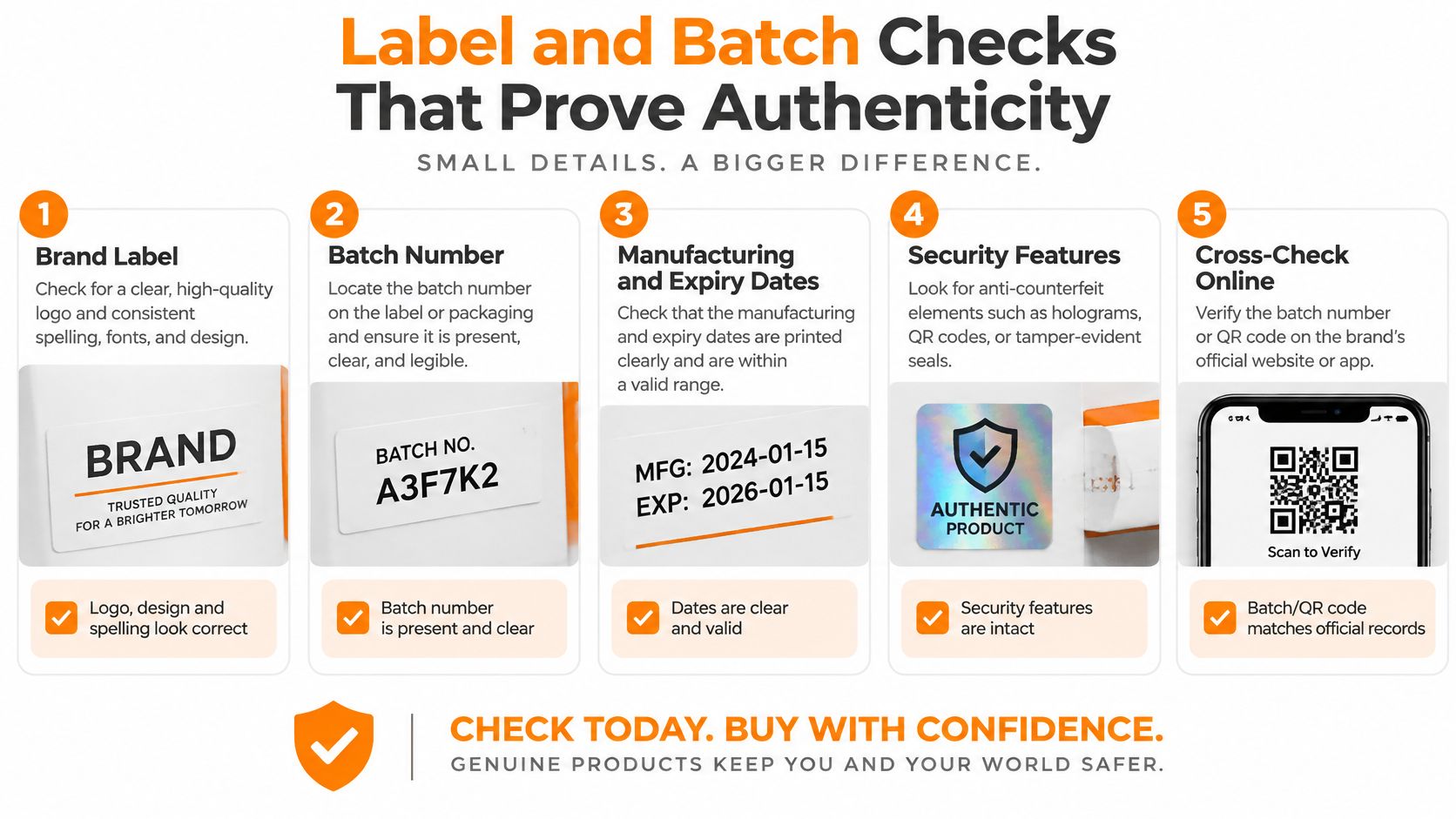
Philippine FDA labelling requirements for cosmetic products require packaging to identify the product function and usage instructions, plus a full ingredient list declared in descending order by weight. An aromatic composition may be listed as "perfume", "fragrance" or "aroma". The same guidance tells buyers to verify the brand and product name, the manufacturing or expiry date, net content, the batch or lot number, the country of manufacture, precautions, the ingredient list, and the responsible company's name and address.
The six items to check on the box
- Batch or lot number, matched across box and bottle. A premium bottle should carry the same code in both places. A mismatch means the packaging and the liquid were separated at some point.
- Manufacturing or expiry date. A date you can read, not a smudge under a sticker.
- Country of manufacture and the responsible company's name and address. This is the detail that lets you trace a problem back to someone.
- Full ingredient list in descending order. A missing panel removes any way to check what's in the bottle.
- Net content and product function. Plain, printed, matching the listing.
- Precautions and usage instructions. Genuine premium lines don't skip them.
What a batch code actually tells you
A batch code ties the bottle to a production run and a rough date. If the code on the box doesn't match the code on the glass, stop, because someone has rebuilt the package. The same logic applies online: if a listing shows no code at all, or the seller can't confirm the responsible entity, the discount isn't a bargain. A perfume batch code checker helps you read the format each house uses, since Lattafa, Rasasi and Armaf don't all encode dates the same way.
Supporting documents belong in the product information file. Safety data sheets and IFRA certification are the two a serious seller can supply on request, and asking for them is a reasonable test of how a shop handles questions.
Licensed operators aren't rare here. Approximately 13,700 licensed cosmetics establishments operated in the Philippines as of February 2025, according to Statista's cosmetics and personal care industry overview, so a seller who can't name the responsible company stands out rather than blending in.
A seller who can't name the responsible company can't be checked against anything. That's the line to hold, online or in a mall.
Words like long-lasting, Arabic or niche are claims, not proof. None of them is a labelling requirement, and any seller can type them. Run the six checks on the box, match the batch code, confirm the responsible entity, and only then decide whether the scent passed your skin test.
Quality Alternatives at Each Budget
Most Filipino buyers are already value buyers. Mass-market perfumes accounted for 62% of total Philippine perfume sales in 2025, inside a market valued at about USD 191.01 million that year, according to IMARC's Philippines perfume market assessment. The same assessment projects the market reaching USD 348.30 million by 2034, a compound annual growth rate of 6.90% from 2026 to 2034, with Luzon holding a 60% share.
That split tells you where the competition sits. Very few shoppers are choosing between prestige and nothing. They're choosing between two bottles at different prices and asking which one earns the extra spend. For a men's scent, the honest answer comes down to concentration, longevity, authenticity and whether the profile suits your lifestyle.
Set your bands before you compare
Pick three spending limits in pesos that match your week, and treat them as limits rather than quality grades. A workable starting point: entry up to about ₱2,500, mid-range between ₱2,500 and ₱4,500, premium above ₱4,500. Adjust to your own budget, then refuse to compare across bands. A ₱2,000 eau de toilette and a ₱5,000 eau de parfum aren't rivals, they're different products.
| Approach | What you gain | What to verify |
|---|---|---|
| Designer-inspired scents | Familiar profile at a lower cost | Stated concentration and a complete label |
| Middle Eastern EDP houses | Strong longevity and bold character for daily or evening wear | Batch code and seller documentation |
| Designer or niche flagships | Brand heritage and refined composition | Authenticity papers and the responsible company's details |
| Sale and clearance purchases | Premium scent at a reduced price | Expiry date and batch code before paying |
Reading the four options side by side
Designer-inspired scents get you a familiar shape, a fresh citrus-woody or a warm amber, without the flagship price. The thing to check is the concentration, because some inspired lines run lighter than the original. If the listing won't state EDT or EDP, ask.
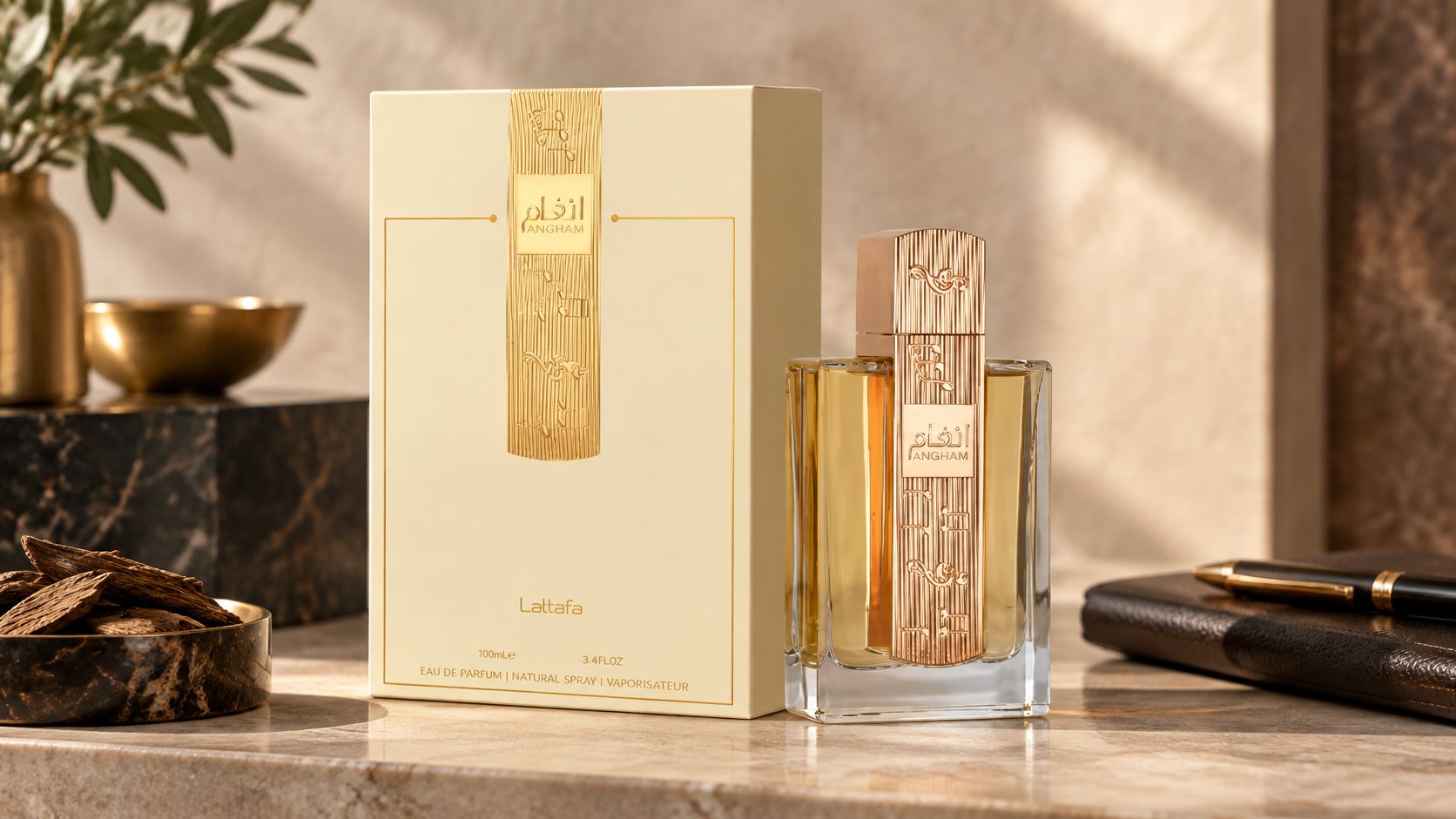
Middle Eastern eau de parfum houses are where the value argument is strongest for Philippine wear. A spicy-woody Arabian EDP at mid-range money often carries the base materials that hold through humidity, which is why a bottle like Lattafa Angham 100ML gets compared to compositions several times its price. It's a 100ml eau de parfum with a warm, Arabian-inspired character and a unisex profile, suited to daily wear as well as evenings. What to verify is the batch code and the seller's documentation, because this is the segment counterfeiters target most.
Designer or niche flagships buy you heritage, a refined composition and the confidence of a known name. You're also paying for the marketing and the counter space. If you go this route, ask for the authenticity paperwork and the responsible company's details, and still run the skin test.
Sale and clearance buys can be good, especially on last-season profiles. Two things matter more than the discount: the expiry date and the batch code. Online is where most of this comparing happens, and the channel is growing fast. The Philippine personal-care e-commerce market generated US$1.073 billion in 2025 and grew 15 to 20% year over year, according to ECDB's personal care market data, which means more listings to check and more sellers to verify.
Compare like with like and the answer gets simple. A mid-range EDP that still smells layered at hour six is a better purchase than a premium bottle that fades by mid-afternoon.
Choose Your Budget and Check the Label Before You Buy
Three decisions, in order, and none of them is about the brand name.
- Choose the concentration your week needs. Eau de cologne for a quick refresh on a hot afternoon, eau de toilette for air-conditioned office days, eau de parfum for humid commutes and evenings out, extrait for occasions where you want one strong impression.
- Set a peso band for that concentration. A band is a spending limit, not a quality signal. If the eau de parfum you want sits above your band, drop to a smaller bottle rather than a weaker concentration.
- Run the label checks and the six-hour skin test before you pay. Batch code matched, ingredient panel present, responsible company named, then two sprays on the forearm and a full day of wear.
The same decision, worked through
Say you work in an air-conditioned office in Makati and commute home in the evening heat. You shortlist two or three eau de parfums in the same mid-range band, check each batch code against the box, confirm each seller lists a responsible company, then test each on the inner forearm: once at your desk, once on the way home.
The bottle that still smells layered at six hours wins, even if it isn't the most expensive one on your list. That's the whole method. Nothing in it requires you to know perfume history or to recognise an oud from a resin.
For a sense of where the top of a working budget sits, our own catalogue has Lattafa Fahad 80ML EDP, an 80ML eau de parfum for men that is oil based and described as lasting 8 to 10 hours, priced at ₱4,599.00. That's the premium band in practice. In the EDP band built for evenings, Rasasi Hawas Fire is a 100ml eau de parfum with a bold, spicy and warm profile, positioned for evening wear and occasions rather than a daily office rotation.
Keep the box, the receipt and the batch code together. If the scent smells off in three months, or the bottle turns cloudy, that record is what turns a complaint into a return.
Buying perfume for men expensive enough to be worth it comes down to this: pay for the two costs that reach your skin, refuse to pay for the four that don't, and test before you commit. The bottle that survives six hours of your actual day is the expensive one, whatever the price tag says.
At Dubai Fragrance Shop PH, we stock eau de parfum from Middle Eastern houses such as Lattafa, Rasasi, Armaf, Afnan, Rayhaan and French Avenue, priced in pesos with nationwide shipping and free delivery on orders over ₱2,000. Every listing is built so you can compare concentration, size and character before you buy, and every order leaves our Makati base with the packaging intact for your batch check. Visit Dubai Fragrance Shop PH to shortlist two or three eau de parfums in your band and run the six-hour test on your own skin.