

Perfume Batch Code Checker: How to Verify Your Bottle
Your perfume has arrived, the box looks convincing, and the seller says it's authentic. You turn the bottle over, find a faint code, and enter it into a perfume batch code checker. A production date appears. Can you finally stop worrying?
Not yet. A useful check connects the physical bottle, its carton, the seller's records and Philippine FDA information. Keep the packaging intact while you work, and treat each result as evidence to record, not a certificate to trust blindly.
Table of Contents
- Where the Batch Code Sits on Your Perfume
- Decode Batch Codes with Tools and Format Checks
- Run the Two-Layer Check Step by Step
- What a Batch Code Can and Cannot Prove
- Red Flags That Signal a Fake or Unsafe Bottle
- Decide to Keep, Return or Report Your Bottle
Where the Batch Code Sits on Your Perfume
Start with the outer carton, not the lookup website. Inspect the base, side panels and flaps for a batch or lot number, often near manufacturing or expiry information. Then examine the bottle base and back label under good light, rotating the glass to make faint printing or embossing readable.
Don't assume the most prominent number is the right one. A barcode identifies the product, while a batch identifier relates to a production run. Retailer stock labels, order stickers and shipping references can add more numbers without helping you trace manufacturing.
Check the packaging before typing
The Philippine FDA's cosmetic labelling advisory states that the product name and manufacturer's batch or lot number must appear on the immediate packaging or outer packaging. It also tells consumers to inspect the product's dates, net content, country of manufacture, ingredients, directions, precautions and responsible company details.
That or matters. Finding a code only on the carton isn't automatically proof of non-compliance. However, when codes appear on both components, comparing them gives you a stronger traceability check than inspecting either alone.
Where to find the batch code and what to check
| Location | What you should see | What to check |
|---|---|---|
| Outer carton | Printed batch or lot number, often near the expiry or manufacturing date | Match it exactly to the bottle code |
| Bottle base or back label | Printed or embossed code near the product information | Legible, not obscured by an added sticker |
| Immediate container | Batch or lot number required on immediate or outer packaging | A code missing from both is a labelling concern |
| Shrink wrap or sticker | Sometimes a second printed code or a retailer label | Confirm the brand convention before relying on it |
A label isn't automatically suspicious. The concern is an added sticker that conceals original information, changes the apparent code or prevents inspection. Don't peel it off immediately, because its position may be useful evidence.
Practical rule: Photograph the packaging as received before removing wrap, labels or seals.
Finish the physical search with a short record:
- Carton code: Transcribe every visible character, preserving separators.
- Bottle code: Write it independently rather than copying your carton entry.
- Comparison: Mark matching, different or unreadable, including any ambiguous characters.
If neither component has an identifiable batch number, pause before using the fragrance.
Decode Batch Codes with Tools and Format Checks
A batch-code tool can answer different questions depending on its source. Brand-issued guidance or customer service can clarify the manufacturer's coding convention. Third-party calculators such as CheckFresh or CheckCosmetic estimate production timing for formats they support. The Philippine FDA Verification Portal provides local product-notification records, not batch-date decoding.
Start with the brand's published guidance. If none is available, compare the code with a documented reference bottle from an authorized source, matching the product and packaging version where possible. A calculator may return a date for a code that the brand's own lookup reads differently, so treat the result as an estimate until the format is clarified.
Establish the format first
- Character structure: Note the code's length and the positions of letters and digits.
- Separators: Preserve spaces, slashes or hyphens when entering the code.
- Placement: Record whether the reference code is etched on glass, printed in ink or shown on a label.
- Reference quality: Keep track of where the comparison came from.
An unfamiliar character or separator calls for a closer format check. Packaging versions and incomplete references can explain differences; a familiar-looking format alone does not establish authenticity.
Record the estimate without upgrading it
Choose the correct brand and enter the code exactly as printed. If a character could be a letter or digit, enlarge the photograph before trying another reading. Repeatedly changing characters until a calculator returns a reassuring date can produce a misleading result.
Save the tool name, entered code, displayed result and date checked. Describe the output as an estimated production date, not proof of authenticity or safety. If a lookup fails, check the transcription and consult brand guidance. If tools disagree, seek clarification rather than selecting the result you prefer.
A useful record captures what each tool answered.
Run the Two-Layer Check Step by Step
Use physical traceability as the first layer and regulatory and supplier records as the second. Work from the actual unit in your hands, rather than seller photographs that may show different stock.
Use this visual checklist for the physical-code portion, then complete the regulatory and documentation checks below.
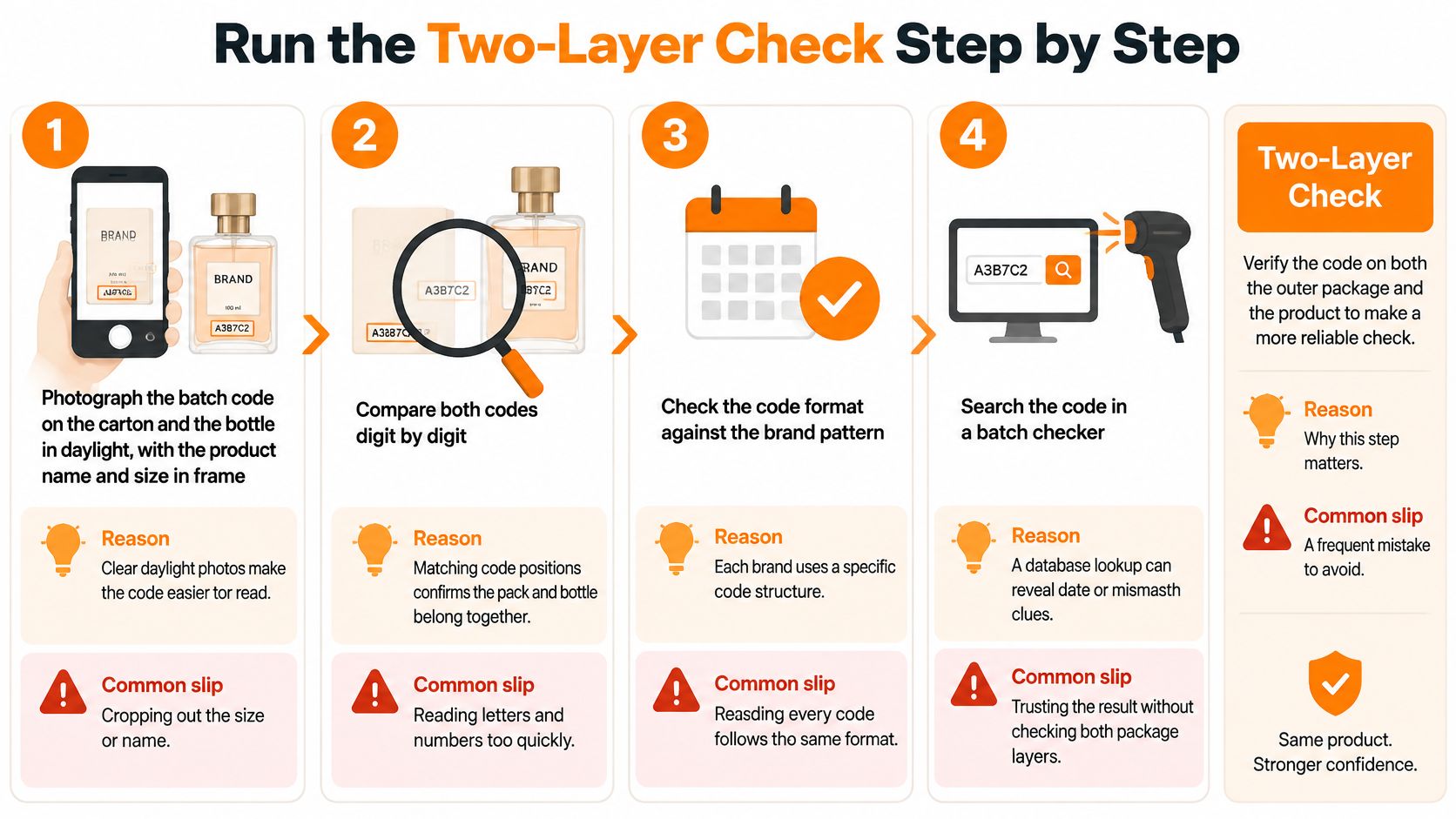
Layer one checks the physical unit
- Photograph the carton and bottle in daylight. Include the product name and size in an overview, then take close-ups of each code. Keep the original files. The common slip is cropping so tightly that nobody can connect the photographed code to the fragrance being disputed.
- Inspect legibility, spacing, typography and how the code was applied. Look for printing or embossing concealed by an added label. If you're inspecting stock from the same shipment, compare placement and print depth across equivalent units, while allowing for differences between printing on cardboard and glass. Don't mistake a tidy finish for sufficient evidence.
- Compare the product identity as well as the code. Check the name, concentration, size, manufacturer, importer or responsible entity, and ingredient information wherever supplied. For a purchase such as Ameerat Al Arab Red Eau de Parfum, compare the full variant name with the order, not merely the shared brand wording. Missing text and conflicting text should be recorded differently: absence needs clarification, while contradictory details are a mismatch.
Layer two checks the records
-
Search the exact product name through the FDA's official verification route. The FDA advisory on unauthorised cosmetics directs consumers to verify notification before purchase or use. Compare the listed identity and responsible company with the packaging, saving the result and search date. Don't substitute a foreign-market registration for Philippine notification.
A positive listing doesn't authenticate your individual bottle. The FDA's explanation of cosmetic postmarketing surveillance describes checks covering notification status, ingredients, restricted substances, claims and labelling. Compare ingredients and claims where records are available, but don't infer a complete formula match from a brief public entry.
- Request purchase documentation and clarification of discrepancies. Keep the invoice, seller identity and written explanation together. Our guide to buying authentic perfume online in the Philippines can help with seller assessment, but the evidence must still relate to your order. We source every fragrance directly from authorised distributors and verify authenticity; every bottle is inspected before shipping.
A missing Philippine result calls for investigation, not an immediate counterfeit accusation. Hold the bottle while the seller clarifies the product's local notification and sourcing.
For an additional visual reference, the accompanying video is available below.
Finish by assigning Pass, Mismatch or Inconclusive to each check. For a high-value purchase, require independent documentary support rather than relying on another calculator result.
What a Batch Code Can and Cannot Prove
A batch code can support traceability, but it cannot establish a bottle's authenticity on its own. Manufacturers use batch or lot numbers to identify production runs. Counterfeiters can copy visible codes, so a plausible calculator result needs to be assessed alongside the carton-to-bottle comparison and available Philippine FDA records.
What a code check establishes
A code that agrees across the carton, bottle and seller's records supports consistency between those items. It does not confirm that the code was assigned to that product or that the bottle passed through an authorised supply chain. An FDA notification record addresses a separate question: whether the cosmetic has been notified for the Philippine market. The FDA advisory on unnotified cosmetics warns that the agency cannot assure the quality or safety of unnotified products.
A code-based date estimate also says nothing about the bottle's storage conditions, seal integrity or possible contamination. An older unopened bottle is not automatically unsafe, and a recent estimate cannot explain a damaged seal or leakage. Check the product's declared information and treat observable condition issues as separate evidence.
Recording each batch code check. Use the result for each check separately; a Pass increases confidence only in the specific comparison or record reviewed.
| Result | When to use it | Next step |
|---|---|---|
| Pass | The carton and bottle codes agree, seller records are consistent, and the FDA search supports the product details | Keep the photographs and invoice with your purchase records |
| Mismatch | The carton and bottle codes differ, or product details conflict | Document the discrepancy and raise it with the seller and the FDA |
| Inconclusive | The code is unreadable, no calculator result is available, or no Philippine listing appears | Seek clearer product information or supporting documentation before treating the check as resolved |
Record mixed findings separately. For example, matching physical codes can pass while the regulatory search remains inconclusive. Note whether the issue is an unreadable code, a calculator with no result or a missing official listing; each calls for different supporting information. Typography or spacing that differs between equivalent units is worth photographing and asking the seller to explain, but it does not by itself establish authenticity.
Red Flags That Signal a Fake or Unsafe Bottle
Counterfeit perfume isn't a marginal concern for Philippine buyers. In its September 2024 coverage, ABS-CBN reported IPOPHL figures showing perfume and beauty products represented 36.1% of seized counterfeit goods.
That figure describes the reported seizures, not the likelihood that your purchase is counterfeit. Its practical relevance is simpler: inspect the complete unit and preserve evidence when something doesn't agree.
Identify the concern before drawing a conclusion
Red flags, what they may mean and what to do
| Red flag | What it may indicate | What to do |
|---|---|---|
| Code printed over a sticker | Possible relabelling | Photograph it and compare with the carton |
| Carton and bottle codes differ | Mismatched or swapped packaging | Treat as a mismatch and escalate |
| Damaged or resealed seal | Possible tampering or packaging damage, including possible heat exposure | Record it and request a replacement |
| Missing importer or responsible company details | Incomplete labelling | Check the FDA portal and ask the seller |
| Unusual odour, discolouration or leakage | Possible storage damage or contamination | Stop using it and keep the bottle |
A damaged seal doesn't tell you exactly what happened. Nor does a sticker prove deliberate deception. Describe the observable fact in your complaint, such as an added label covering the original print, rather than stating an accusation you can't yet support.
For more physical comparison points, use our fake versus original perfume guide. Compare the same fragrance and packaging version where possible; unrelated bottles make poor references.
Separate sourcing from condition
A counterfeit concern asks who manufactured and supplied the item. A condition concern asks whether this particular bottle is damaged or unsuitable for continued use. You don't need to settle the first question before acting on the second.
- Unexpected smell or colour: Document the observation without deliberately applying more fragrance to your skin.
- Leakage: Keep the bottle upright and photograph the bottle, carton and affected packing.
- Skin reaction: Stop using the product. Seek medical advice if symptoms persist, and urgent care for severe symptoms.
Don't use longevity alone as an authentication test. Personal perception and wearing conditions make that a weak basis for declaring a bottle fake.
Keep your complaint specific: identify the order, attach photographs, describe the discrepancy and state the remedy you're requesting. Numbers on packaging can be reproduced, so resolve the entire evidence trail rather than accepting a fresh screenshot of a successful lookup.
Decide to Keep, Return or Report Your Bottle
Keep it when the checks agree and the bottle is in good condition. Retain the carton and store the fragrance away from heat and direct sunlight. Save photographs of both packaging components, the transcribed code, seller name, invoice and FDA search result with the date checked.
Return or escalate when product details conflict or the bottle arrives damaged. Inspect your order on receipt and contact us immediately if it's defective, damaged or the wrong item. Check your order confirmation and our return and refund policy before submitting a request; a documented concern doesn't automatically establish refund approval. Send unresolved regulatory or suspected counterfeit concerns to the FDA with supporting records.
Hold it when the outcome is inconclusive. Before using it, obtain evidence that resolves the actual gap. For purchases elsewhere, ask how the stock was sourced and whether it came through authorised distributors. At Dubai Fragrance Shop PH, every fragrance is sourced directly from authorised distributors and verified for authenticity.
The batch code is a screening tool; your records are what support resolution of a dispute.
Dubai Fragrance Shop PH offers authentic Middle Eastern fragrances, with every bottle inspected before shipping. Visit Dubai Fragrance Shop PH to choose your fragrance, then keep your order records and inspect the carton and bottle on arrival.