

EDP vs Perfume: Concentration, Longevity and Which to Buy
Search for edp vs perfume and you'll meet the same tidy ranking within seconds. Eau de parfum lasts six to eight hours, perfume lasts twelve or more, so pay the premium if you want the scent to survive the day. It reads like a specification sheet, and it isn't one. Those numbers describe typical outcomes, and in Philippine heat they fail in both directions. A dense extrait can sit so close to the skin that nobody around you registers it by lunchtime, while a well-made EDP sprayed on a shirt collar is still there at nine in the evening.
Concentration measures how much aromatic material is dissolved in alcohol. It says nothing about your skin's oiliness, the humidity on your commute, how many sprays you used, or whether the bottle is the format it claims to be. Treat the choice as a practical one instead: what the percentage changes, how to test both formats on your own arm at local temperatures, and how to compare cost per wear rather than cost per bottle.
Table of Contents
- EDP vs Perfume at a Glance
- What Concentration Changes and What It Does Not
- How to Test Longevity and Projection on Your Skin
- Which Format Fits Your Day in Philippine Heat
- Price per Millilitre and What You Really Pay
- Label and Seller Checks Before You Buy
- Choose the Right Format for Your Next Bottle
EDP vs Perfume at a Glance
Eau de parfum is a mid-to-high concentration fragrance, usually built on about 15 to 20 percent fragrance oil. Perfume, sold as parfum or extrait de parfum, is the most concentrated format on a shelf, typically 20 to 30 percent, and it's almost always the dearer of the two per millilitre. That's the definition. Everything past it is a claim about how the two normally behave, not a promise the bottle has to keep.
The chart below puts the two formats side by side on the points that decide a purchase.
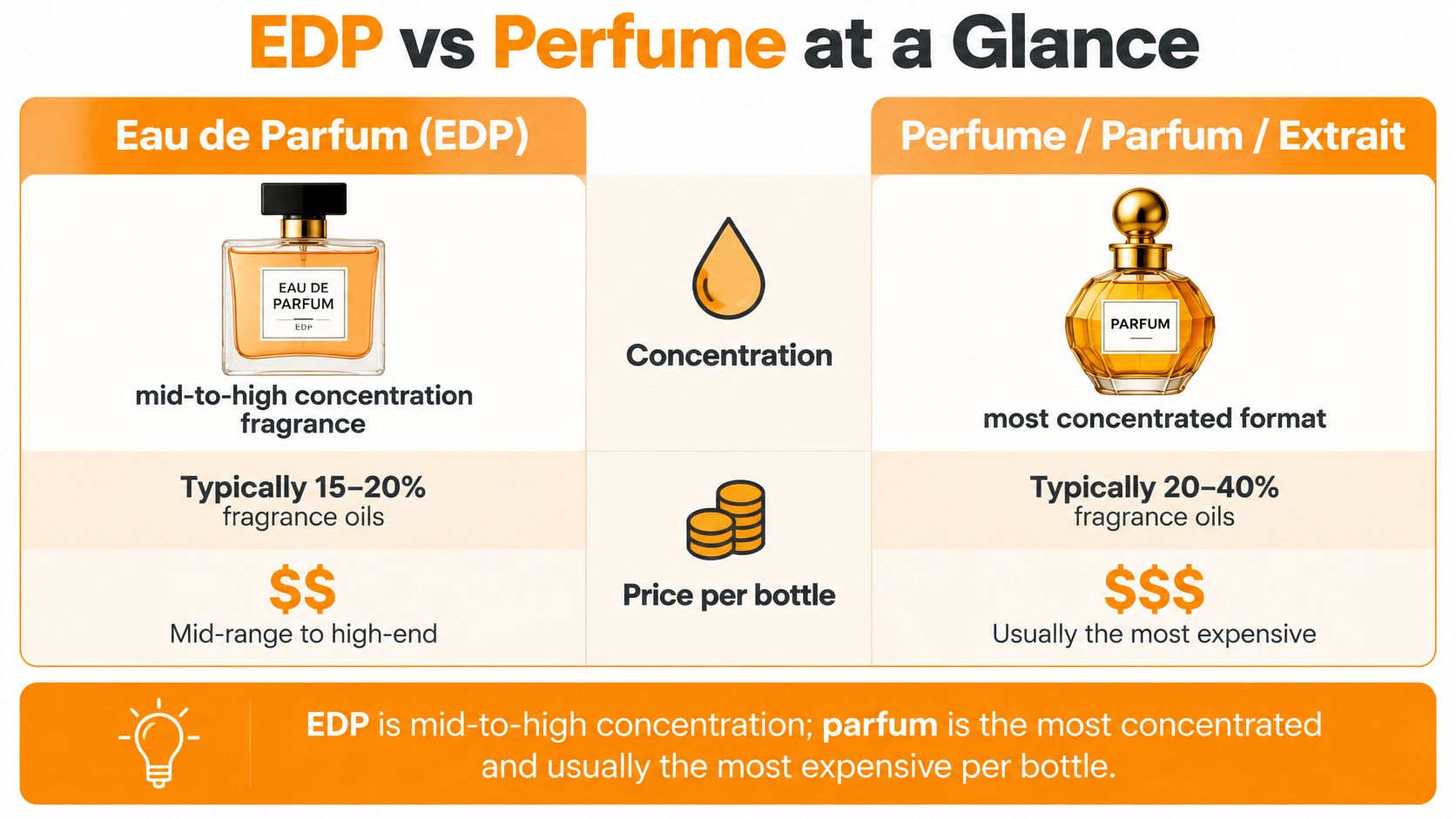
EDP vs perfume side by side
| Factor | Eau de Parfum (EDP) | Perfume (Parfum or Extrait) |
|---|---|---|
| Fragrance oil concentration | About 15-20% | About 20-30% |
| Typical skin wear | About 6-8 hours, often longer with good application | About 8-12 hours or more |
| Projection | Stronger opening, noticeable to people nearby | Softer, closer to the skin |
| Usual spray count | Two to three sprays | One or two sprays |
| Price position | Middle to premium | Premium |
| Typical use | Daily wear, office, commuting, events | Evenings, special occasions, long wear |
Read every row as a range. Formula, dose, skin and weather move all six, and two bottles with identical percentages can behave nothing alike. A citrus-forward EDP loses its top notes faster than a resinous parfum, and a parfum that ran twelve hours on your arm in an air-conditioned office may thin out by mid-afternoon if you spent the day outdoors in traffic.
Shop listings blur the words, too. Plenty of product pages describe any bottle as "perfume" because that's the search term people type. Before you compare anything, find the stated format on the listing or the bottle face: eau de toilette, eau de parfum, parfum, extrait. Where no format is stated, treat the concentration as unknown.
Which row matters for your routine
If your days need a scent that people standing near you notice, weigh projection and price position first, and EDP usually wins that pair. If you want one or two sprays to carry an evening to its end, the wear time and spray count rows decide it, and parfum usually wins those. The rest of the table is context.
What Concentration Changes and What It Does Not
A concentration figure tells you how much of the bottle is aromatic material. It's a recipe ratio, not a rating. Houses choose a strength for reasons of cost, texture and the kind of opening spray they want, and the label reports the result. It's worth knowing the size of the category you're buying into: IMARC Group's Philippines perfume market report valued the market at USD 191.01 million in 2025, with mass perfume products accounting for 62% of it. Most bottles sold here are affordable formats, not extraits.
The ladder, from cologne up
The bands below are industry convention rather than legal grades, and they overlap at the edges.
- Eau de cologne sits at roughly 2 to 4 percent, built for a bright, fleeting effect that you reapply through the day.
- Eau de toilette runs about 5 to 15 percent, which is why it reads fresh and airy and fades inside a working morning.
- Eau de parfum begins where eau de toilette tapers off, and parfum or extrait sits at the top of the ladder.
What higher concentration actually buys you
Adding oil usually deepens the dry-down. Base materials such as resins, woods, amber and musk have more room to hold on, so the last third of the scent stretches out. The trade-off is physical: heavier materials cling closer to the body, which softens the opening burst. That's why an EDP often smells stronger to the people around you in the first hour while a parfum hums along for longer.
The other thing it buys is cost. Concentrate is the expensive component to source and import, so price climbs with the oil even when the bottle shrinks in size. A 30 ml extrait routinely costs more than a 100 ml EDP from the same house.
A 20 percent label doesn't outlast a 15 percent label on every arm. Skin oil, dose, sweating and air movement decide that, which is why a test on your own wrist beats any concentration chart.
Use the percentage to predict strength and cost. Use your own skin to confirm wear.
How to Test Longevity and Projection on Your Skin
No label predicts your result, because your skin and your commute are part of the formula. Heat lifts a fragrance off the skin and makes it project, and it also makes dense formulas feel heavier and sometimes cloying, so the benchmark has to be local rather than borrowed from a temperate-climate guide. The Philippine FDA advisory on fragrance formats makes the same point in regulatory language: parfum generally carries a higher proportion of concentrate than EDP, which can give it greater skin persistence and lower volatility, while EDP tends to open more strongly and spray lighter. Temperature, dosage, skin oil and airflow still decide the outcome, so test at roughly 30 to 34°C rather than trusting the word on the box.
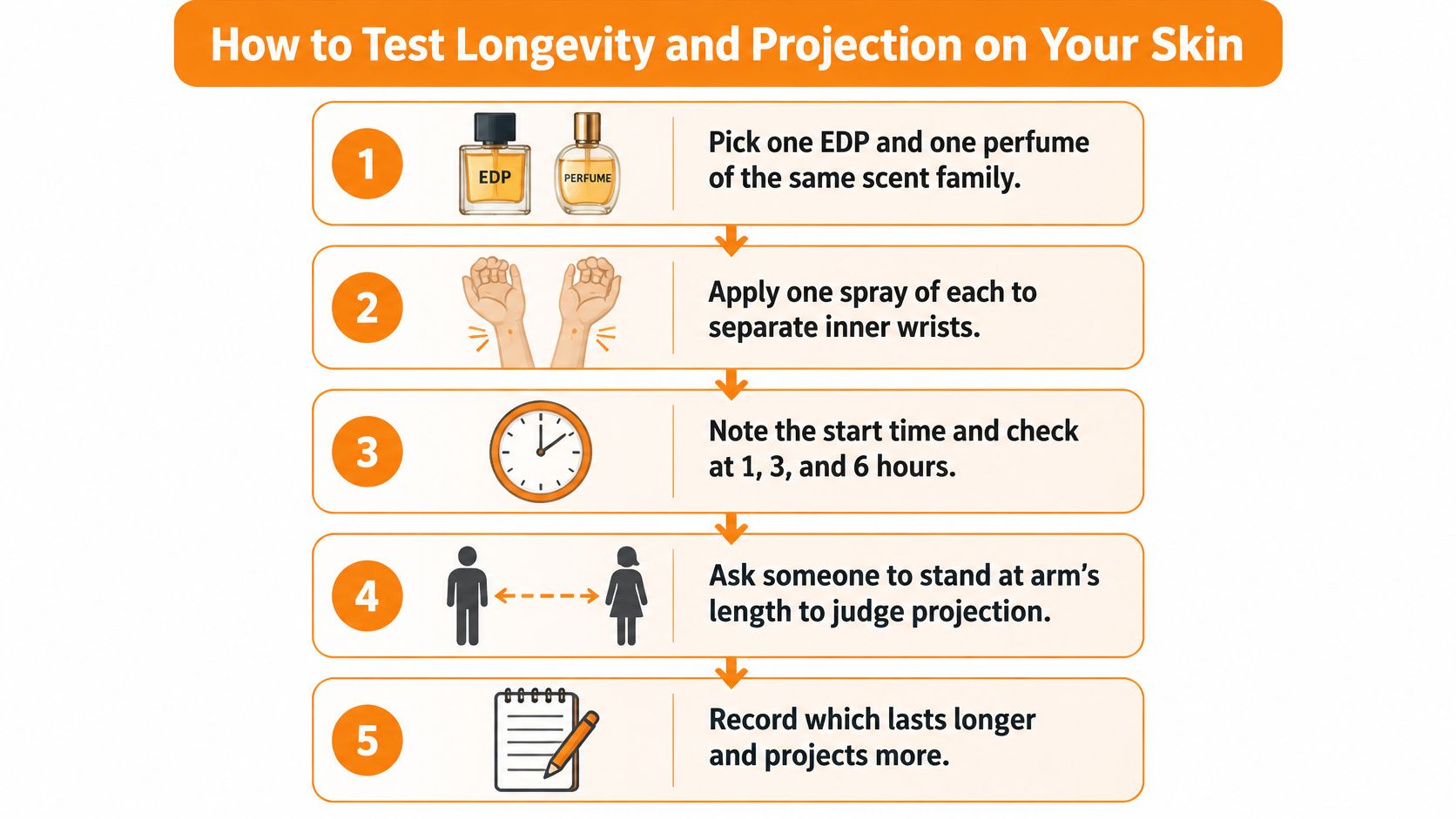
- Pick a fair pair. Choose one EDP and one parfum from the same scent family, or two bottles you already own. Wash both forearms with unscented soap and let them dry, because lotion residue or yesterday's scent will skew the comparison before you start.
- Dose both arms identically. One spray each, same distance, same spot on the inner forearm. Two sprays on one arm and one on the other means you've tested dose, not format.
- Start a clock and rate at fixed intervals. Score intensity from 1 to 5 at 0, 2, 4, 6 and 8 hours. Write the scores down, because memory flatters whichever scent you liked at the opening.
- Run it in local heat, then repeat indoors. Do the first pass on a warm afternoon with no air conditioning, then repeat in an air-conditioned room on another day. The pair tells you what your commute and your desk will each do to the same fragrance.
- Check fabric separately. Sniff a cotton shirt cuff or collar at the eight-hour mark. Clothing usually holds a scent longer than skin, which is why a spray on the shirt can carry you through a full working day when the wrist has given up.
- Bring in a second nose. At the two-hour point, ask someone to stand about a metre away and rate how clearly they notice it. You go nose-blind within minutes, so your own sense of projection is unreliable.
If you'd rather watch the process before running it, this walkthrough covers application and the same check points.
Three ways the test goes wrong
- Moisturised versus dry skin. Dry skin releases fragrance faster, so testing one arm freshly moisturised and the other bare measures the lotion, not the format.
- One warm evening as your sample. A single dinner outdoors in March tells you very little about a Tuesday commute in May.
- Mismatched scent families. A fresh citrus will lose to an amber every time, whatever the label says. Compare like with like.
Reading the result is the straightforward part. When a format drops below a 2 by hour four, check the dose and the state of your skin before blaming the concentration. When a scent holds at 4 on your arm at hour eight but disappears from fabric in three, you've found a skin scent that behaves better on you than on your clothes. Shoppers who want the practical expectations rather than the theory can start with this guide to long-lasting perfume in the Philippines. The FDA's advice applies either way: check cosmetic notification status before buying, and confirm the product information covers identity, ingredients, responsible company and batch details.
Which Format Fits Your Day in Philippine Heat
The setting decides more than the label does. On a packed train at 7am, a scent that fills the carriage is a cost you're charging to everyone else. At a shared desk for eight hours, moderate projection is the courteous range, and dose control matters more than which format you bought.
The audience for this decision is growing quickly. Market coverage shows Philippine fragrance retail value and volume both grew by double digits in 2024, according to Euromonitor International's Philippines fragrances report, which means a large number of first-time buyers are choosing between formats with no frame of reference. Here's how the choice plays out by situation.
Best format by setting in the Philippines
| Setting | Better fit | Why | Application tip |
|---|---|---|---|
| Metro Manila commute | EDP | Noticeable without overwhelming a crowded train | Two sprays on clothing and wrists |
| Air-conditioned office | EDP | Moderate projection suits shared spaces all day | Two sprays, reapply only after lunch if needed |
| Outdoor event in heat | EDP, sprayed sparingly | Heat speeds evaporation and can intensify the scent | One spray on clothing rather than bare skin |
| Evening or special occasion | Perfume | Richer dry-down and longer wear from fewer sprays | One or two sprays on pulse points |
| All-day wear without reapplying | Perfume | Lower volatility keeps the scent on skin longer | Apply to moisturised skin before spraying |
| Gifting | EDP | Broad appeal at a more accessible price | Choose a standard 80-100ML size |
Heat changes the arithmetic of application. A formula that behaves beautifully in an air-conditioned room can turn sharp and heavy on a humid street at noon, and the fix is usually distance and quantity rather than a different bottle.
Practical rule: in humid heat, one spray placed lower on the body or on the inside of a collar projects further and offends less than three sprays on the neck.
If you want the placement detail rather than the principle, this guide to the best perfume for hot weather covers where to spray and how much.
For five of those six settings, the dose you apply matters more than the word on the box. Pick the two settings you face most often, a weekday commute and a shared office, or an office and evenings out. That pair normally settles the format on its own.
Price per Millilitre and What You Really Pay
Shelf price hides the only number that helps you compare, which is what each wear costs. A ₱4,599 bottle can be cheaper to own than a ₱2,199 one if it needs a third of the sprays, and the reverse is just as common.
Two numbers, then a comparison
Work out peso per millilitre first: divide the price by the volume. Then estimate wears: at roughly ten sprays per millilitre, an 80ML bottle holds around 800 sprays, so divide the millilitres by ten and then by your sprays per wearing. Price divided by wears gives cost per wear. Run that once per bottle and bottle size stops driving the decision.
Applied to four listed EDPs, the arithmetic looks like this.
Price per millilitre for listed EDPs
| Product | Size | Price (PHP) | ₱ per ml |
|---|---|---|---|
| Nujoom Dehnee EDP 80ML | 80ML | ₱2,199.00 | ₱27.49 |
| Lattafa Asad 100ML EDP (sale) | 100ML | ₱2,999.00 | ₱29.99 |
| Lattafa Petra Viola 100ML EDP | 100ML | ₱3,999.00 | ₱39.99 |
| Lattafa Fahad 80ML EDP | 80ML | ₱4,599.00 | ₱57.49 |
The spread runs from ₱27.49 to ₱57.49, so the dearest bottle per millilitre costs more than twice the cheapest. Sticker price understates that gap: the ₱4,599 bottle looks about 53 percent dearer than the ₱2,999 one, but per millilitre it costs nearly double, because the expensive bottle is also the smaller one.
Say a 100ML eau de parfum costs ₱3,000 and a 100ML parfum costs ₱4,500, so the parfum is 50 percent dearer per millilitre. At three sprays a day the EDP lasts about a third as many days as the parfum at one spray, so the parfum lands at roughly half the cost per wear despite the bigger outlay. Format changes the divisor as well as the price.
Rule of thumb: a parfum that needs one spray where your EDP needs three can cost more per bottle and less per wearing. Neither figure is the whole story until you know your spray count.
That spray count is not a fixed number either. Skin that absorbs fragrance quickly, and afternoons humid enough to strip a top note in an hour, both push it up, so cost per wear has to be measured on your own skin rather than read off the box.
One structural caveat applies here. The Philippine fragrance trade is import-led, and 6W Research's Philippines fragrance and perfume market report recorded import shipments growing at a 45.37% compound annual growth rate from 2020 to 2024, including 14.27% between 2023 and 2024, with pricing shaped by foreign sourcing, shipping, duties, exchange rates and local distribution. Prices in Dubai Fragrance Shop PH's online store may differ from prices in its physical stores or in third-party stores, and all prices on the site are shown in Philippine pesos (PHP), so confirm the current figure and any sale before running the division.
Label and Seller Checks Before You Buy
A higher concentration label proves nothing about authenticity, safety or quality. What it tells you is how the fragrance was diluted. Everything else has to come from the packaging and the seller, and in the Philippines those checks are specific.
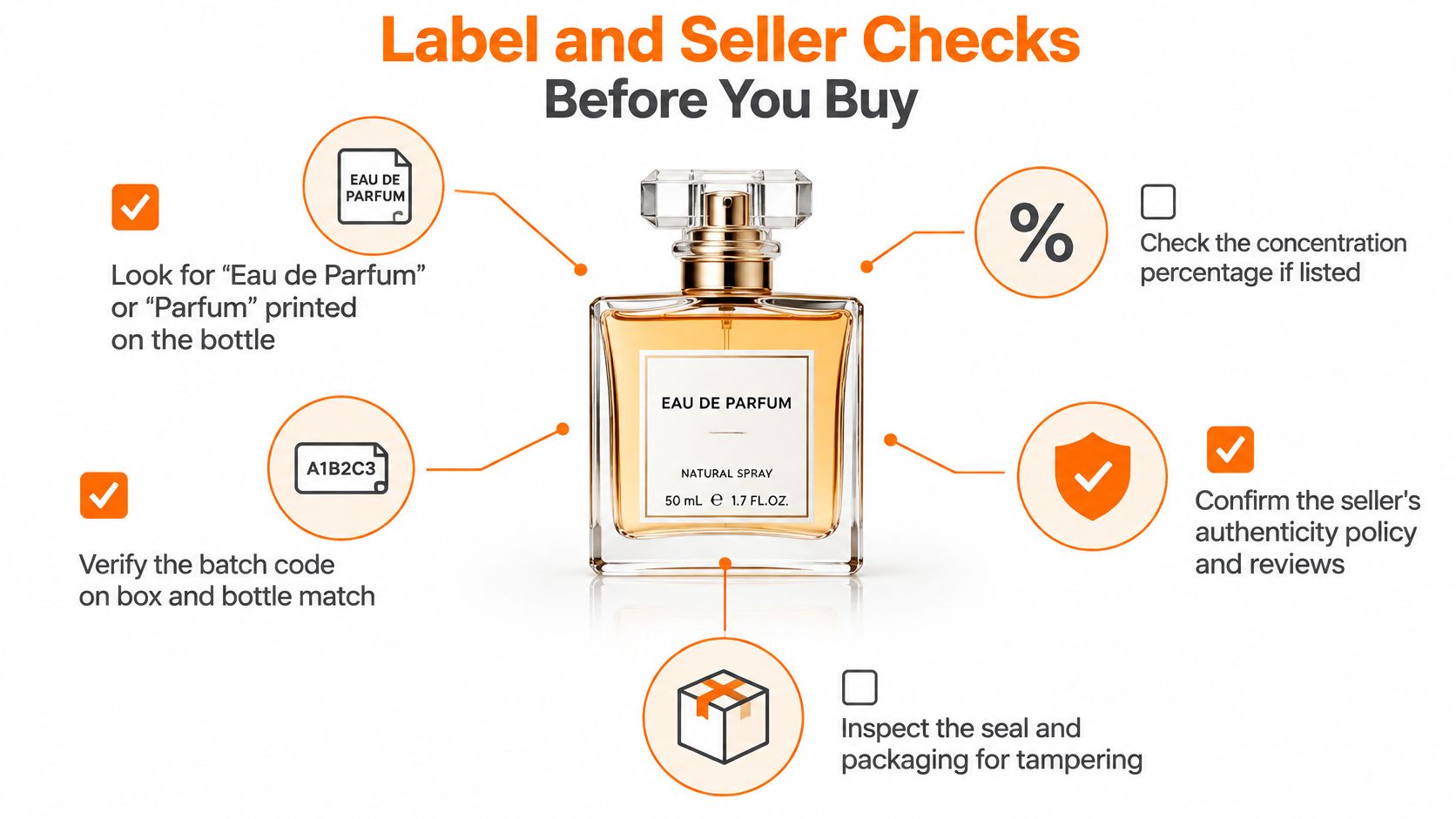
The Philippine FDA's guidance on cosmetic labelling sets out what a compliant package should carry. Work through this list before you pay.
- Product identity. The name tells you what you're buying and lets you match the box to the listing.
- Responsible company or person. Someone has to be accountable for the product being on the market.
- Net content. You're paying per millilitre, so the stated volume matters to the arithmetic.
- Batch or lot number. It ties the bottle to a production run and supports any complaint later.
- Manufacturing or expiry information. Fragrance ages, and citrus-heavy formulas age faster than resinous ones.
- Country of manufacture. Useful when a listing implies a European origin without stating it.
- Full ingredient list. Fragrance materials may be declared as "Fragrance" or by chemical name, and that's normal.
- Instructions and precautions. Relevant if your skin reacts, and the first place to look before spraying on fabric.
Supporting documents such as a safety data sheet and IFRA conformity sit in the product information file rather than on the label, so their absence from the box isn't evidence of anything. If your skin is reactive, patch test on the inner elbow and wait a day.
Seller checks that carry weight
Ask whether the product has cosmetic notification, which the FDA treats as a condition for placing a cosmetic on the market. Look for working contact details, a published returns policy and visible proof of past transactions; a seller with all three is easier to hold to account than one with none. Remember that "perfume" is used loosely in marketing, so request the stated format rather than accepting the word. Our own guide to telling fake versus original perfume walks through the physical signs in more detail.
Choose the Right Format for Your Next Bottle
Decide from your two most common settings and your forearm scores, not from the word "perfume" printed on a box. That's the whole decision rule, and it takes one weekend to apply.
Choose EDP when the two-hour check at one metre needs to register on a commute or in a shared office, and when a mid-priced bottle should give you more applications. Choose parfum when the eight-hour skin score matters more than the opening burst, and one or two sprays have to carry an evening.
Two catalogue EDPs fit that starting point. Nujoom Dehnee EDP is an oil-based eau de parfum in an 80ML bottle at ₱2,199.00, described by the store as suited to everyday wear and special occasions, with a listed wear of 8-10 hours. Maison Alhambra Delilah Blanc EDP is a soft floral with subtle warmth at ₱2,799.00, positioned for daily wear and events.
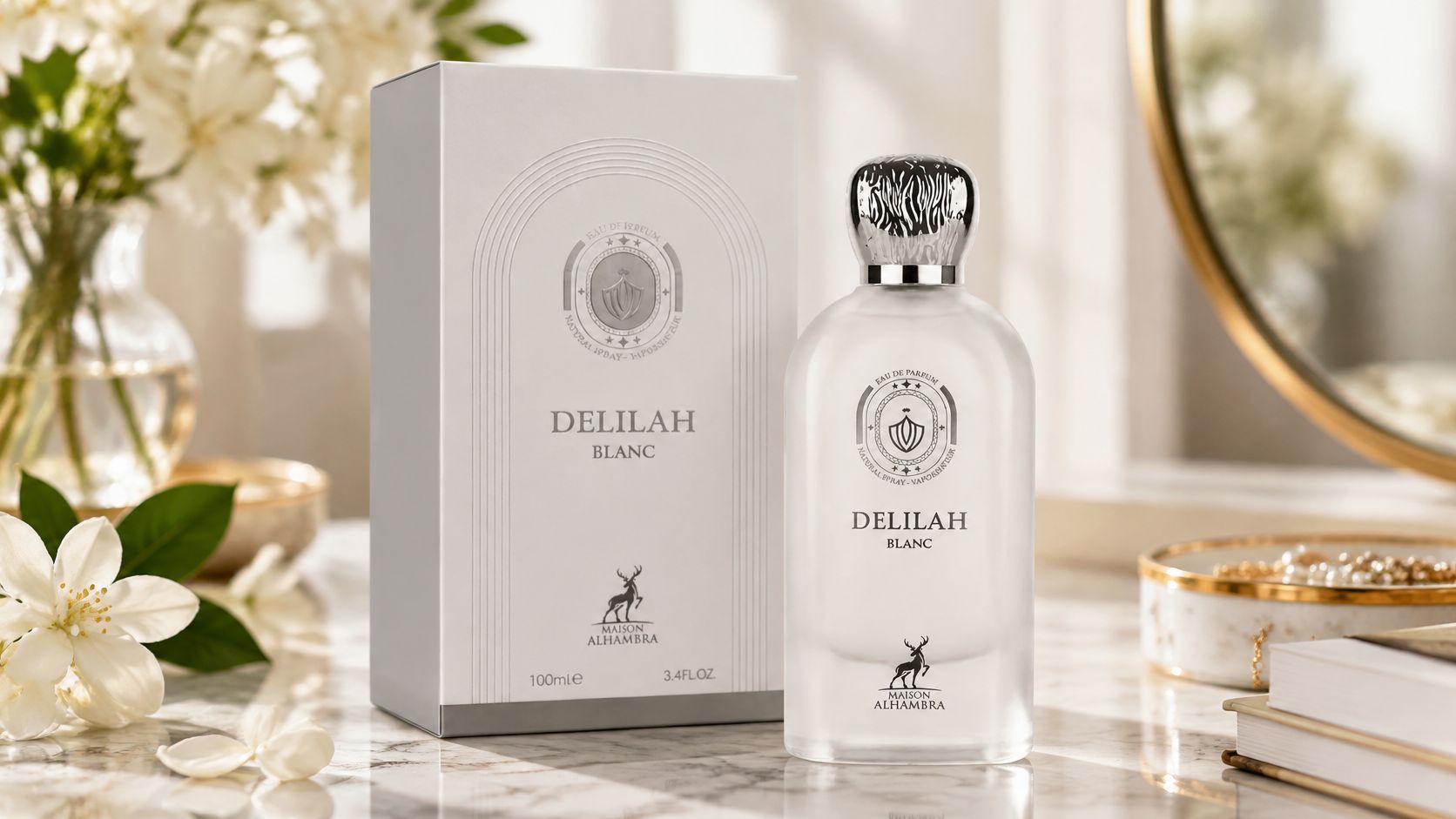
Those wear times are the store's figures and your skin overrides them, so run the eight-hour check on your own arm before assuming them. If your two scores are close, buy one standard 80-100 ml EDP first, repeat the routine over a full week, and move to a parfum bottle only if the scent fades before the hours you need it.
The last step is unglamorous and it's the one that protects your money. Read the stated format on the listing, complete the label and seller checks, and test two sprays from the bottle before you buy a second. Concentration is a starting point for a comparison, never the conclusion of one.
Dubai Fragrance Shop PH stocks oil-based eau de parfum from houses such as Lattafa, Afnan, Armaf, Rasasi and Maison Alhambra, priced in Philippine pesos with nationwide shipping. If you're weighing concentration against cost per wear, start with an 80-100ML EDP and run the eight-hour test on your own skin before adding a parfum. Visit Dubai Fragrance Shop PH to compare formats and bottle sizes side by side.