

Return & Refund Policy Guide for Philippine E-Commerce
Philippine law does not allow a blanket No Return, No Exchange rule when a product is defective, damaged, or not what was promised. Under the Consumer Act and the Internet Transactions Act, buyers can still seek remedies such as refund, replacement, or repair, so your policy has to reflect that reality, not wishful thinking.
A customer opens a parcel in Makati and finds a cracked perfume bottle, a leaking atomiser, or a variant that doesn't match the listing. At that moment, your return & refund policy stops being a legal page and becomes a live operating decision.
Table of Contents
- Why Your Return Policy Must Start With Philippine Law
- Statutory Remedies Versus Voluntary Return Options
- How the Internet Transactions Act Governs Your Returns
- Choosing Your Return Policy Model for a Niche Fragrance Store
- Sample Return and Refund Policy Text You Can Adapt
- Solving the Operational Gaps Most Policies Ignore
- Implementing Your Return Policy Step by Step
- A Real Return Scenario Showing the Policy in Action
Why Your Return Policy Must Start With Philippine Law
A fragrance store owner usually feels the pressure first at dispatch, not in the legal department. The box went out clean, the courier scan looks fine, and then a customer sends photos of a damaged bottle or the wrong scent profile. Your first instinct might be to point to store policy, but the stronger starting point is the legal baseline that governs the sale.
The Department of Trade and Industry says consumers may seek an exchange or refund when goods have a defect in quality or an imperfection in the service, and sellers must honour applicable warranties and provide remedies for hidden faults, defects, or undisclosed charges. That means a policy can't erase remedies the law already gives the buyer. A store may still offer voluntary perks, but those sit on top of the law, not above it. DTI consumer education on consumer remedies
What that means in practice
For a fragrance retailer, the trigger points are usually obvious once you slow down and inspect the facts. A bottle arrives broken, a seal is compromised, a listing promised one variant and shipped another, or the item turns out to have a problem the buyer couldn't have seen at checkout. Those are the situations where statutory protection matters.
Practical rule: write your policy so the customer service promise never weakens the legal remedy.
That legal foundation matters because it also changes how you train staff. If a support agent treats every complaint as a goodwill exception, the team will make inconsistent decisions and create avoidable disputes. If the team knows the difference between a defect claim and a change-of-mind request, the business can respond faster and with less friction.
What to ask customers to keep
The buyer should preserve proof of the transaction, including the official receipt, order confirmation, delivery records, photographs, and relevant messages with the seller. On your side, that same documentation gives you a clearer audit trail when a claim needs inspection. A strong policy should say exactly which records you'll ask for, because vague requests only slow the process.
A good policy also makes one thing clear. Your internal terms can define convenience options, but they can't contract away Philippine consumer protections. That's why the best return & refund policy for a local fragrance shop starts with the law, then layers operational detail on top.
Statutory Remedies Versus Voluntary Return Options
A lot of return pages fail because they treat every request the same way. That sounds customer-friendly, but it creates confusion the moment an unopened bottle arrives safely, a customer changes their mind, or a parcel turns out to be defective. The policy has to separate what the law requires from what you choose to offer.
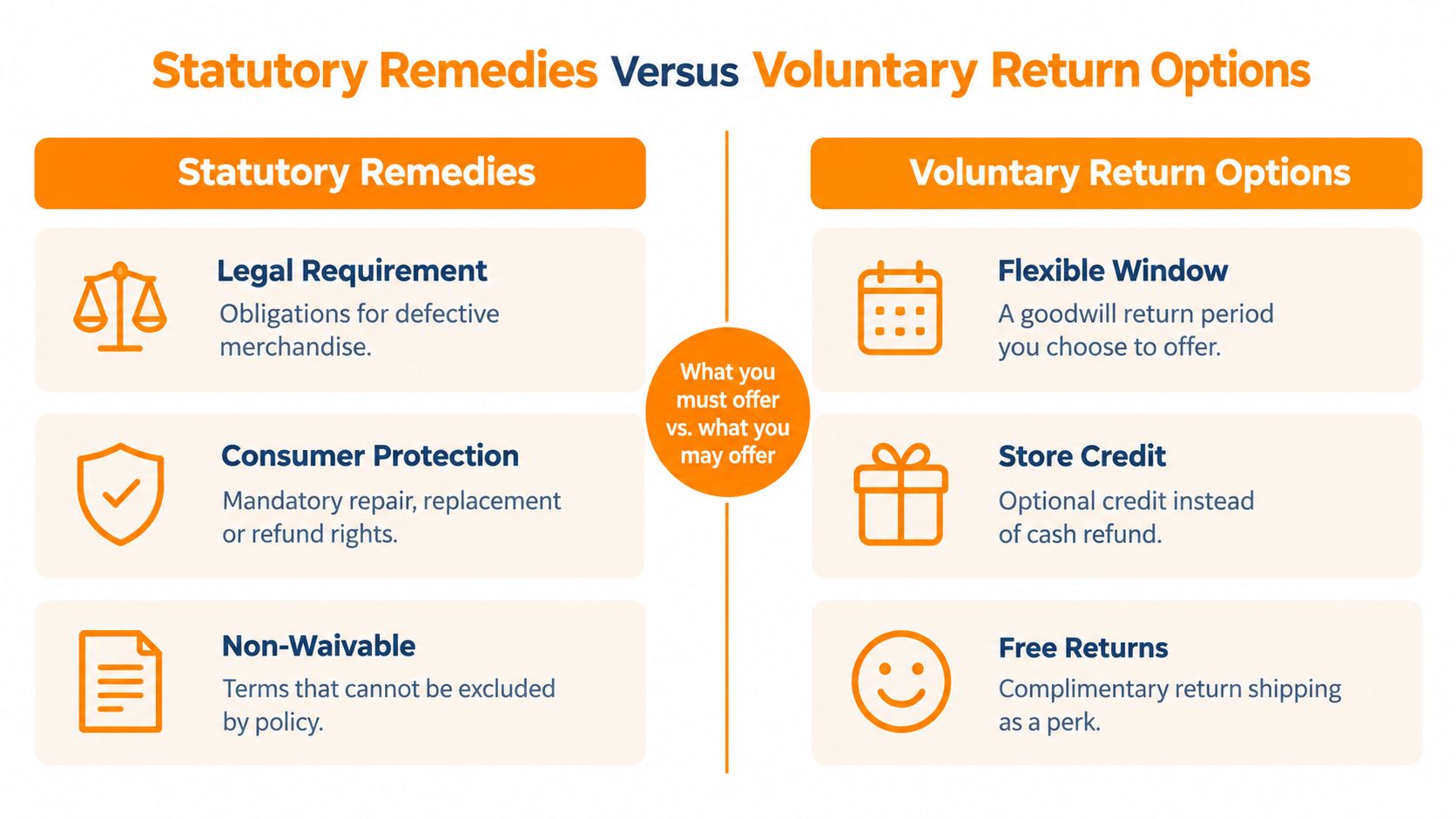
Two categories, two different obligations
Statutory remedies apply when the item is defective, materially different from the product description, damaged in transit, or affected by an undisclosed fault. In those cases, Philippine law gives the consumer a real remedy, not a courtesy. Voluntary return options are different. Those are the extra windows, store credits, or free return shipping perks you choose to offer for goodwill, conversion, or brand building.
For a perfume store, the line between the two is easy to blur if the wording is sloppy. A customer may dislike the scent, expect a designer fragrance to smell exactly like a comparable note profile, or regret the purchase after opening the parcel. Those are not the same as a cracked bottle or an undisclosed defect. If your policy mixes them together, customers will read more into the rules than you intended.
A clean policy language set saves more time than a generous but vague policy ever will.
How to write the distinction clearly
Use one section for defects and non-conforming goods, then a separate section for any voluntary returns. Don't bury the legal remedy inside a long paragraph about store credit. Don't say “all sales are final” if you mean “non-defective change-of-mind returns are not accepted.” That distinction matters because one phrase is lawful and precise, while the other can sound like you're denying statutory rights.
The optional side of the policy can still be useful. A limited goodwill window can help with unopened items, gift purchases, or buyer remorse, especially in a high-emotion category like fragrance. But it should be labelled as a customer-service benefit, not a right. That's the part most stores get wrong, and it's the part buyers remember when a dispute starts.
How the Internet Transactions Act Governs Your Returns
Republic Act No. 11967 gives your return workflow its real mechanics. It says an online consumer may pursue repair, replacement, refund, or other remedies when an item is defective, malfunctions, is lost without the consumer's fault, fails to conform to its warranty, or reflects another contractual liability of the online merchant. For a fragrance shop, that means your policy should be built around remedy selection, evidence handling, and return logistics, not just a generic complaint email. Internet Transactions Act text
The return sequence you need to define
If the consumer chooses refund or replacement, the original goods must be returned to the merchant at no cost to the consumer and within a reasonable period from receipt, unless the parties agree otherwise. That makes the shipping instruction a legal and operational issue, not an afterthought. The policy should say who issues the return label, where the parcel goes, and what proof the buyer needs before sending it back.
The reimbursement rule matters too. If a refund has already been issued but the item cannot be returned because of the consumer's fault, the consumer must reimburse the amount received, subject to an appropriate proportional reduction. DTI materials specify a seven-working-day reimbursement period in that situation. Keep that clause plain and visible, because support agents need to know what to do when a customer can't return the item after getting the refund.
What to inspect in fragrance claims
A perfume claim usually turns on a small set of evidence. Seal condition, leakage, wrong variant, transit damage, and authenticity or listing discrepancies should all be checked against the order record. Keep batch, order, courier, and refund records in PHP so the file stays complete from claim to close-out.
A practical policy should also define your claim channel and approval steps. Don't leave customers guessing whether they should email, message, or fill out a form. Don't leave staff guessing whether a photo alone is enough for provisional approval. A simple decision chain works better than a vague promise to “review each case carefully.”
Operational rule: if the item can't be returned because the buyer caused the loss, document the reason and the reimbursement calculation in writing.
That level of structure protects both sides. Buyers know the remedy path before they complain, and your team has a defensible process when a claim reaches inspection.
Choosing Your Return Policy Model for a Niche Fragrance Store
Different stores need different levels of tolerance. A niche fragrance retailer serving gift buyers, collectors, and first-time perfume shoppers has to balance trust, fraud risk, and resale condition. The best policy is usually the one that matches your stock profile and your support bandwidth, not the one that sounds most generous on paper.
Three workable models
| Model | Return Window | Defect Coverage | Change-of-Mind Policy | Operational Complexity | Best For |
|---|---|---|---|---|---|
| Strict | Short reporting window | Full statutory coverage | Not accepted | Low | Small teams, tightly controlled inventory |
| Balanced | Limited reporting window | Full statutory coverage | Limited unopened-item goodwill returns | Medium | Most niche fragrance retailers |
| Generous | Extended return window | Full statutory coverage | Broad exchanges or returns | High | Premium brands focused on loyalty |
A strict model works if you want the cleanest operations and the lowest abuse risk. It's the easiest to enforce, because staff mostly decide one thing, whether the item is defective or not. The downside is obvious. New buyers may hesitate if they're nervous about trying a scent online for the first time.
A balanced model usually fits fragrance best. Defects and misrepresentation get full statutory remedies, while unopened change-of-mind returns can be accepted within a limited goodwill window if you want to protect conversion. That approach keeps the legal side firm and the customer experience manageable. The trade-off is more inspection work, because your team has to verify packaging condition and whether the item qualifies for the voluntary path.
A generous model can build loyalty, but only if your verification process is strong. It also puts pressure on margins and support capacity, especially when parcels move across different regions and through multiple couriers. If you adopt this model, write your exclusions and evidence rules very carefully.
For deeper product-education language that can support your policy page and reduce pre-sale confusion, this internal reference is useful: authentic perfume guidance for Philippine shoppers.
Sample Return and Refund Policy Text You Can Adapt
A policy only helps if staff can use it without decoding legal language. The draft below is written for a Philippine fragrance retailer, and it separates legal remedies from voluntary customer-service options in plain English.
Sample policy language
Return and Refund Policy
We want every customer to receive the product they ordered in proper condition. If your order arrives damaged, defective, missing, or materially different from the product description, please contact us immediately with your order number, photos, and any supporting delivery evidence.
We comply with the applicable requirements of Philippine consumer law and the Internet Transactions Act. Where a defect, mismatch, hidden fault, or other covered issue is confirmed, we will provide the appropriate remedy, which may include replacement, repair, or refund, depending on the case and the available lawful options.
To start a claim, contact [Shop Name] through [contact number], [email address], or [order-tracking page URL]. Please include the official receipt or proof of payment, order confirmation, delivery records, and clear photographs of the item and packaging. Claims without basic documentation may take longer to assess.
If a return is approved for a covered issue, we will provide return instructions. In qualifying cases, return shipping will be arranged at no cost to the customer. After we receive the returned item, we will inspect it and send a written decision.
If the refund route is approved, the refund will be issued to the original payment method when possible. If the payment was made through a digital wallet or another electronic method, posting time may depend on the provider's processing cycle.
Opened or used products are not eligible for voluntary change-of-mind returns unless required by law or expressly approved in writing. This does not limit your statutory rights for defective, misdescribed, or non-conforming goods.
Clauses that matter most
The strongest clauses are the ones people can follow. Name the evidence required, name the contact channel, and say how the inspection works. If you sell inspired scent profiles, make your product-description wording careful and consistent so customers understand what they're buying, and so your claims don't overpromise.
Keep the policy short enough that support can use it and detailed enough that disputes can't exploit it.
The final version should also mention how you handle authenticity concerns and listing discrepancies. Those are especially sensitive in fragrance, where packaging condition, batch code, and product presentation often drive the complaint.
Solving the Operational Gaps Most Policies Ignore
Most return pages answer the legal question and skip the operational one. Customers still want to know how long the process takes, who pays for transport, what happens with a partial refund, and how a PayPal reversal behaves after approval. If the policy ignores those points, support ends up explaining them one by one in email threads.
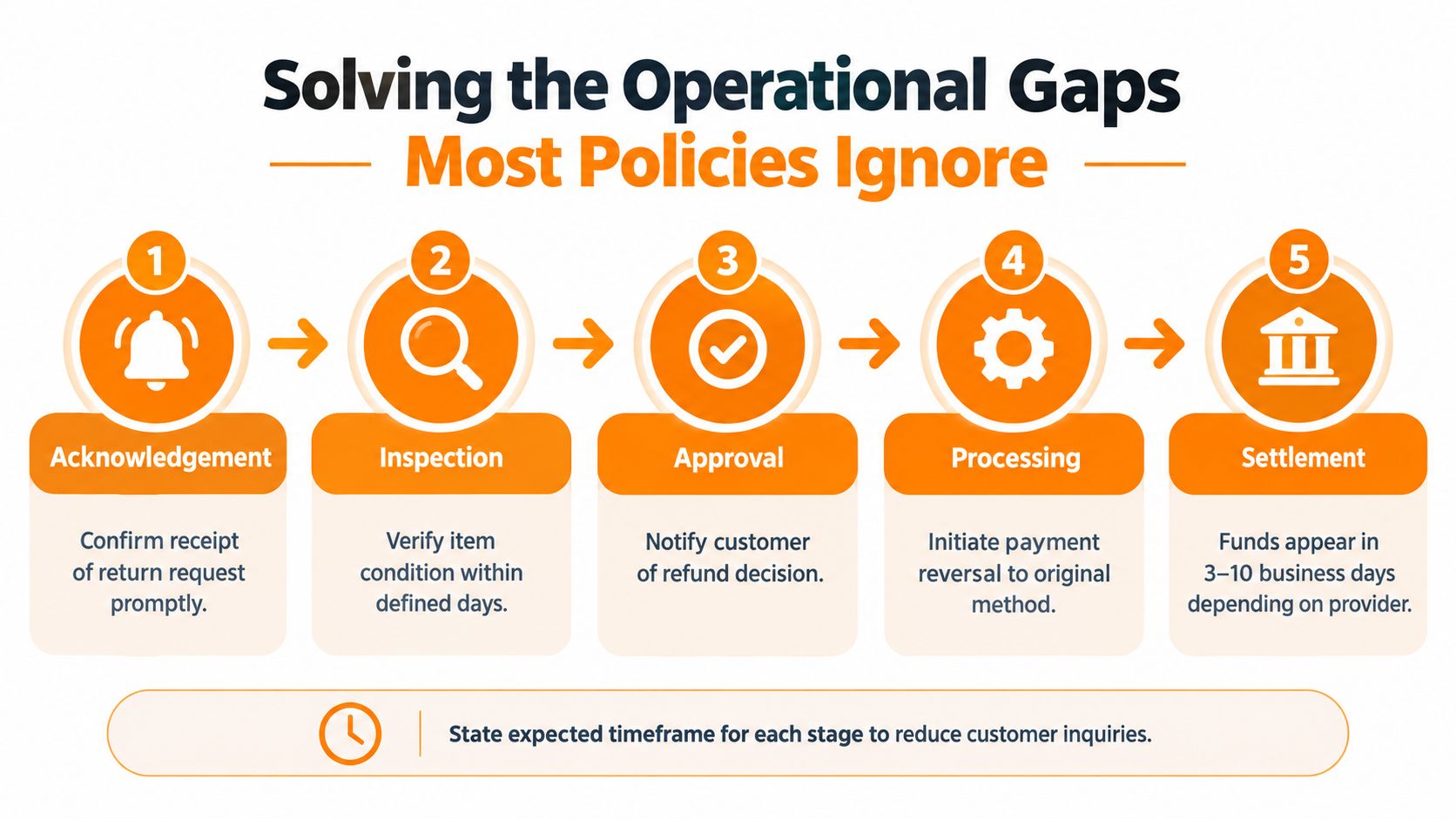
The workflow customers actually experience
A usable policy should set an acknowledgement deadline, an inspection period, a decision notice, a refund initiation date, and a posting window. That sequence gives the buyer a realistic view of what happens after they submit the claim. It also helps the team separate internal approval from bank or wallet processing, which are not the same thing.
Return shipping also needs a clear rule. Failed delivery, customer refusal, courier damage, and parcels lost after hand-off shouldn't all be treated alike. The policy should say which side pays in each scenario, especially for metro and provincial returns where logistics costs and transit times can vary. If you offer free shipping on some orders, make it clear how that incentive interacts with refunds, vouchers, and partial reversals.
Documents that prevent disputes
Receipts, payment confirmations, courier records, and support correspondence matter because they turn a complaint into a traceable case file. The more complete the file, the easier it is to prove whether the issue came from shipping, handling, listing mismatch, or customer fault. That matters even more if the customer paid through PayPal or another electronic method and expects the reversal to look instant on their end.
The support page for checkout and payment handling can sit naturally beside your policy reference. This internal guide on Shopify and PayPal guest checkout is useful if your staff need to understand how payment routing affects the refund trail.
A good rule is simple. If the customer asked for a refund, the policy should explain when the clock starts, when the inspection ends, and when the refund is initiated. That clarity reduces repeat follow-ups and helps the buyer distinguish between your approval time and the bank's posting time.
Implementing Your Return Policy Step by Step
A written policy doesn't help if nobody can find it or use it. The next job is to place it where customers expect it and train the team so every claim gets the same handling standard.

Publish the page where customers can see it before they pay, not after they complain. Put it in the footer, on the product page, in checkout, and in order confirmation messages. Then make sure the same language appears in support replies so buyers don't see conflicting instructions.
Train staff on two separate workflows. One is for defects, damage, and misdescription. The other is for change-of-mind requests that may or may not qualify as a voluntary return. If the team uses one script for both, someone will eventually promise the wrong remedy.
The shipping side matters too. If your store handles nationwide fulfilment, your support checklist should show who records the courier tracking number, who opens the inspection case, and who confirms the refund posting. Keep those steps consistent in every case file.
A more detailed shipping reference helps staff answer return-adjacent questions without improvising. This shipping guide for Philippines orders is a useful companion when you're mapping delivery evidence and return logistics.
Here's a short implementation checklist:
- Place the policy prominently: Add it to the footer, checkout flow, and post-purchase emails.
- Use standard reply templates: One for defect claims, one for voluntary return requests, one for approval notices.
- Create an inspection checklist: Seal, leakage, variant, packaging, order number, and courier condition.
- Keep a refund log: Record date received, date approved, date initiated, and payment method.
- Train for escalation: Staff should know when to approve, when to inspect, and when to refer a disputed case.
The point isn't just compliance. It's giving the customer one obvious path from complaint to resolution, so the process feels organised instead of improvised.
A Real Return Scenario Showing the Policy in Action
A customer in Makati buys an Afnan perfume as a gift and opens the parcel to find the seal compromised. She sends the order number, photos of the bottle, and delivery records through the published contact channel the same day. That's exactly the kind of case where a return & refund policy has to work cleanly, not theatrically.
The store acknowledges the claim within its published timeframe and checks the item against the listing description, the packaging photos, and the courier record. The seal issue qualifies as a covered defect, so the merchant approves a prepaid return. Once the item is received and inspected, the store processes the refund through PayPal and sends written confirmation that the case is closed.
What makes this work is not generosity alone. It's the chain of evidence, the documented remedy path, and the fact that the customer didn't have to argue about whether the claim was even eligible. The buyer kept the receipt and photos, the store kept the inspection record, and both sides had a clear written trail.
That kind of process reduces escalation because it answers the questions buyers usually ask first. Who pays to send it back, when the refund starts, and what proof is needed. If your policy answers those questions before the complaint begins, you'll spend less time on damage control and more time on operations that scale.
If you sell fragrances online in the Philippines and want a policy that feels clear to customers and defensible for your team, visit Dubai Fragrance Shop PH and see how a local fragrance retailer presents product, shipping, and support information in one place. Use it as a reference point for tightening your own return & refund policy, so buyers know exactly what to expect before they check out.