

How to Ship to Philippines: Perfume & E-Commerce Guide
You've found a fragrance you want to order, checked that the seller delivers to the Philippines, and then noticed the difficult part: perfume isn't an ordinary parcel. An alcohol-based eau de parfum can be treated as a restricted or dangerous good, the archipelago creates uneven delivery conditions, and the customer may face customs questions if the product crosses the border personally.
Learning how to ship to the Philippines therefore starts with separating two workflows. Cross-border shipping brings customs, import documentation, carrier acceptance, and dangerous-goods compliance into the process. Domestic fulfilment begins after inventory has been cleared and stored locally, but still requires a courier that accepts perfume, protective packaging, accurate addresses, and realistic delivery promises.
Table of Contents
- Navigating Philippine E-Commerce Logistics
- Clearing Customs and Understanding Import Duties
- Managing Dangerous Goods and Perfume Restrictions
- Transitioning from Cross-Border to Domestic Fulfillment
- Packaging Protocols and Regional Delivery Expectations
- Optimizing Checkout and Last-Mile Tracking Metrics
Navigating Philippine E-Commerce Logistics
A fragrance order can clear customs successfully and still fail as a delivery promise. The Philippines' total e-commerce market reached approximately US$28 billion in 2024, with retail e-commerce accounting for about US$15.5 billion. Average e-commerce spending was approximately US$273 per person, according to Philippine e-commerce market data from Payments CMI. The opportunity is substantial, but alcohol-based perfume adds carrier, routing, and fulfilment constraints that ordinary parcels may avoid.
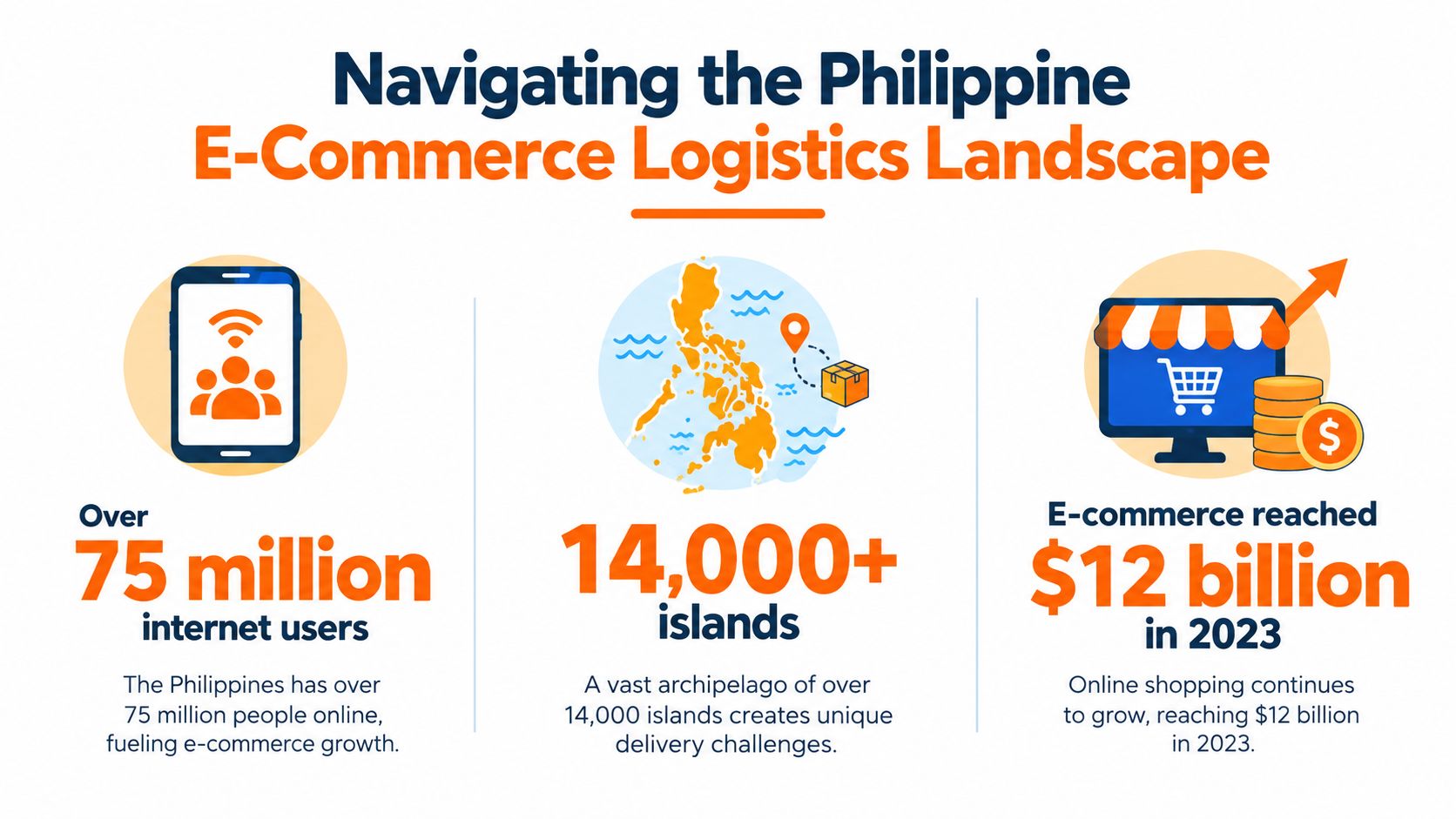
A plan built around one metropolitan area can break down outside its original service zone. Metro Manila, including a Makati fulfilment centre, may offer frequent collections and faster line-haul connections. Luzon provincial routes can have different cut-off times and handover points. Visayas and Mindanao require inter-island routing, while rural addresses may need longer transit and additional delivery coordination.
Practical rule: Treat Metro Manila, Luzon, Visayas, and Mindanao as separate operating zones, not one nationwide service area.
Payment behaviour also affects fulfilment risk. An estimated 85% of Filipinos used cash on delivery during the three months preceding the cited 2024 market analysis, while Bangko Sentral ng Pilipinas findings reported by Payments CMI indicate that 54% of retail payment transactions were digital in 2024. A fragrance store should support both delivery-friendly payment options and digital checkout methods. The choice affects order confirmation, failed deliveries, cash handling, and when inventory can be released.
The shipping policy should answer these questions before payment:
- Coverage: State whether service reaches the customer's island group and address type.
- Payment confirmation: Explain when COD and digital orders enter fulfilment.
- Delivery attempts: Describe what happens if the recipient cannot be reached.
- Tracking: Provide a usable reference and explain when updates appear.
- Charges: Show PHP shipping costs and any order-value threshold for free delivery.
A local retailer such as Dubai Fragrance Shop PH's delivery information for Baliuag shows why location-specific expectations matter. “Nationwide shipping” is too vague for a product that may pass through several hubs and face carrier acceptance rules before reaching its final barangay. The delivery promise should match the route, the courier's restrictions, and the actual handoffs required.
Clearing Customs and Understanding Import Duties
Cross-border delivery begins with a customs decision, not a courier tracking page. The Bureau of Customs uses a PHP10,000 de minimis threshold as a key boundary. Imported goods valued at PHP10,000 or less generally qualify for exemption from duties and taxes, while goods above that amount may incur duties and taxes depending on the item and customs assessment, as explained in the Bureau of Customs parcel guidelines.
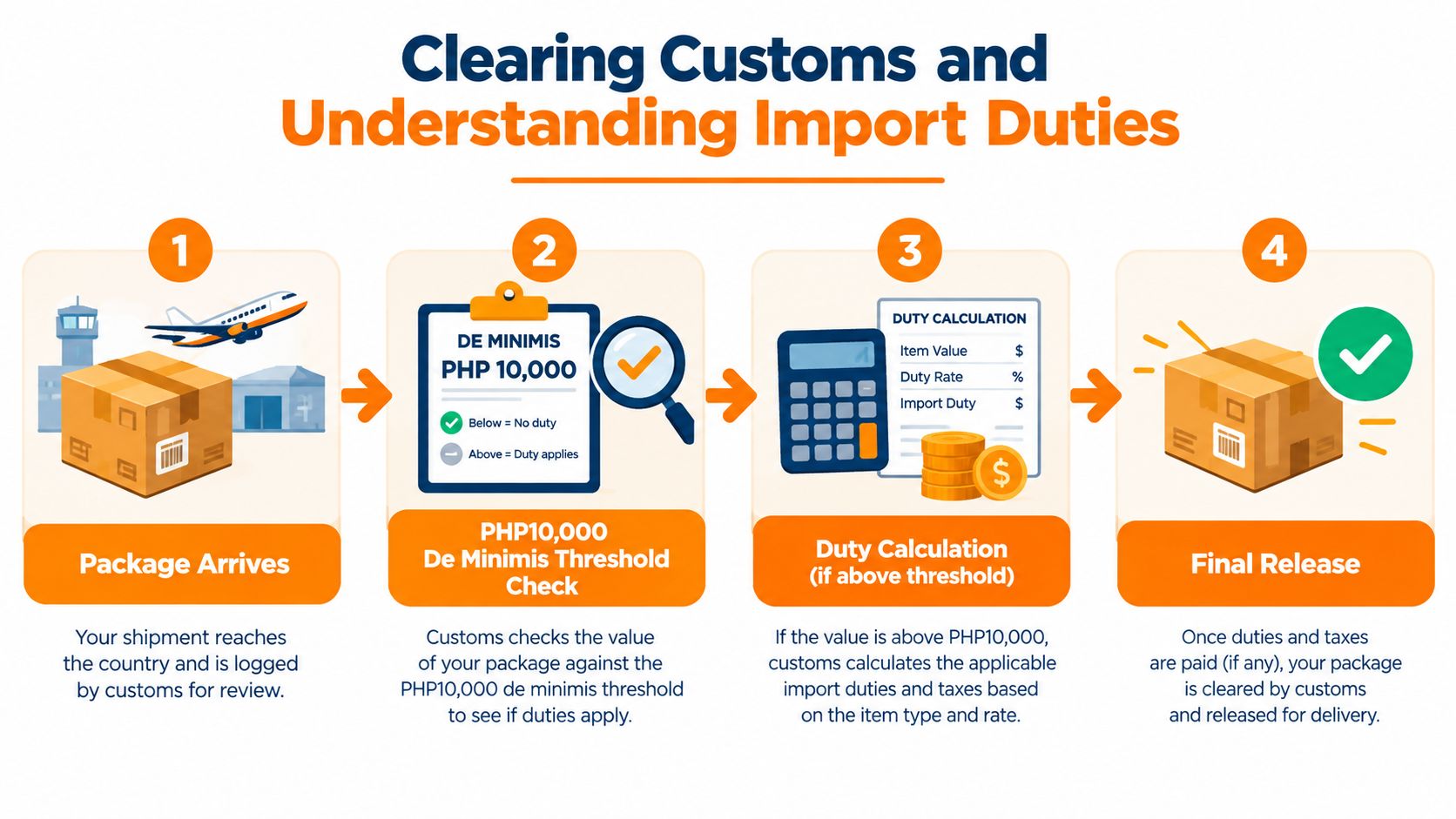
That threshold doesn't remove the need for an accurate declaration. Customs requires the parcel's contents and value to be stated correctly on the postal declaration or air waybill. A vague description can create questions, especially when the item is a regulated product such as alcohol-based perfume. “Cosmetics” doesn't adequately communicate the transport and regulatory characteristics of a flammable fragrance.
What happens after arrival
International parcels are unloaded into a customs-controlled facility. They can pass through X-ray and K9 inspection, then move to physical examination or additional compliance checks if customs requires more information. The parcel is released to the courier only after the applicable clearance process is complete, after which delivery proceeds to the recipient's stated address.
The practical sequence looks like this:
- Prepare the declaration: Use a precise product description, accurate value, and complete sender and recipient details.
- Attach transport documents: Depending on the shipment, this can include an air waybill or postal declaration, commercial invoice, and packing list.
- Check the threshold: Confirm whether the shipment is at or below the PHP10,000 boundary and understand that goods above it may receive an assessment.
- Prepare for inspection: Keep descriptions, invoices, packaging, and regulatory documents consistent.
- Resolve requests promptly: A parcel that needs a permit, clarification, or supporting document can remain in a controlled facility until the requirement is met.
A shipment can be treated as abandoned and forfeited when it fails to meet the relevant requirements. Regulated or restricted goods may also require permits before importation. That's why a buyer importing one bottle personally faces a different risk profile from a retailer that imports a documented inventory shipment through a freight partner.
Declaration discipline matters: The invoice, air waybill, packing list, and physical contents should all describe the same product in the same practical terms.
The distinction between product price and landed cost also matters for customer communication. A shopper may see a fragrance price online but not understand that a direct overseas order can involve customs assessment, clearance delays, or additional documentation. A locally stocked order avoids that recipient-facing import process because the inventory has already entered the domestic supply chain.
For fragrance buyers comparing product concentration and price, an explanation such as why eau de parfum can cost more can also support clearer product expectations. It shouldn't replace shipping information, but it helps customers distinguish the fragrance itself from import and delivery costs.
Managing Dangerous Goods and Perfume Restrictions
Alcohol-based perfume must enter the transport chain through a dangerous-goods workflow. Carriers explicitly treat perfumes and other flammable substances as restricted or dangerous goods under IATA-related rules, and transport commonly requires UN 1266, Class 3 flammable liquid classification together with a current Safety Data Sheet. The DHL restricted-items guidance for shipping from the Philippines explains why ordinary parcel descriptions and standard packaging aren't enough.
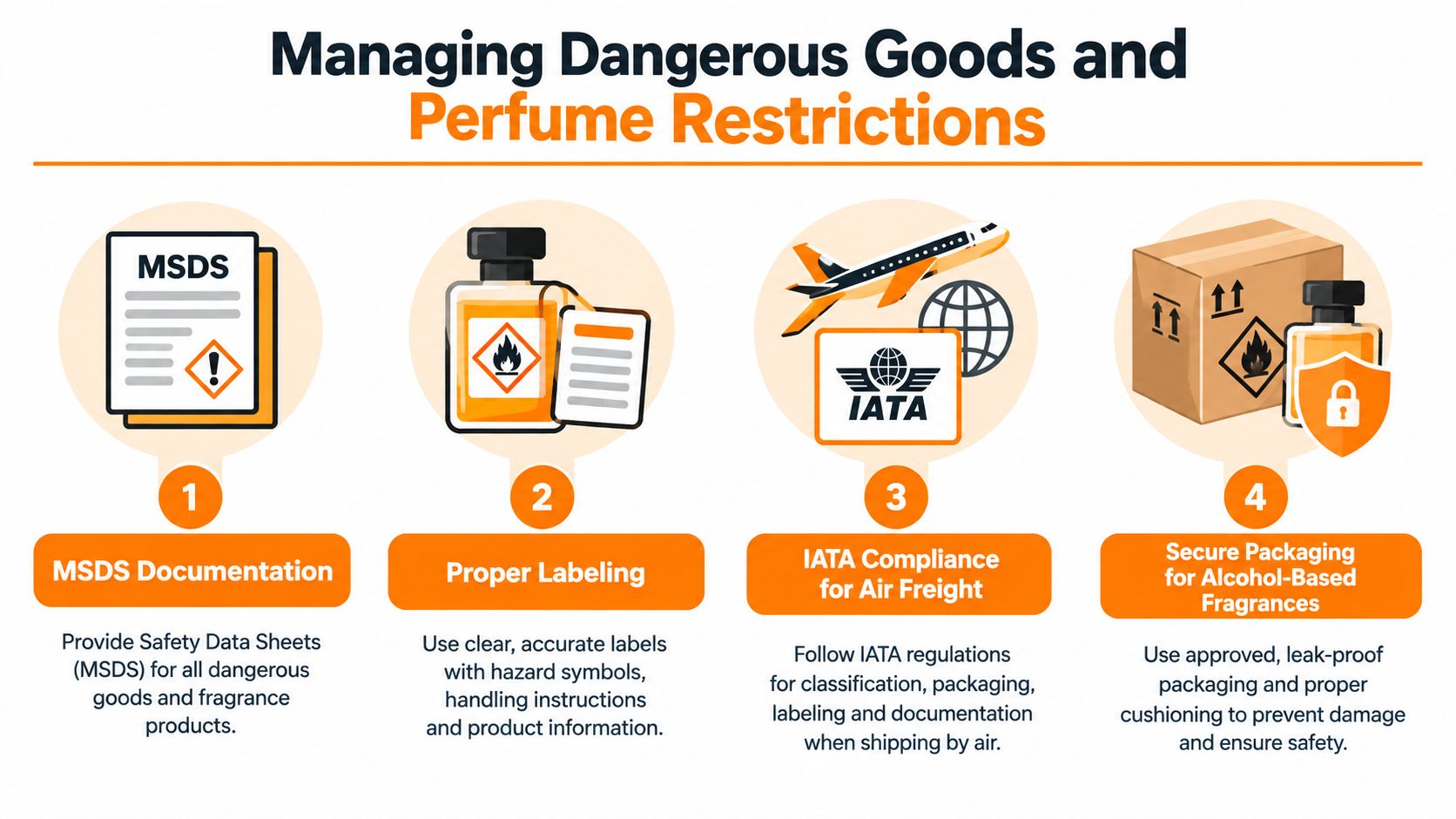
Start with the supplier. Request the current SDS for each fragrance SKU, then confirm the transport classification, alcohol information, flashpoint, bottle volume, and carton configuration. A product page may be suitable for retail selection, but it isn't a substitute for the technical document a carrier or customs broker may request.
Obtain acceptance before booking
A booking confirmation doesn't automatically mean the carrier has accepted the perfume as declared. Send the SDS and shipment details to the airline, freight forwarder, or courier and obtain written acceptance before handing over the consignment. Some services refuse dangerous goods entirely, while others accept them only under defined packaging, labelling, route, and documentation conditions.
The outer carton must match the approved transport method. Use:
- Leak-proof inner containment: Place each bottle in a sealed inner bag or equivalent containment.
- Absorbent material: Add material capable of containing liquid if a bottle leaks.
- Rigid outer packaging: Use a strong carton that resists compression and keeps bottles separated.
- Cushioning: Prevent movement and bottle-to-bottle contact during handling.
- Required marks: Apply the carrier's dangerous-goods or Limited Quantity markings and orientation arrows where applicable.
- Supporting paperwork: Prepare the commercial invoice, packing list, air waybill or bill of lading, and any required permit or clearance.
Don't label perfume vaguely as “oil” or “cosmetics”. That can create a conflict between the physical product, the SDS, the shipping description, and the customs declaration. When documents disagree, the shipment may be held while the carrier or authorities determine what is being transported.
Operational control: Keep an SKU-level compliance file containing the SDS, alcohol percentage, flashpoint, bottle volume, carton configuration, supplier invoice, and batch or authenticity records.
Philippine Customs requires regulated goods to have the relevant declarations, licences, or clearances before importation. Import entries generally must be lodged within 15 days after the last package is discharged, so an importer shouldn't wait until a shipment is already under examination to organise its documents.
This process is heavier than ordinary parcel fulfilment, but it protects the inventory and the customer relationship. A high-value fragrance consignment can be delayed because the outer carton uses one description, the airway bill uses another, and the SDS reveals a classification that was never disclosed during booking. Compliance is therefore part of purchasing, not a paperwork task added after the supplier has shipped.
Transitioning from Cross-Border to Domestic Fulfillment
The cleanest model for a Philippine fragrance retailer is to separate inventory replenishment from customer delivery. Import stock through a documented cross-border process, clear it, store it locally, and dispatch domestic orders from the cleared inventory. Asking every customer to import an individual bottle creates avoidable customs, tax, and carrier uncertainty.
The two models operate differently:
| Cross-border replenishment | Domestic customer fulfilment |
|---|---|
| Requires supplier documents, dangerous-goods classification, carrier acceptance, and customs clearance. | Starts with inventory that has already been cleared and stored locally. |
| May involve duties, taxes, permits, inspection, and release delays. | Avoids recipient-facing import clearance for the local order. |
| Depends on international route and transport mode. | Depends on domestic courier acceptance and island-group routing. |
| Needs commercial invoices, packing lists, and airway or sea-freight documents. | Needs an accurate address, secure packaging, tracking, and delivery instructions. |
A Makati-based store can use its local stock position to create a more predictable customer experience. The retailer still has to confirm that the chosen domestic courier accepts perfume and understand the courier's packaging rules. Domestic movement doesn't make the product non-flammable, so a courier's standard parcel service may not be suitable without prior approval.
Write delivery promises by zone
A single nationwide service level usually hides the actual trade-off. Metro Manila can support a faster service zone, while provincial cut-offs and inter-island routes need more conservative promises. Rural destinations may require additional time and more active recipient coordination.
That zoning also helps customer service. Instead of apologising after a generic promise fails, the store can show a delivery estimate based on the destination, order cut-off, stock location, and courier route. A customer in a major urban centre and a customer in a remote provincial address shouldn't receive identical expectations because both entered a Philippine address at checkout.
Product selection can fit into the same local-fulfilment model. For example, Habik for Women is a 100ML concentrated eau de parfum with an oriental floral composition, amber warmth, floral notes, musk, vanilla, and subtle oud. Whether a customer orders that bottle or another fragrance, the fulfilment process still depends on the product being securely packed and accepted by the domestic carrier.
Domestic fulfilment works when the retailer owns the handoff. The store controls stock, documents the packed parcel, records the weight, and gives the customer a trackable domestic consignment. Cross-border replenishment remains necessary, but it should happen in planned inventory movements rather than being recreated inside every customer order.
Packaging Protocols and Regional Delivery Expectations
A perfume parcel must withstand handling and satisfy carrier controls at the same time. Glass can break or leak, while alcohol-based contents may be refused if booked as an ordinary package. The packing method therefore needs physical protection, accurate product identification, and compliance with the courier's approved dangerous-goods or restricted-item process.
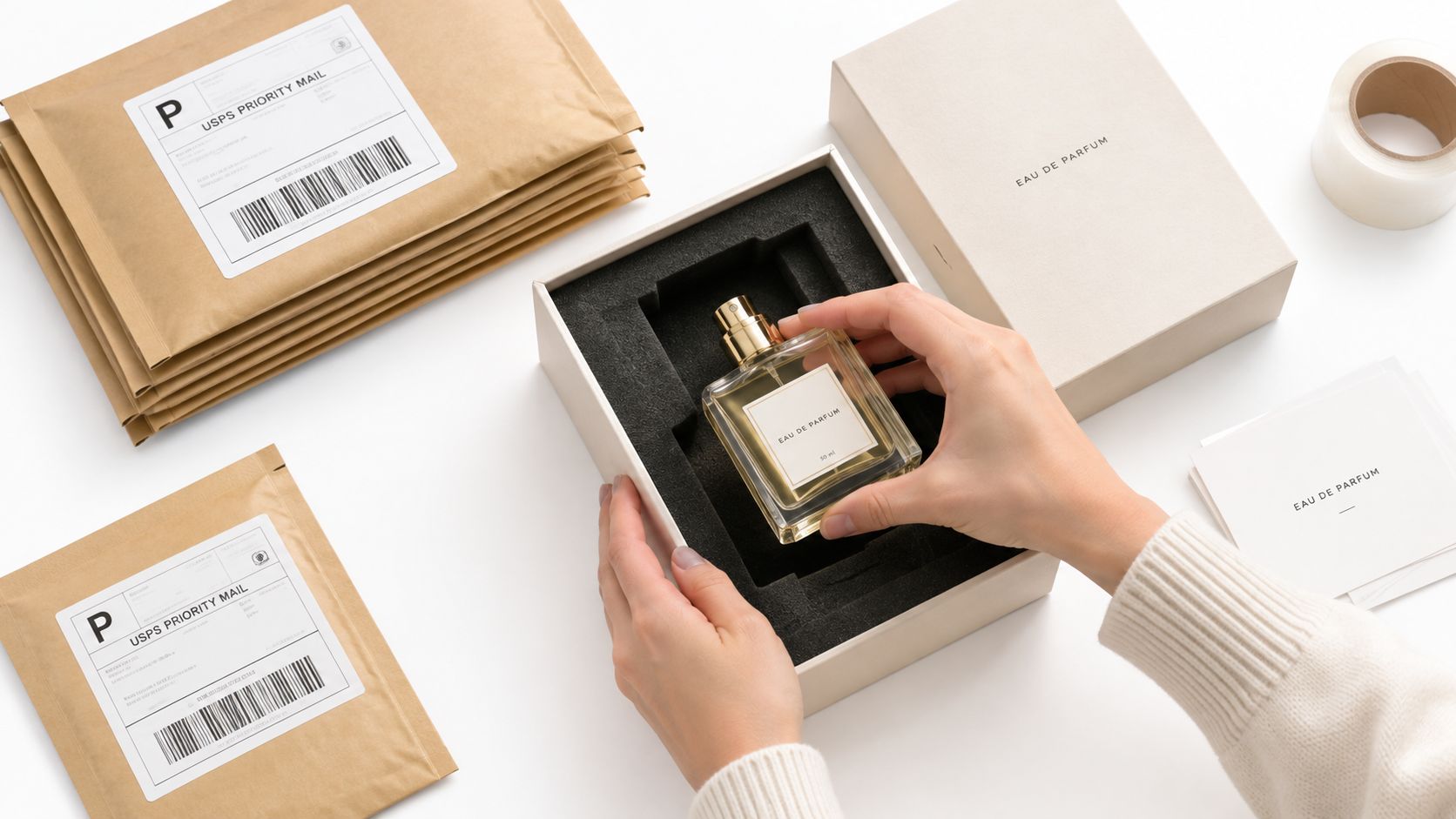
Use the same packing routine for every order:
- Secure the closure: Check the cap or atomizer lock before placing the bottle in its inner packaging.
- Contain the bottle: Put it in an individual leak-proof bag or another sealed containment layer.
- Add separation: Cushion the bottle so it cannot hit another item or the carton wall.
- Choose a rigid box: Use an outer carton that can resist crushing during sorting and line-haul handling.
- Check the finished parcel: Photograph the packed order and record its weight before handover.
- Match the paperwork: Make sure the order description and carrier booking identify the product accurately.
A gift box is presentation, not transport protection. Place it inside a stronger outer carton rather than using it as the only barrier around glass. Pack the Free Gift Travel Spray Atomizer 5ML separately, with enough cushioning to prevent movement inside the parcel.
Set expectations by destination
Philippine delivery planning varies sharply by route. Reported benchmarks indicate roughly 24 to 48 hours in major cities versus one to two weeks for rural destinations, and delivery costs can represent 20% to 30% of order value, according to DHL's Philippines delivery guidance. Treat these figures as planning references rather than promises for every address. Weather, ferry schedules, hub capacity, address quality, and failed delivery attempts can all alter the result.
Address quality is a direct operational control. Collect the recipient's barangay, municipality, province, postal code, and reachable mobile number. A landmark or building name does not replace a complete address, and a courier may not be able to resolve missing details without contacting the customer.
Use a last-mile routine that reduces avoidable returns:
- Pre-dispatch review: Check the full address and contact number before the parcel leaves the warehouse.
- Tracking messages: Send the tracking reference and updates tied to the expected delivery window.
- Recipient readiness: Ask customers to stay reachable during the delivery period.
- High-value verification: Confirm high-value COD orders before dispatch.
- Return-to-sender rules: State what happens after failed attempts or when the recipient cannot be reached.
The operational target is a supported service level, not the shortest advertised delivery time. Clear packaging records, accurate booking details, route-based expectations, and recipient contact reduce the chance that a compliant perfume shipment becomes a damaged parcel or an avoidable return.
Optimizing Checkout and Last-Mile Tracking Metrics
A perfume order can look profitable until delivery, failed contact, and return costs are counted. If shipping represents 20% to 30% of order value, the free-delivery threshold must protect margin on smaller fragrance baskets. Use the earlier benchmark as a planning reference, then adjust it for destination, parcel size, and the risk of a failed delivery. A threshold set too low may attract orders that are costly to move across an island route.
Set up checkout around three operating decisions:
- Payment method: Offer COD alongside digital options because customers use both.
- Delivery zone: Display charges by destination instead of applying one nationwide rate.
- Order value: Base the free-shipping threshold on the cost of successfully delivered orders, not product margin alone.
The payment behaviour data from the market overview above points to a practical trade-off. COD can increase order access, while a free-shipping threshold can increase basket size, but an unaccepted perfume parcel still creates packing, dispatch, delivery-attempt, and return costs. Measure COD return risk against the threshold rather than treating free delivery as a universal conversion tool.
Protect COD without adding unnecessary friction
Verify high-value COD orders before dispatch. A short confirmation using the customer's reachable mobile number can identify an incorrect address, an accidental order, or a recipient who will be unavailable. Apply the rule consistently, using order value or clear risk signals rather than assumptions about the customer.
Digital checkout needs equally direct instructions. State when payment is confirmed, whether fulfilment starts immediately, and what happens if payment fails or the address requires correction. Customers comparing payment options may find information about Shopify PayPal guest checkout useful, but the store must still publish its own confirmation and fulfilment policy.
Track delivery performance by island group, not only through a nationwide average. Include:
- Dispatch-to-delivery time: Measure the period from courier handover to confirmed delivery.
- First-attempt delivery rate: Find zones where recipients are often unavailable.
- Leakage or damage rate: Separate packaging failures from carrier-handling incidents.
- Return-to-sender rate: Record whether the cause was an incorrect address, refusal, non-contact, or failed COD confirmation.
- Shipping cost per delivered order: Include successful fulfilment costs, not only the quoted courier fee.
Review these measures alongside order value, payment type, product count, and destination. A high return-to-sender rate for Visayas orders may call for stronger mobile verification or clearer delivery windows. Concentrated leakage in one carton configuration points to an inner-containment change before a courier change. The 20% to 30% delivery-cost benchmark noted earlier should also be checked against the cost of delivered orders by route.
Dubai Fragrance Shop PH offers locally stocked Middle Eastern fragrances with PHP checkout and nationwide fulfilment from its Makati-based operation. That model lets customers avoid the recipient-facing complexity of importing an individual perfume parcel. Visit Dubai Fragrance Shop PH to review the available fragrance range and select a delivery option suited to your Philippine address.