

Fragrance Shops Near Me: A Local Buyer's Reference Guide
You're in traffic, waiting for a friend, or winding down at home when you type “fragrance shops near me” into your phone. The results show mall counters, marketplace listings and online shops, but a nearby pin doesn't tell you whether a bottle is authentic, what delivery will cost or whether anyone will help if it arrives damaged.
Treat the search as a verification problem, not just a directory. The right shop is one you can check, whose total price makes sense and whose delivery and after-sales terms you understand before paying.
Table of Contents
- What Fragrance Shoppers Near You Are Really Searching For
- Why Near Me Now Includes Online Local Sellers
- How to Search for Fragrance Shops Near You
- Comparing the Main Shopping Channels in the Philippines
- Reading a Product Listing for Authenticity Cues
- Calculating the Real Landed Price in Pesos
- What Nationwide Delivery Actually Looks Like
- Verifying a Seller Before You Pay
- Matching Middle Eastern Houses to Scent Preferences
- Worked Examples From a Philippine Fragrance Catalog
- Pre-Purchase Checklist and Quick-Reference Summary
- Common Questions From Filipino Fragrance Buyers
What Fragrance Shoppers Near You Are Really Searching For
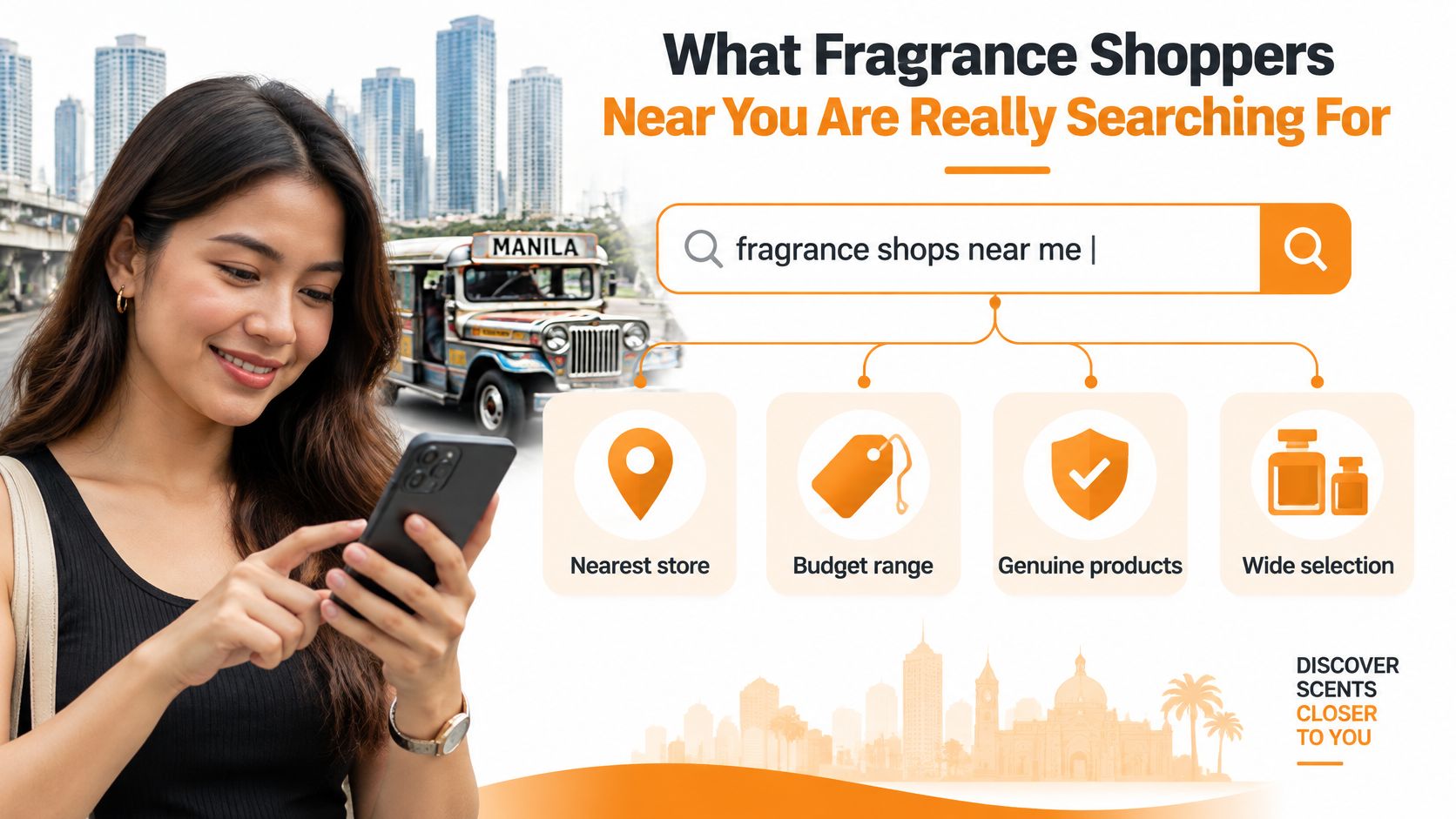
A Manila-area buyer might start by searching for a tester within walking distance. Then comes the practical part: does the shop carry the style of fragrance they want, is the listed price the final price, and can they trust the seller with an online payment? Those questions matter whether the result is a boutique around the corner or a Philippine-based online shop shipping from another city.
“Near me” can mean a physical counter where you can smell a fragrance before buying, a local online seller with domestic fulfilment, or a marketplace reseller. Each option solves a different problem. A store visit can help with choosing a scent; an online catalogue can offer a wider selection or delivery to an address far from a shopping centre. Neither format guarantees authenticity on its own.
Digital checkout is now an ordinary part of Philippine retail. The Bangko Sentral ng Pilipinas reported that digital retail payments accounted for 57.4% of monthly retail-payment transactions by volume and 59.0% by value in 2024, compared with 52.8% and 55.3% in 2023 (BSP report on e-payments). That makes online buying a realistic way to shop, but it doesn't make every listing trustworthy.
| Channel | Best For | Watch For | Verification Shortcut |
|---|---|---|---|
| Physical shop | Smelling a tester before buying | Unclear return terms | Ask for a receipt and inspect the packaging |
| Local online shop | Nationwide delivery and product choice | Vague seller details or delivery charges | Check business identity, policies and contact details |
| Marketplace reseller | Comparing listings in one place | Unclear stock origin and inconsistent listing details | Check the seller's own record and ask for packaging images |
Before you pay, settle four questions: where the seller operates, what the complete price is, what proves the product is traceable and how the order will reach you.
Why Near Me Now Includes Online Local Sellers
A local seller doesn't have to be a shop you can walk into. A Philippine-based online retailer can still be a practical choice if it shows where it operates, lists prices in pesos, provides a working local contact and explains shipping and returns. Those details give you a way to assess the business before checkout, even if you're ordering from another region.
That shift makes sense in a country where buyers can discover and pay for goods online. The Philippine digital economy generated about ₱2.25 trillion in gross value added in 2024, with e-commerce accounting for 13.5% of that total, according to figures from the Philippine Statistics Authority reported by BusinessWorld's coverage of the digital economy. For a fragrance shopper, the useful takeaway isn't that every online seller is a safe bet. It's that a physical location nearby isn't the only sensible route to a locally fulfilled order.
A Makati retailer may be able to serve customers in Pampanga, Cebu or Davao through domestic delivery. But a city name on a profile isn't proof of local stock. Ask whether the order ships from within the Philippines, whether the seller can give you a realistic dispatch estimate, and what happens if the courier damages a bottle.
My rule: Treat “local” as something the shop demonstrates through its business details, payment options and delivery terms, not just a phrase in its bio.
How to Search for Fragrance Shops Near You
Search with a shortlist in mind, not an endless scroll. Use the same basic process whether you're after a mall counter or an online shop that delivers to your province.
- Start with map results. Search for perfume shops near your area and note which results appear to be physical stores. A map listing can also surface an online business or paid placement, so don't assume a pin means there's a walk-in counter. Check the address, photos and contact details.
- Check the brand's own store locator. If you already know the fragrance house you want, a locator can help identify authorised or listed retailers. If no local location appears, don't take that as proof that no legitimate online seller stocks the brand. Move on to seller verification.
- Review social pages as a contact trail. Look for recent product posts, replies to customer questions and a consistent business name. A busy page or polished bottle photo is not evidence of authenticity; use it to find the seller's website and policies.
- Compare marketplace listings carefully. Filter for local delivery options and inspect the individual seller profile, not just the product title. Save the listing and seller details so you can compare them against other candidates.
- Visit the direct website. Check for PHP pricing, a local contact, delivery information, returns terms and product packaging photos. A direct site gives you a better chance to read the full policy than a short social post.
Keep two or three candidates, then compare the same product across them. Record the seller identity, listed price, shipping terms, packaging evidence and refund conditions. That's enough to move from browsing to a meaningful comparison.
Comparing the Main Shopping Channels in the Philippines
The best channel depends on what you need to decide in person. If you're uncertain about the scent itself, a tester is valuable. If you already know the product and need delivery beyond Metro Manila, a local online shop may be more convenient. Don't assume the lowest displayed price is the best deal until you've checked the whole order and the seller's terms.
| Channel | Brand Range | Price Transparency | Shipping | After-Sales Support |
|---|---|---|---|---|
| Mall perfume counter | Often focused on established brands and stocked lines | Prices are visible in store; promotions may vary | Take-home purchase or arranged delivery, depending on the shop | Ask the counter about receipts, exchanges and returns |
| Department-store fragrance hall | A range of brands in one place; tester access may help with selection | In-person prices are easy to compare | Usually straightforward for an in-store purchase | Use the store's published service terms |
| Independent boutique | Can offer a more specialised assortment | Compare displayed prices and ask what the price includes | Pickup or delivery depends on the individual business | Check who handles complaints and refunds |
| Marketplace reseller | Range can be broad, but listings may come from different sellers | Easy to compare listings, harder to compare stock and service | Depends on the seller and platform arrangement | Read seller-specific terms and platform protections |
| Dedicated online fragrance shop | May focus on a particular category, such as Middle Eastern houses | Look for PHP prices, visible discounts and clear shipping fees | Domestic fulfilment may serve provincial addresses | Check direct contact and written policies |
For a scent you haven't tried, I'd favour a place where you can test it or buy a sample if available. For a known bottle, a clearly identified online seller can be more practical. Either way, make sure the listing says whether you're buying a sealed retail bottle, a tester or a decant. Those are different products and should never be treated as interchangeable.
Reading a Product Listing for Authenticity Cues
A convincing product photo isn't enough. Read the listing for information that helps you connect the bottle to its label, responsible local business and regulatory record. ASEAN cosmetic-labeling requirements make a useful checklist: cosmetic packaging should include a full ingredient list, normally using International Nomenclature of Cosmetic Ingredients (INCI) names, along with the responsible company or person, country of manufacture, relevant date details and language consumers can understand. Perfume compositions may be listed using terms such as “perfume,” “fragrance” or “aroma.”
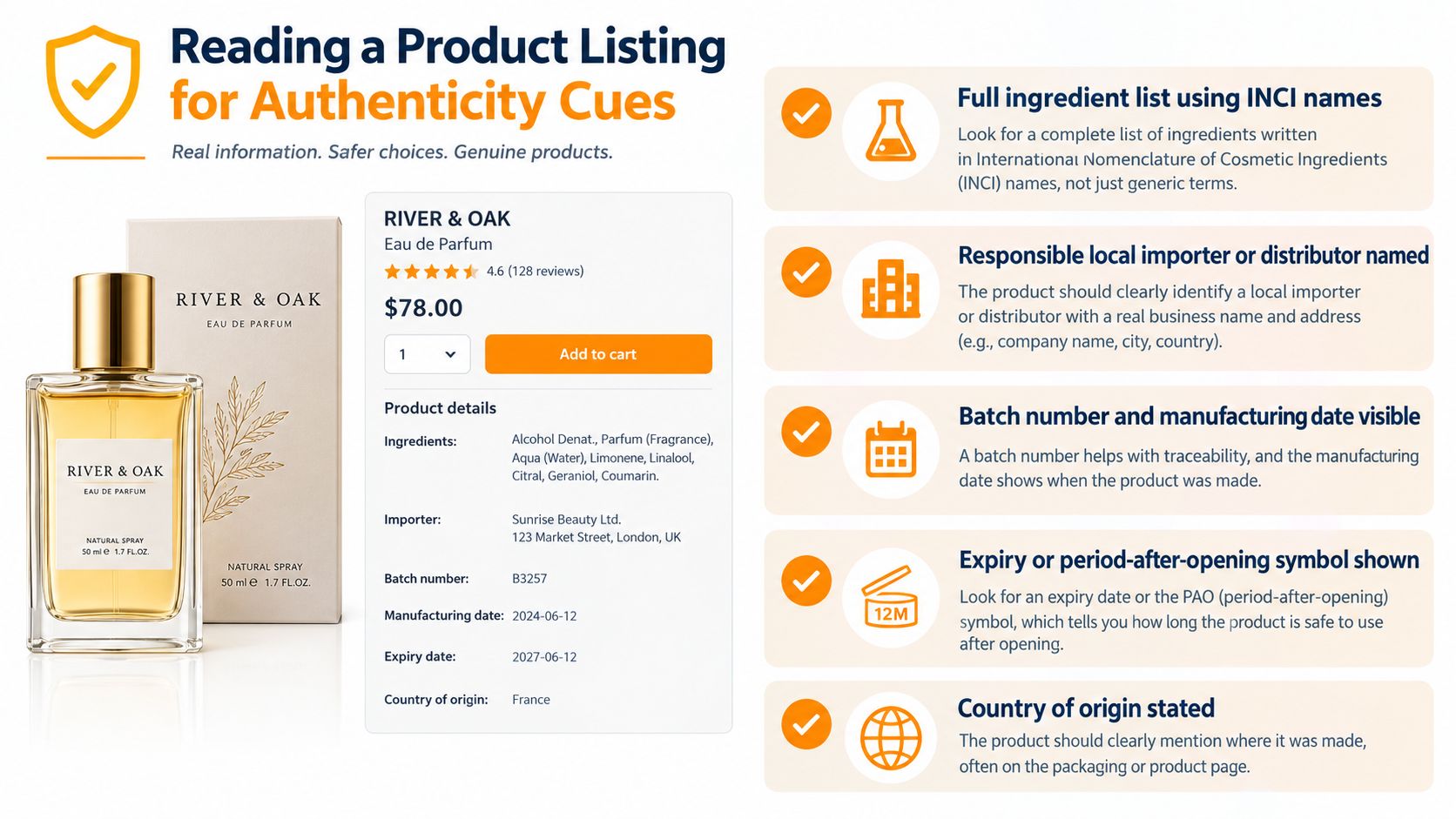
Before checkout, use this routine:
- Inspect the listing photos. Look for clear images of the front and back of the box and bottle, including the ingredient panel and manufacturer or importer details. If the seller only shows a stock image, ask for actual packaging photos.
- Capture traceability details. Record the product name and variant, country of manufacture, batch information and date markings. Compare what you see on the box with what the seller says.
- Check the Philippine FDA record. The FDA advises consumers to verify a cosmetic's Certificate of Product Notification (CPN) through its FDA Verification Portal guidance. It warns that products without notification haven't gone through the required process, so their quality and safety can't be assured.
- Treat foreign-language-only labelling as a warning. A seller should be able to provide information you can understand and explain who is responsible for the product in the local market.
The ASEAN cosmetic labelling requirements are a practical reference for what to look for. Keep screenshots of the listing and seller's answers. For additional guidance on spotting warning signs, consult this guide to fake versus original perfume.
If a seller can't show the packaging or identify the responsible local company, don't let a familiar brand name or a low price talk you out of asking questions.
The video below offers another visual reference for evaluating a fragrance purchase.
Calculating the Real Landed Price in Pesos
The price on the product page is only one part of the decision. Before you buy, work out the landed total: the product price after visible discounts, delivery charges and any payment-related fee that applies. If the shop accepts a wallet or PayPal, check what amount the checkout shows in PHP rather than assuming the displayed product price will be the final charge.
For a simple comparison, write down these figures:
| Cost Item | What to Check |
|---|---|
| Listed price | Current PHP price for the exact bottle and size |
| Discount | Whether the displayed promotion applies to that item |
| Delivery | The fee to your address, including any remote-area charge shown |
| Payment | Any disclosed fee or currency conversion shown at checkout |
| Free-shipping gap | How much more you'd need to add to qualify, if the shop offers a threshold |
Some Philippine fragrance sellers, including Dubai Fragrance Shop PH, state that free shipping applies to orders over ₱2,000. Treat that as a threshold to check, not a reason to add an item you don't want. Compare the shipping fee with the cost of the extra product, and read the threshold's exact wording before you decide whether combining purchases makes sense.
Promotions can also change the comparison. A seasonal sale or a store-wide offer may reduce the item price, but it doesn't automatically make the final order cheaper if delivery or payment costs differ. Compare the checkout total for the same product and delivery address, not just the crossed-out price on the listing.
A useful final check is to screenshot the checkout total before payment. If the amount changes between the product page and payment screen, pause and ask the seller what changed. Surprise charges are a reason to reconsider, not a detail you should have to uncover after paying.
What Nationwide Delivery Actually Looks Like
A seller can be local and still rely on a courier for the hardest part of the transaction. Set expectations around the process: an order confirmation isn't the same as dispatch, and dispatch isn't the same as delivery. Ask when the shop expects to hand the parcel to the courier, how tracking will be shared and whether delivery times may vary for your address.
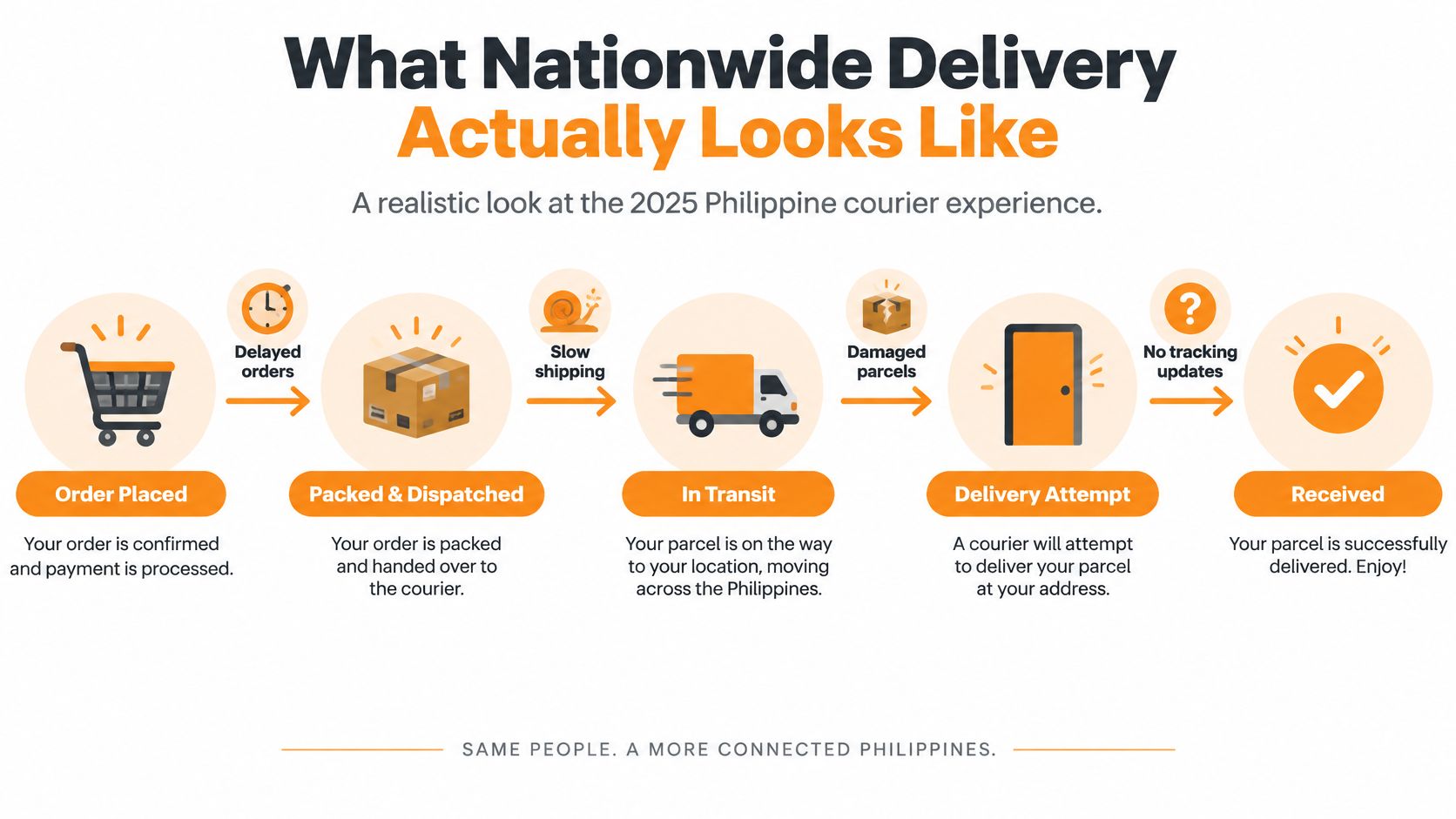
Delivery problems are common enough to plan for. In a 2025 survey of Philippine online shoppers, 47% reported delayed orders, 43% slow shipping and 37% damaged or missing parcels; 58% said they would abandon a cart when surprise charges appeared, according to the survey's logistics findings. Those figures aren't a prediction for your particular order. They're a good reason to check shipping charges and damage procedures before paying.
Perfume bottles are fragile, so look for a clear answer on packaging. Ask whether the shop protects the bottle against movement and leakage, and whether you should photograph the parcel before opening it. If a package arrives wet, crushed or broken, keep the outer packaging and take pictures of the damage before disposing of anything. Contact the seller promptly through its published channel and follow the written claims process.
For practical details on delivery arrangements, see this guide to shipping to the Philippines. A responsible shop should distinguish dispatch estimates from courier transit time and should explain how it handles a damaged or missing order. For provincial deliveries, judge the seller by clear updates and a realistic explanation, not a promise that every parcel will arrive on the same schedule.
Verifying a Seller Before You Pay
Product checks tell you about the bottle. Seller checks tell you who will take responsibility if the order goes wrong. A social-media account can be a useful way to discover a shop, but a profile alone isn't enough to establish who you're paying.
Before entering card or wallet details, look for the following:
- A named business. Check whether the site identifies the owner or business name and publishes a DTI business number. If you need to verify a registration, use the relevant official channel rather than relying on a screenshot posted by the seller.
- A working local contact. Look for a published phone number or contact page, then check whether the shop responds to a straightforward question about stock, labelling or delivery.
- Clear written policies. Read the returns and refunds terms before checkout, including what the shop says about sealed, opened, damaged or incorrect items. Check the privacy policy and terms as well.
- Consistent payment and order details. Confirm that the checkout displays PHP pricing, the business identity matches the payment information and the final amount is clear.
- Evidence you can assess. Customer reviews and transaction records can add context, but they don't replace regulatory checks or written policies.
Those service details affect whether shoppers feel comfortable placing an order. A 2025 survey found that 46% of Filipino online shoppers would stop buying from sellers without returns or refunds, 36% avoid sellers without flexible or secure payment options and 27% leave when deliveries are late (survey findings on online shopper service expectations).
Don't mistake a large follower count, polished product photos or a friendly chat for proof. Look for a seller that is identifiable, reachable and willing to state its terms in writing.
Matching Middle Eastern Houses to Scent Preferences
Brand names can help narrow a catalogue, but they don't tell you exactly what a fragrance will smell like on your skin. Lattafa, Afnan, Armaf, Rasasi, Arabiyat, Rayhaan and French Avenue are Middle Eastern houses you may encounter in Philippine listings. A retailer's descriptions can guide your first pass, but use note information and, where possible, a tester or sample to decide whether a particular bottle suits you.
Instead of buying by brand reputation alone, start with the kind of fragrance you wear. Do you gravitate towards something fresh and easy to reach for, or prefer a richer profile for evenings? Are you shopping for yourself or someone whose preferences you know? A product page may also mention a comparable designer composition. Treat that as a shopping reference, not a guarantee of an identical scent.
For example, Ameerat Al Arab Red Eau de Parfum is described as a 100ML Eau de Parfum with spice and floral notes that develop into a warm, woody base. Its listing positions it for women who enjoy bold fragrances and says it's suited to evening wear and special occasions. That gives a buyer a direction to consider, not a substitute for trying the fragrance.
If a description uses terms you're unsure about, check the house's listed notes and compare them with scents you already enjoy. This perfume notes finder can help you think in terms of notes and preferences rather than choosing from a name alone.
Worked Examples From a Philippine Fragrance Catalog
A product page is a starting point for checks, not a certificate of authenticity. Consider a listing such as Lattafa Angham 100ML. Its catalogue description identifies it as an Eau de Parfum in a 100ML bottle and presents it as a versatile, Arabian-inspired fragrance for women and men. Those are useful product details, but they don't answer every regulatory or delivery question.
For either bottle, I'd ask the same practical questions before paying: Can the seller provide clear images of the actual box and bottle? Does the packaging show the responsible company, country of manufacture, ingredient information and batch or date markings? Can I check the product's CPN through the FDA Verification Portal? And what does the seller's written policy say if the parcel arrives damaged?
A catalogue may describe a fragrance as suitable for everyday use or special occasions. That's a positioning cue, not a promise that you'll enjoy it. Read the description, check whether the notes and intended use sound right for you, then look for the packaging and seller evidence that a product page can't establish on its own.
Don't infer regulatory status from a retailer's assurance, a product's popularity or a familiar-looking bottle. Verify the record independently, save the listing and confirm the full checkout cost and delivery terms. If the shop can't answer your questions clearly, choose a seller that can.
Pre-Purchase Checklist and Quick-Reference Summary
Keep this checklist open while you compare listings. It's designed to help you make a decision before the checkout screen, when it's easiest to walk away from a confusing purchase.
- Seller: Can you identify the business, find a local contact and read its return and refund terms?
- Product: Does the listing show the front and back packaging, ingredient information, responsible company, country of manufacture and batch or date markings?
- Regulatory record: Can you verify the cosmetic's CPN through the FDA Verification Portal?
- Price: Have you calculated the total in PHP, including delivery and any payment fee shown at checkout?
- Delivery: Does the seller distinguish dispatch from transit, explain tracking and state what to do if the parcel is damaged?
- Payment: Is the payment option clear, and does the final amount match what you expect to pay?
Keep a few useful reference points in mind. The ₱2,000 free-shipping threshold described by some sellers is specific to the shop's terms, so check whether your order qualifies. FDA CPN verification is a product check, while ASEAN labelling cues help you assess what information should appear on cosmetic packaging. Neither replaces a seller identity check or a clear return policy.
If a listing lacks actual packaging photos or the seller won't answer basic questions, don't rush. Move to another candidate and compare the full order, not just the product price.
Common Questions From Filipino Fragrance Buyers
Can I return an opened perfume?
Check the seller's written policy before buying. Shops may set different conditions for sealed and opened products, and you shouldn't assume a fragrance can be returned just because you don't like how it smells. If the policy doesn't explain what happens with a damaged or incorrect item, ask the seller to clarify in writing before checkout.
Are decants and testers the same as sealed retail bottles?
No. A decant is a portion transferred into another container, while a tester is a product presented as a tester rather than ordinary sealed retail stock. Ask exactly what you're buying and whether the packaging and condition match the listing. If you want an unopened retail bottle, say so and confirm that the seller is offering one.
What should I do if a sealed box arrives with a broken seal?
Photograph the package, the seal and the bottle before using it. Keep the packaging and contact the seller promptly using its published channel. Ask for the resolution process and follow the shop's written policy. Don't rely on a verbal promise alone.
How should I handle a fragrance gift sent to a provincial address?
Confirm the recipient's address and contact details, the expected dispatch timing and whether tracking will be shared with you. Ask how the shop handles a delivery issue if you won't be there to inspect the parcel yourself. A clear process matters more than a vague promise of fast shipping.
Dubai Fragrance Shop PH is a Makati-based online retailer with Middle Eastern fragrance listings, PHP pricing and nationwide fulfilment, alongside published contact and store policies. If you're comparing fragrance shops near you, review the product details and delivery terms before you decide, then visit Dubai Fragrance Shop PH to browse its catalogue.