

100 Ml Parfum Bottle Size and Buying Guide
100 ml is the amount of liquid in the bottle, about 800 to 1,000 sprays from a full fill, and it says nothing about how strong the scent is. The size table below turns that into a picture of what each bottle in the lineup delivers, before you spend full-bottle money on a number that only describes volume.
The advice you'll hear most often is to buy the largest bottle because the price per millilitre is lowest. That's arithmetic, not a plan. A 200 ml bottle at a friendly price per millilitre is the worst deal in the shop if it sits two-thirds full on a shelf in a Metro Manila bedroom for two years while you wear something else, and heat gets to work on it long before you finish it.
Value in fragrance is cost per wear, which means sprays per application, wearings per week, and whether the bottle survives your storage conditions long enough to be finished. That's the whole argument, and it starts with knowing what the printed volume buys you.
Table of Contents
- What a 100 ml Parfum Bottle Holds
- Why Parfum on the Label Is Not the Millilitres
- How Long 100 ml Lasts in Real Wear
- Heat Humidity and Carrying 100 ml
- Checks Before You Pay for a Full Bottle
- Daily Signature Versus Occasional Wear
- Choose the Bottle Size You Will Finish
What a 100 ml Parfum Bottle Holds
A sealed 100 ml bottle contains 100 cubic centimetres of liquid, roughly 3.4 US fluid ounces. The printed number measures volume, and it does not rate strength, longevity or how the scent behaves on your skin.
Everything else about the bottle is a separate question.
A standard atomiser releases about 0.08 to 0.12 ml per press, so the workable planning figure is 0.1 ml per spray. That gives roughly 1,000 sprays from a sealed, full fill, with a realistic band of 800 to 1,250 once you account for valve differences and the long, hard press people give a bottle when they are running late. Here is how the common sizes compare on that basis.
| Bottle size | Approx. sprays | Usual role |
|---|---|---|
| 30 ml | 300 | Travel or a short test |
| 50 ml | 500 | Second scent or cautious first bottle |
| 80 ml | 800 | Common full-size alternative |
| 100 ml | 1,000 | Standard retail bottle |
| 105 ml | 1,050 | Concentrated parfum bottle |
| 200 ml | 2,000 | Hard for one person to finish |
The glass, the cap, the atomiser collar and the printed carton are packaging. They add weight and shelf presence. Hold two 100 ml bottles side by side and the heavier one usually has thicker glass rather than more perfume inside. Judge the contents by the printed volume and the fill line, and ignore how substantial the bottle feels in your hand.
Three things eat into the count before you own the bottle. A tester that has been pressed on a counter dozens of times, a decant poured into a travel atomiser, and an opened bottle that has sat in a warm room all hold less than the figure on the carton. The spray counts above assume a sealed, full fill and a clean first spray.
Where the count drifts
- Valve type: wide, generous sprays from a pressurised atomiser can push past 0.12 ml a press, trimming a few hundred sprays off the bottle.
- Press length: a slow full press delivers more liquid than a quick half-spray, and the total count changes with it.
- Fill level: retail bottles are filled to a stated net volume, and an opened bottle drops below the line quickly once you start using it.
- Unit conversion: sellers sometimes list ounces and millilitres inconsistently. Convert once, compare every bottle in millilitres, and ignore the ounce figure.
Plan on 1,000 sprays and treat any figure above or below it as a projection until the bottle has survived a full week of your real routine: morning sprays before work, a humid commute, a top-up in the evening.
Treat the 100 ml row as your baseline. Whether a full bottle earns its price comes down to how many wearings you get out of it and how quickly your routine burns through them.
Why Parfum on the Label Is Not the Millilitres
Two boxes sit side by side on a Makati shelf. One says 100 ml Eau de Parfum. The other says 105 ml Parfum. In the hand they feel nearly identical, and the difference in liquid is five millilitres, roughly fifty sprays at a tenth of a millilitre each. On skin they behave like different products, and the word printed after the volume is the reason.
The words parfum, extrait, eau de parfum and eau de toilette describe how much fragrant concentrate is dissolved in the alcohol. The millilitres describe how much liquid that concentrate sits in. Cordial works the same way: the glass tells you how much you are drinking, the ratio of cordial to water tells you how strong it is, and a small glass of double-strength cordial hits far harder than a large glass of the weak mix.
| Label | Typical concentrate | What it means for use |
|---|---|---|
| Eau de toilette | about 5 to 15% | Light and shorter-lasting, so spray more freely |
| Eau de parfum | about 15 to 20% | Standard daily strength |
| Parfum or extrait | about 20 to 30% or more | Fewer sprays; a smaller bottle can last as many outings |
Houses don't all follow the same recipe, so treat those bands as the shape of the market rather than a formula every brand obeys.
The practical consequence is that a concentrated bottle needs fewer presses. Three sprays of a parfum can carry a whole evening where a light eau de toilette needs eight plus a top-up. In a Philippine commute that cuts two ways. A 105 ml parfum can outlast a larger eau de toilette because you reach for it less often, and the same parfum can overwhelm a packed jeepney when the wearer keeps spraying it like a cologne. What the people beside you notice is the dose on your skin, so a stronger juice asks for a lighter finger on the atomiser.
If you're weighing an eau de parfum against a pure parfum for daily wear, our comparison of EDP and perfume sets out the trade-off in plain terms.
Armaf Club de Nuit Intense Man Limited Edition Parfum 105ML is the 105 ml case in practice, and at ₱5,999 it shows what the parfum label buys: smoky pineapple with lime, lemon, bergamot and double pepper over a heart of rose, jasmine, freesia and lily of the valley, settling into leather, cedarwood, patchouli, ambergris, white musk and ambroxan. It is the parfum-strength entry in the Club de Nuit line, built for weddings, formal evenings and cooler weather.
The video below shows how concentration changes what a single press delivers.
Read both lines on the box, the size and the concentration, before you compare prices. A 100 ml bottle with no stated concentration is an unfinished specification, whatever the discount tag says.
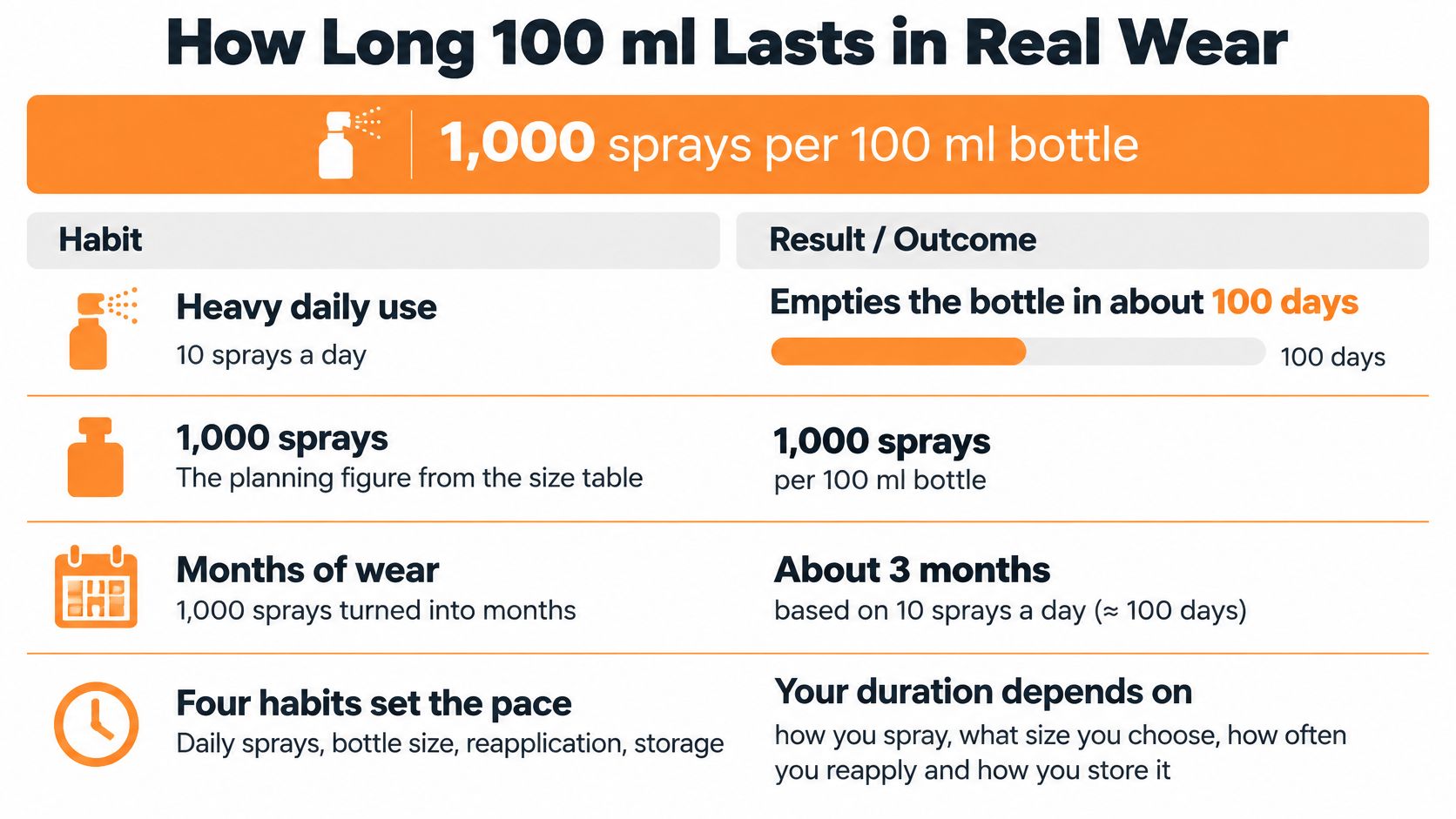
How Long 100 ml Lasts in Real Wear
Six sprays a day is the common case for someone who has settled on a scent they like. At that pace, the 167 days worked out from the bottle math earlier means roughly five and a half months of daily wear before the bottle runs dry. It is a calendar answer, not a performance claim.
Longevity is a different number. When a listing promises 8 to 10 hours, it's describing how long the scent stays detectable on skin after one application. That says nothing about how fast the bottle empties, and the two get muddled constantly in reviews.
Four habits that set the pace
| Wear pattern | Sprays | 100 ml lasts about | Better fit |
|---|---|---|---|
| Heavy daily use | 10 a day | 100 days | 100 ml if it is the only scent |
| Daily signature | 6 a day | about 167 days, or five and a half months | 100 ml |
| Weekday office | 3 sprays, 5 days a week | about 15 months | 50 or 80 ml if rotation is wide |
| Evening only | 8 sprays, twice a week | about 14 months | 30 or 50 ml |
Cost per wear is the only comparison that survives contact with a real routine. Lattafa Asad 100 ml is listed at ₱2,999, so a daily six-spray habit works out at about ₱18 a day across those 167 days, or roughly ₱3 per spray. A second bottle bought on sale and left sealed in a drawer costs the full ₱2,999 whether or not a single spray ever leaves it, and two bottles bought on impulse outspend a year's worth of Asad before either is opened.
Treat every figure here as the best case. Heat, humidity, fabric and a generous hand all shorten the count, and a hot afternoon usually adds a second application that turns a six-spray habit into eight.
Price sensitivity is still the dominant force in this market. IMARC Group's Philippines perfume market report puts mass fragrances at 62% of the market in 2025, which is exactly why cost per finished wear matters more than a large bottle that only looks like a bargain on the shelf.
A full bottle pays off when the scent earns repeat wear. Lattafa Angham 100ML is a 100 ml eau de parfum, and a bottle that size earns its price only when the wearer reaches for it most mornings. The label cannot tell you that. Your own rotation can.
The rule: a daily signature you already know justifies 100 ml. An untested, gifted or occasional scent rarely does, however good the price looks.
Heat Humidity and Carrying 100 ml
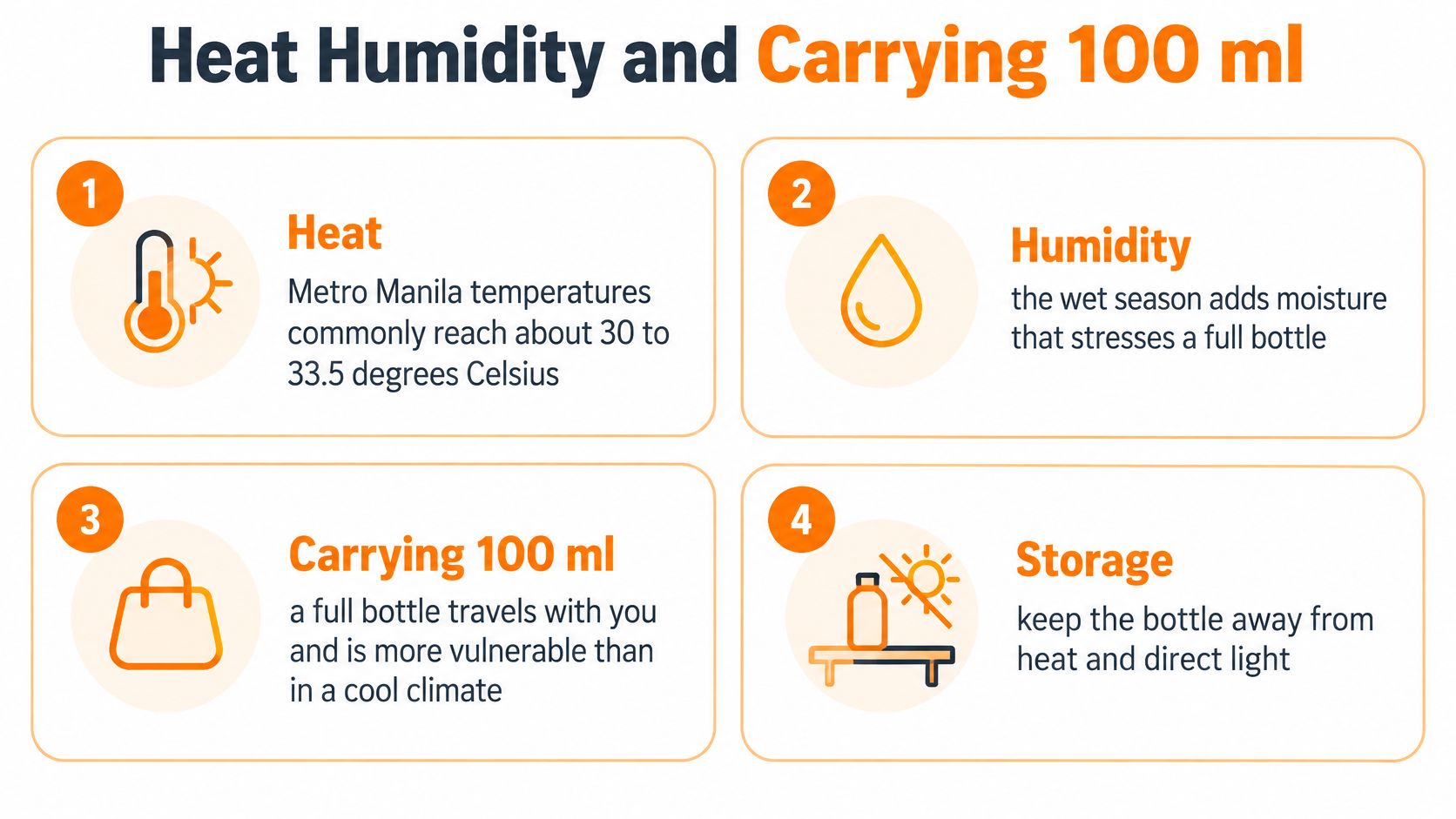
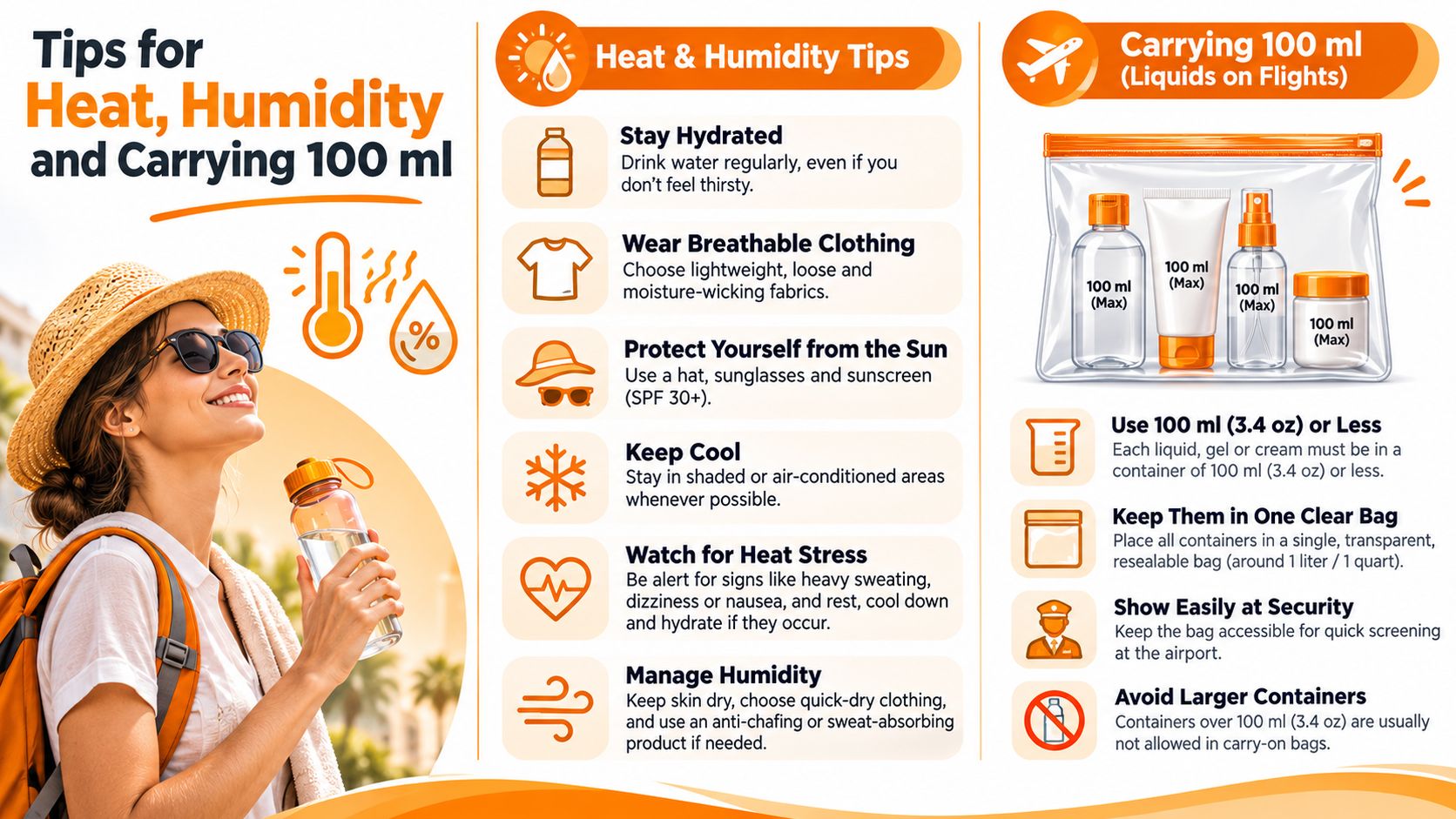
A sealed bottle is a small chemistry experiment, and Metro Manila gives it more to deal with than a cool, dry city does. Temperatures commonly reach approximately 30 to 33.5°C, and the wet season adds moisture that works on the carton, the label and the seal, according to Philippine Airlines' restricted items guidance. Heat and light speed up the changes that make a fragrance smell flat or sharply sour well before the last third.
Storage at home
Keep the bottle in a cupboard, not on a windowsill or a bathroom shelf above the shower. Leave the carton on, click the cap shut, and keep it away from the water heater and any spot that catches afternoon sun. A car door pocket on a parked day is the worst place in the house, and it isn't close.
Flying with a full bottle
The same guidance treats perfume as a toiletry article for air travel: each individual perfume or similar article must not exceed 0.5 L, with the combined quantity limited to 2 L or 2 kg per person. One 100 ml bottle sits far below the single-item cap, but declaration and packing rules still apply, and the airline's checks matter more than the bottle's size.
Carry-on liquid rules are separate and stricter, commonly capping containers at 100 ml. A bottle labelled 100 ml usually meets that. A 200 ml bottle filled only to the 100 ml mark does not, because screeners read the container, not the contents.
Courier is not cabin
Domestic couriers run on their own rules, and a cabin allowance doesn't transfer to a rider or a forwarder. Protect the atomiser with its cap or a strip of tape, seal the bottle inside a bag, wrap it in bubble wrap, then box it rigidly and mark it as a fragile liquid. A leak in transit doesn't just break one order, it scents everything in the same parcel.
If you're choosing a scent for this climate in the first place, our guide to the best perfume for hot weather covers the families that hold up under heat.
The storage test: if you can't keep a bottle cool and dark for the months your wearing habit predicts, buy the smaller size and repurchase later.
Checks Before You Pay for a Full Bottle
Net contents come first on any bottle you are considering. Net contents must be stated in metric units, and the bottle and the outer carton should agree on the number. If the carton says 100 ml while the bottle label offers only an ounce figure with no metric equivalent, the packaging has already failed its first check.
This matters more at 100 ml than at any smaller size. A full bottle is the biggest single spend in a fragrance wardrobe, and the one you will live with the longest. A fake or untraceable 30 ml bottle is a cheap lesson. The same failure at 100 ml is expensive, and it sits on your shelf for months.
FDA Philippines labeling requirements set out what a 100 ml parfum sold locally should carry: the product name and function, full ingredients, country of manufacture, the responsible local company, a batch number, and a manufacturing or expiry date. The aromatic composition may be declared as "perfume", "fragrance" or "aroma", with the remaining ingredients generally in descending order by weight. The product information file should also tie the finished bottle to a named or coded fragrance composition and an identified supplier, the chain that makes an imported bottle traceable at all.
| Check | Pass | Problem |
|---|---|---|
| Net contents | 100 ml matches on bottle and carton | Missing or conflicting volume |
| Batch and date | Batch code plus manufacturing or expiry date | No traceable code |
| Origin and seller | Country of manufacture and local responsible company | Blank import details |
| Concentration | EDP, parfum or extrait stated separately from volume | Only a size, no strength |
| Inspiration claim | Clearly an inspired comparison | Sold as if the designer house made it |
| Seal and invoice | Intact seal and a real receipt | Decant, reseal or no paperwork |
Online is where these checks get skipped most often. The Philippine e-commerce cosmetics and fragrances import market grew at a compound annual growth rate of 11.38% from 2020 to 2024, according to 6Wresearch, and faster volume means more sellers you have never dealt with before.
- Seller identity: a registered business name, an address you can look up, and a contact number that a person answers during business hours.
- A real invoice: a receipt with the item, size, price and seller details on it. Screenshots of a chat are not paperwork.
- Sealed packaging: a broken seal on a "brand new" bottle turns it into a used item, and used fragrance sits outside the return window for hygiene reasons.
- The inspiration claim: "inspired by" is an honest comparison. A listing that implies the designer house manufactured the bottle is a different statement entirely.
- Batch and box consistency: codes get copied and cartons vary by production run, so one matching code proves very little on its own.
A decant is a legitimate way to test a scent, and our explanation of what a decant perfume is covers how to buy one without losing the paper trail.
Pass or pause: if the volume, the batch code and the seller's identity don't all check out, don't pay full-bottle money. A missing batch number leaves the bottle untraceable.
Daily Signature Versus Occasional Wear
Four buyers, four verdicts. Same shelf, entirely different arithmetic.
The commuter with one scent. She's worn the same eau de parfum for two years, sprays six times before a 7 am bus ride, and knows how it turns in the afternoon heat. She's the 100 ml buyer. That six-spray habit lines up almost exactly with five and a half months of daily wear, so the bottle finishes before it has time to sit and spoil.
The office worker under a light-scent rule. Buying 100 ml of a dense oriental and then overspraying it in a shared air-conditioned room solves nothing. A 30 or 50 ml bottle of something softer keeps both the workplace rule and the rest of the wardrobe intact, and it costs less to get wrong.
The collector rotating five bottles. Every bottle sits idle for weeks at a time, so heat has months of quiet opportunity to work on each one. Smaller bottles keep a wide collection fresher longer and reduce the chance of a third of a bottle turning up sour.
The gift buyer in Metro Manila. The recipient's taste is a guess, and an opened bottle can't be returned for hygiene reasons. Choose a smaller size, or choose a scent the person already wears and has mentioned out loud.
Choosing scent by daily habit rather than saving it for occasions is a long-standing local pattern: the Philippines was described in the late 19th century as the "Queen of Perfumes in the Orient", a reputation built on ylang-ylang oil prized in European markets, as BusinessMirror's account of that history records.
Evening wear follows the same logic in reverse. A bold oriental worn to dinners twice a month is a 30 ml purchase, while the same scent worn four nights a week for work events justifies the large bottle. And if a scent already in your rotation also comes in a concentrated parfum size, the label section above explains why that bottle's millilitres work on different maths.
None of these verdicts is permanent. The office rule can change, the collection can shrink, and the occasional scent can become the daily one. Re-run the comparison each time a bottle runs low, because the right size follows the habit you have, not the one you planned when you last bought.
Choose the Bottle Size You Will Finish
The sequence matters as much as the decision: prove the scent, verify the bottle, then check whether your shelf can protect it.
- Test the scent in a small size first. A properly tested sample or a small bottle tells you more than any comparison chart. Two weeks of daily wear shows how the scent behaves through a commute, office air-conditioning and your own skin before you commit 100 ml of money to it.
- Check the label before you pay. Apply the checks covered earlier: net contents, concentration, batch code, responsible company and invoice. A seller rating alone is not a substitute for them.
- Confirm you can store it. Cool, dry and dark, for the months your wearing habit predicts. If the only shelf available catches afternoon sun, buy the smaller bottle and buy again later.
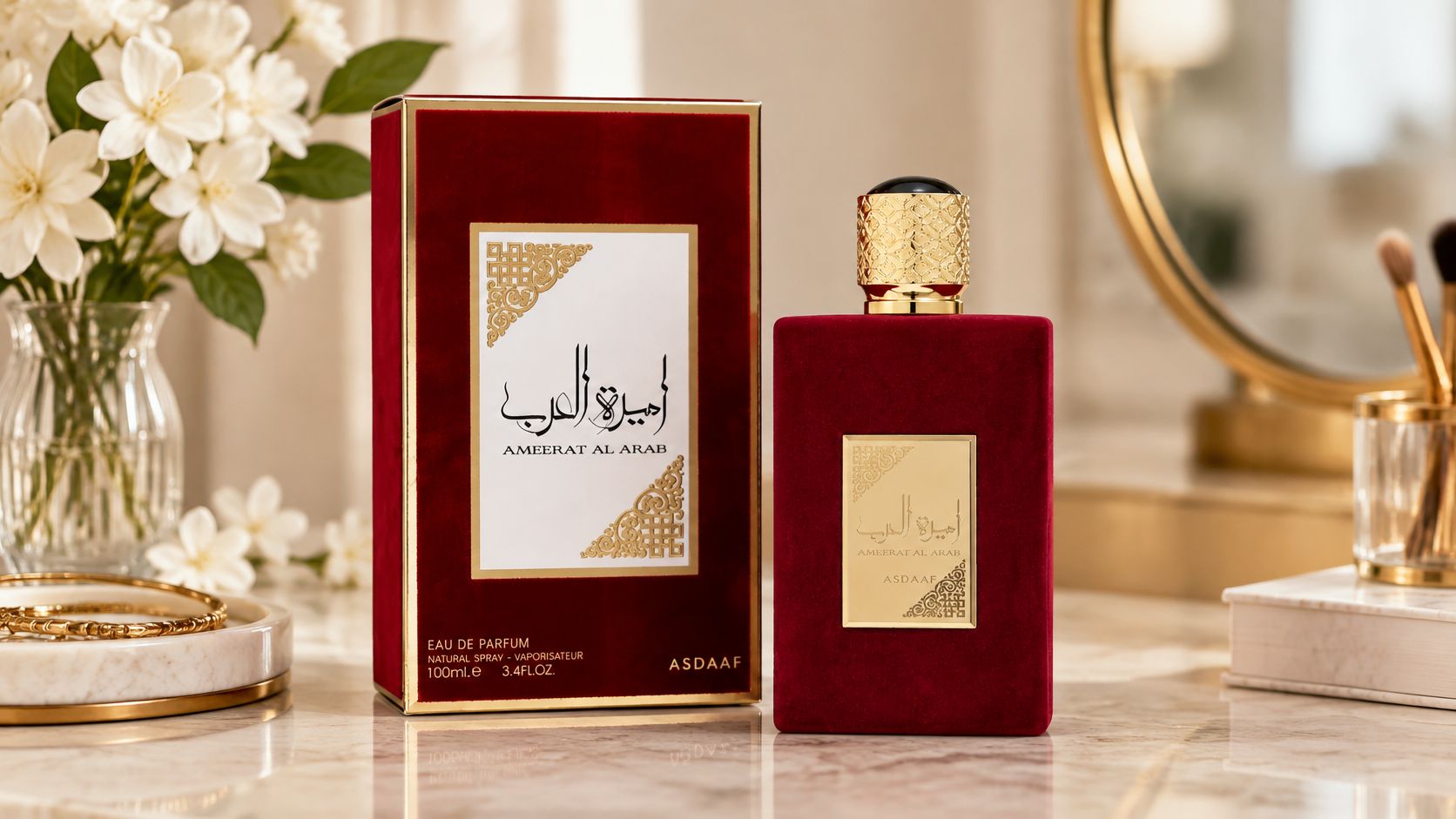
We're Dubai Fragrance Shop PH, a Makati-based seller of authentic Middle Eastern eau de parfum, shipping nationwide in Philippine pesos with 100% guaranteed authentic stock. Lattafa Asad 100 ml is our full-bottle example for a daily scent: oil based, with 8 to 10 hours of wear. For size neighbours, Ameerat Al Arab Red Eau de Parfum is a 100 ml eau de parfum for women, a rich oriental that suits evenings and special occasions, priced at ₱2,199. Free shipping applies above ₱2,000, and opened bottles fall outside the return window, so settle the size before you break the seal.
Size is the part of a fragrance purchase you can reason about before you smell anything, and Dubai Fragrance Shop PH stocks the range to match: 80 and 100 ml eau de parfum alongside a 105 ml parfum, priced in pesos and shipped nationwide from Makati. Start with a smaller size while the scent is unproven, then browse the 100 ml listings once it has earned a place in your routine.