

Best Perfume for Hot Weather in the Philippines: A Practical
The usual answer to the best perfume for hot weather is “choose something citrusy and light.” That advice is incomplete for the Philippines. In a tropical climate, a bright cologne can disappear quickly, while a syrupy amber or dense floral can become suffocating before you reach your destination. The smarter question is not which scent smells fresh. It's how concentration, notes, placement, and spray count behave in humidity.
The Philippines has a mean annual temperature of 26.6°C, with average temperatures reaching 28.3°C in May, while typical relative humidity ranges from 71% in March to 85% in September, according to climate information referenced by IMARC's Philippines perfume market overview. That combination changes how perfume wears on skin. You can still wear an ambitious Middle Eastern EDP in Manila, but you need to control it rather than drown yourself in it.
Table of Contents
- Why Your Usual Summer Fragrance Picks May Be Failing You
- How Philippine Heat and Humidity Actually Change a Fragrance
- Fragrance Families and Notes That Hold Up in Tropical Weather
- Choosing the Right Concentration for Hot Philippine Days
- Application and Storage Tips for Tropical Climates
- Two Middle Eastern EDPs Worth Testing for Hot Weather
- Shopping for Authentic Middle Eastern Fragrances in the Philippines
- Your Quick Decision Framework for Hot-Weather Fragrance
Why Your Usual Summer Fragrance Picks May Be Failing You
“Just pick citrus” is one of the laziest pieces of summer fragrance advice. Citrus can make the opening feel clean and energetic, but it's often the least reliable part of a perfume's performance in tropical heat. On warm skin, lemon, bergamot, grapefruit, and orange can flash brightly, then recede while the rest of the composition struggles to keep its shape.
That doesn't make citrus a bad choice. It makes citrus alone an incomplete strategy. A bergamot opening supported by cedar, vetiver, musk, or dry amber has a better chance of remaining interesting than a thin citrus cologne with no substantial base.
Heat changes the risk on both sides
The Philippines creates two separate fragrance problems. Light compositions can feel refreshing at first but become unremarkable after the opening. Heavy perfumes, especially sweet gourmands, thick ambers, dense white florals, and resinous ouds, can expand aggressively outdoors and overwhelm people around you.
A commute is where poor selection becomes obvious. A perfume that seems luxurious in a cool bedroom may become cloying inside a crowded vehicle, beneath a helmet, or under a lanyard. Body heat and close quarters magnify mistakes.
Practical rule: Don't judge a hot-weather fragrance by its first spray. Judge the dry-down after movement, sweat, and a change in air temperature.
The better mental model is adjustment rather than avoidance. You don't have to abandon bold Middle Eastern EDPs or restrict yourself to aquatic scents. Instead, match the formula and application to the setting.
- Outdoor commute: Use a fresh woody, aromatic, or musky profile and keep the application restrained.
- Air-conditioned office: A balanced EDP can work well because cooler indoor air reduces the risk of an explosive scent trail.
- Open-air daytime plans: Favour dry woods, herbs, and clean musks over thick vanilla, syrupy fruit, or powerful white florals.
- Evening dinner: Amber, saffron, leather, and oud can work, but choose one with a dry structure rather than a sugary opening.
The Philippines' perfume market is expanding, with estimates and forecasts pointing to sustained demand for fragrance, as described in World Data's Philippines climate reference. That demand creates room for more precise advice. The best summer scent isn't automatically the lightest bottle on the shelf. It's the one whose intensity stays controlled in the conditions where you'll wear it.
How Philippine Heat and Humidity Actually Change a Fragrance
Perfume behaves differently when heat and moisture arrive together. Warm skin increases evaporation, especially during the opening, so volatile top notes rise quickly. Humidity also changes diffusion through the surrounding air, making a fragrance feel more noticeable at first even when the wearer later feels it has faded.
PAGASA climate information cited in Facts and Details' Philippines weather reference describes average temperatures of about 25.5°C in January and 28.3°C in May, with monthly relative humidity ranging from 71% in March to 85% in September. The March-to-May period is especially uncomfortable because heat and humidity rise together. For fragrance, that means a strong opening can arrive faster, while the composition's balance changes sooner.
Read the wear in three stages
First, heat accelerates the opening. Citrus, herbs, aldehydes, and other volatile materials can project quickly from warm skin. This is why one spray may smell bigger outdoors than it did indoors.
Second, humid air affects diffusion. Moisture can make the scent feel denser around you, particularly when the formula contains sweet, balsamic, or resinous materials. A rich amber may not smell merely “stronger”. It can feel thicker and more enveloping.
Third, the dry-down determines comfort. Once the bright opening recedes, the base becomes more important. A dry woody or musky base can remain wearable. A sticky vanilla, heavy caramel, or dense floral accord may dominate the entire experience.
| Condition | Temperate Summer, for example 26°C and 50% RH | Philippine Hot Season, for example 32°C and 80% RH |
|---|---|---|
| Opening | Gradual and easier to control | Faster and more noticeable |
| Fresh notes | Often remain distinct for longer | Can recede quickly |
| Sweet notes | Usually easier to moderate | May feel thicker and louder |
| Spray strategy | Moderate application may work | Fewer sprays are usually more practical |
| Best structure | Light compositions can suffice | Fresh top notes need a stable base |
The key distinction is that heat affects evaporation, while humidity affects how the scent feels as it diffuses. That's why an EDP can seem too loud on an outdoor commute but perfectly composed inside an air-conditioned office. For more practical guidance on maintaining performance without overapplying, see this discussion of long-lasting perfume in the Philippines.
Fragrance Families and Notes That Hold Up in Tropical Weather
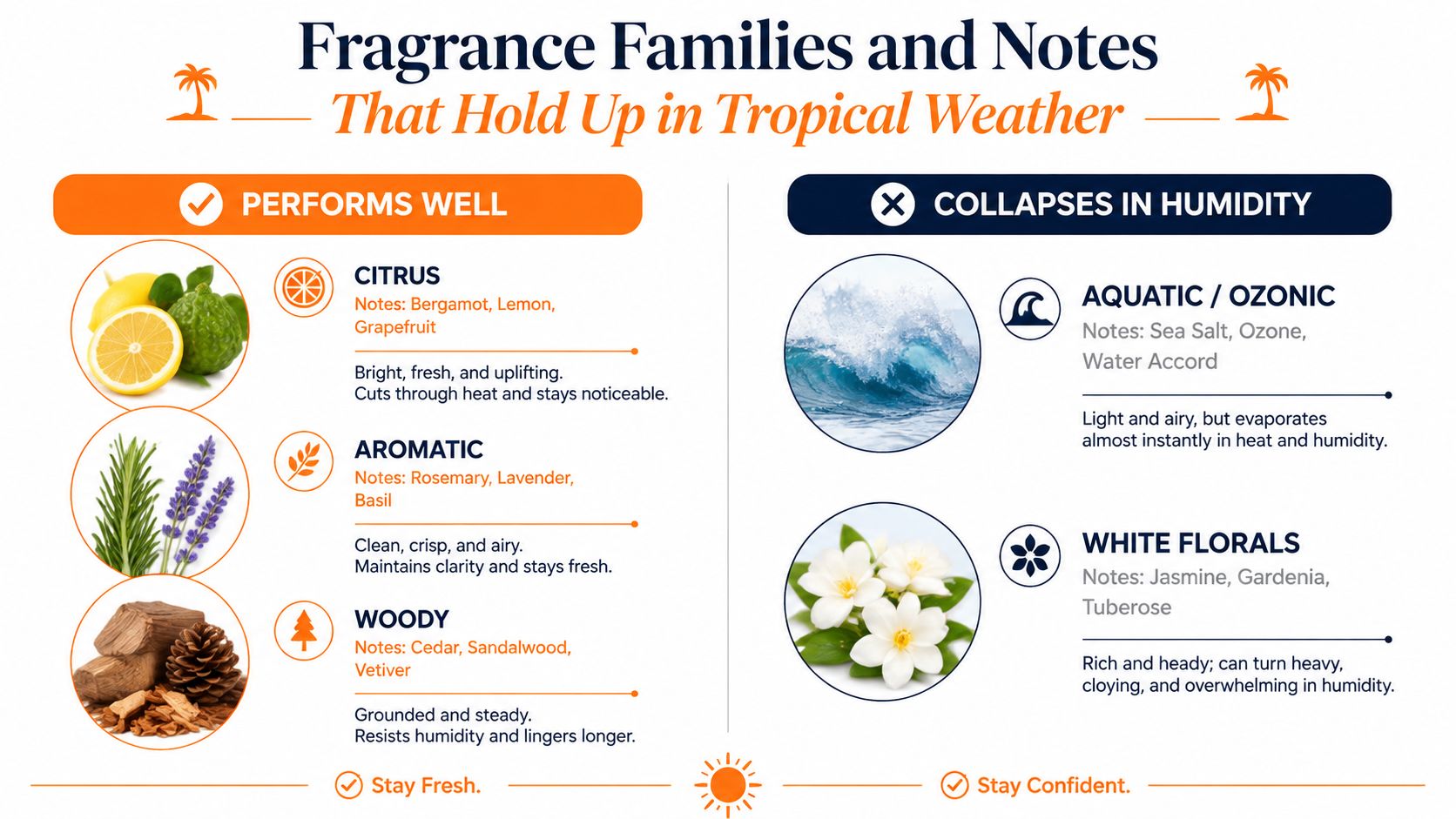
Not every “fresh” family performs well in humid weather. Aquatic and ozonic perfumes can smell crisp for a short period, then become faint or indistinct. White florals can project with surprising force, while sweet gourmands often become heavier as body heat pushes the base forward.
The strongest tropical options usually combine clarity at the top with structure underneath. They smell fresh without depending entirely on fragile freshness.
The families I'd prioritise
Woody ambers offer the best compromise for Middle Eastern EDP shoppers. Look for cedar, sandalwood, dry amber, and restrained resins. These notes give a fragrance a skeleton, so the opening doesn't collapse into a flat citrus trace. In this category, saffron, leather, and a polished oud can add character without automatically making the perfume winter-only.
Green and herbal fragrances are especially useful for daytime wear. Vetiver, mint, galbanum, rosemary, and basil can cut through heat with a dry or cooling impression. Mint and bergamot orange are also part of the fragrance conversation in 2025, alongside lavender, as reported in Philstar's fragrance trend coverage. My preference is a composition where those notes sit over woods or musk rather than a fragile aquatic base.
Aromatic fougères work when lavender, rosemary, sage, and clean woods lead the formula. They suit offices, errands, and smart-casual daytime wear because they project cleanliness without relying on excessive sweetness.
Clean musks and modern ambroxan styles are reliable when you want a skin scent with presence. Musk, ambroxan, cedar, and soft amber can create a clean trail that feels less intrusive than a dense gourmand. They're also easier to wear in shared spaces.
Profiles to approach carefully
Aquatic notes such as ozone, sea salt, and watery accords can evaporate or lose definition quickly. Jasmine, tuberose, gardenia, and other white florals may become forceful in crowded spaces. Vanilla, caramel, praline, and thick fruit syrups are the notes I'd test most cautiously, particularly in a high-concentration EDP.
For Middle Eastern fragrances, don't reject oud automatically. Dry oud with saffron, leather, cedar, or smoky woods can work in heat. The danger is an oud or amber profile built around syrupy sweetness, dense fruit, and a large spray count.
Choosing the Right Concentration for Hot Philippine Days
Concentration matters, but the label doesn't tell the whole story. Formula balance, materials, skin chemistry, and spray quantity all affect wear. Still, concentration gives you a useful starting point when choosing between a cologne, EDT, EDP, and extrait-style fragrance.
An expert perfumery reference cited by Philippines Frontier's weather guidance places eau de cologne at about 3-5% aromatic compounds, eau de toilette at about 8-12%, eau de parfum at about 15-20%, and extrait at about 20-30%. These ranges help explain why a dense EDP can remain present with fewer sprays, while a very light cologne may need repeated application.
Concentration is a control setting
A higher concentration doesn't automatically mean louder projection. It often means a greater share of fragrance material remains available during the dry-down. In humid heat, that can be useful if the composition is balanced, but unpleasant if the formula is already syrupy or resin-heavy.
| Concentration | Oil percentage | Longevity in PH heat | Best use case |
|---|---|---|---|
| Eau de cologne | About 3-5% | Brief and refreshing | Very hot outdoor activity or quick refresh |
| Eau de toilette | About 8-12% | Light and easier to control | Daytime commuting and open-air plans |
| Eau de parfum | About 15-20% | More persistent with fewer sprays | Office wear, indoor errands, and evening use |
| Extrait | About 20-30% | Dense and long-lasting | Controlled application, cooler interiors, and night wear |
For most shoppers, a well-constructed EDP is the practical middle ground. Apply it sparingly to a quieter area of skin rather than spraying heavily across the neck and chest. An EDT can be the better choice for a beach day or a long outdoor commute, especially when you want freshness without a lasting cloud.
You can also compare terminology and formulation expectations in this guide to what eau de parfum means. Treat concentration as a guide, not a promise. Reformulation, batch variation, and differences between fragrance houses can shift a familiar Middle Eastern EDP from relatively airy to extrait-like, so sample testing remains more reliable than the label alone.
Application and Storage Tips for Tropical Climates
The right perfume can still fail if you apply it in the wrong place. In humid weather, wrists and the front of the neck often create too much movement and projection, especially under a helmet, lanyard, collar, or mask. Start with quieter areas where the scent can develop without sitting directly in everyone else's breathing space.
Apply for controlled sillage
Use the inner elbows when you want a slower, less aggressive scent trail. Behind the ears gives close-to-skin warmth, while the nape of the neck works well when your hair moves through the air. These placements are more discreet than coating the front of your neck.
Moisturised skin usually holds fragrance more comfortably than dry skin. A tiny amount of an unscented balm or petroleum jelly on a dry patch can provide a smoother surface, but don't turn it into a thick layer. You can also spray clothing, although test the fabric first because natural resins, oils, and darker liquids may stain. Synthetic-rich Middle Eastern EDPs are often more practical on fabric, but caution still matters.
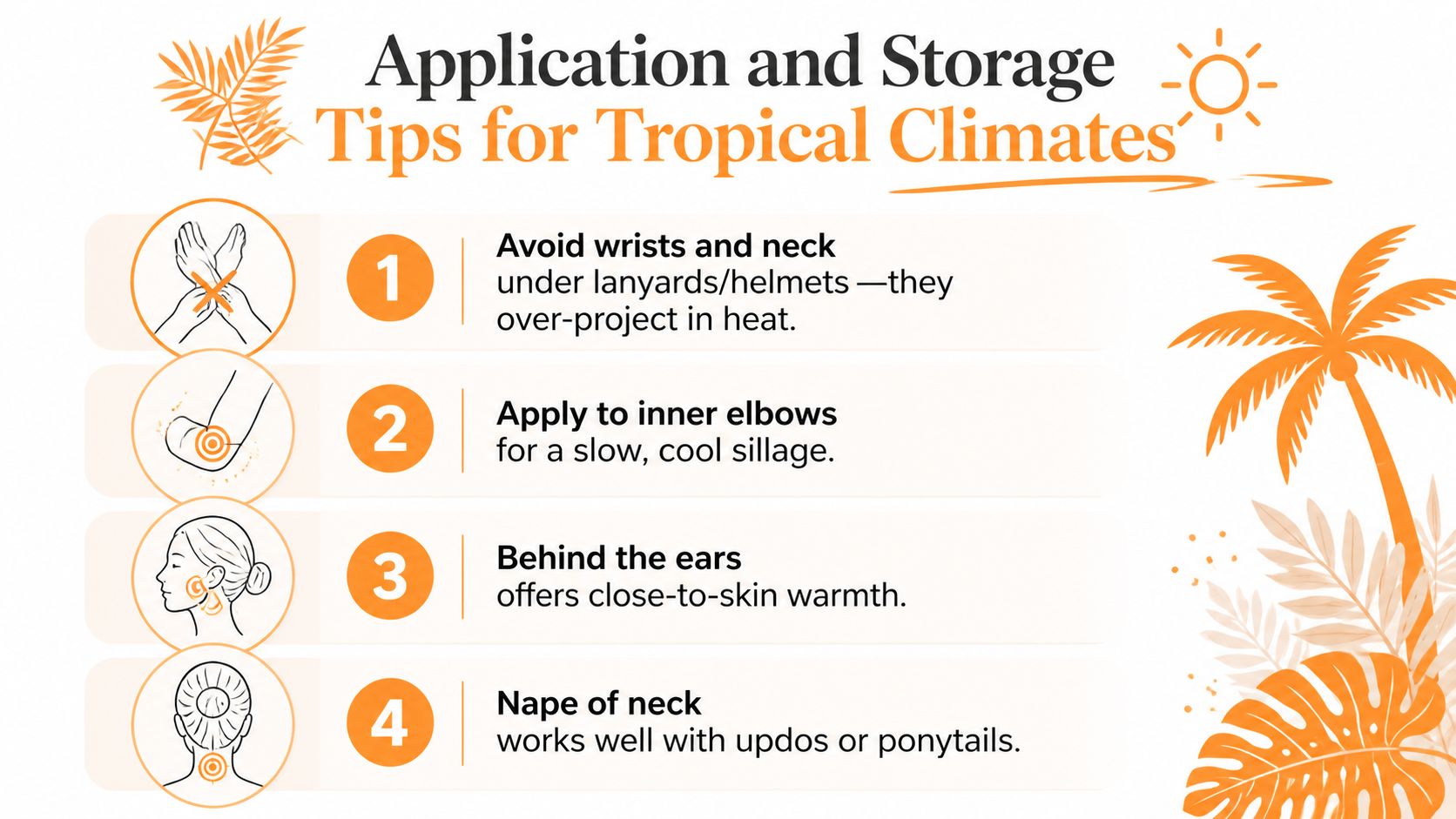
Placement rule: Start with one spray on an inner elbow or behind an ear. Add only after you've experienced the dry-down in the environment where you'll wear it.
Keep the rest of your routine quiet. An unscented deodorant and a mild body wash make more sense beneath oud, musk, or saffron than competing scented products. If you're testing different formulas, perfume sample bottles let you compare application strategies without committing immediately to a full bottle. A Free Gift Travel Spray Atomizer 5ML can also be considered as a small-format carrying option, subject to its listed variants and terms.
Store bottles away from tropical stress
Don't keep perfume in the bathroom. Steam and repeated temperature changes create a poor storage environment. A car is also unsuitable, including the glovebox, because enclosed interiors can become intensely hot.
Choose a drawer, wardrobe, or closet away from direct sunlight and humidity. Keep the cap secure, store the bottle upright, and avoid opening it repeatedly just to smell it. Citrus and floral top notes are particularly vulnerable to changes caused by heat and oxidation, so stable indoor storage protects the balance you paid for.
Here's a practical video reference for applying fragrance with more control:
Two Middle Eastern EDPs Worth Testing for Hot Weather
I can't responsibly name two specific catalogue EDPs as hot-weather winners without verified product details, note pyramids, or controlled wear data for those exact bottles. The brief doesn't provide those facts, and inventing longevity, projection distance, or performance observations would make the recommendation unreliable.
A better comparison starts with two performance profiles that you can identify on a catalogue page or test from samples. The first is an amber-woody EDP, and the second is a fresher aromatic, white-floral, or aquatic-musk EDP. They serve different jobs in Philippine weather.
Option A for amber-woody lovers
Choose an EDP built around dry amber, cedar, sandalwood, saffron, leather, or a restrained oud. This profile suits an air-conditioned office, a mall day, or evening dinner, where the scent has room to settle and the surroundings aren't constantly pushing the base into the air.
Its strength is composure after the opening. Woods and musks can keep the fragrance recognisable after citrus and herbs recede. Its weakness is obvious: if the amber comes with syrupy vanilla, caramel, thick fruit, or a large oud accord, it may become oppressive outdoors.
Option B for fresh aromatic wearers
Choose an EDP led by lavender, mint, bergamot orange, rosemary, clean musk, or a restrained aquatic accord, ideally supported by cedar or ambroxan. This is the easier choice for daytime heat, public transport, and shared offices because the opening reads cleaner and less dense.
The trade-off is persistence and definition. A very airy aquatic-musk may fade into a vague skin scent outdoors, while a white-floral-heavy version can project far more than expected. Test the dry-down rather than buying from the opening alone.
| Attribute | EDP Option A | EDP Option B |
|---|---|---|
| Core profile | Amber, woods, saffron, leather, or oud | Lavender, mint, bergamot, aromatics, or clean musk |
| Best setting | Air-conditioned office or evening dinner | Daytime errands, commuting, or casual office wear |
| Main advantage | More structure and a richer dry-down | Fresher first impression and easier daytime control |
| Main risk | Syrupy sweetness can become cloying outdoors | Aquatic or floral facets may fade or over-project |
| First buyer | Someone who wants presence and warmth | Someone prioritising freshness and low intrusion |
My direct recommendation is simple. If you already know you enjoy Middle Eastern amber and oud, test the woody option first, but begin with minimal application. If you're sensitive to sweetness or share enclosed spaces, start with the aromatic musk option and add richness later through a different evening fragrance.
Shopping for Authentic Middle Eastern Fragrances in the Philippines
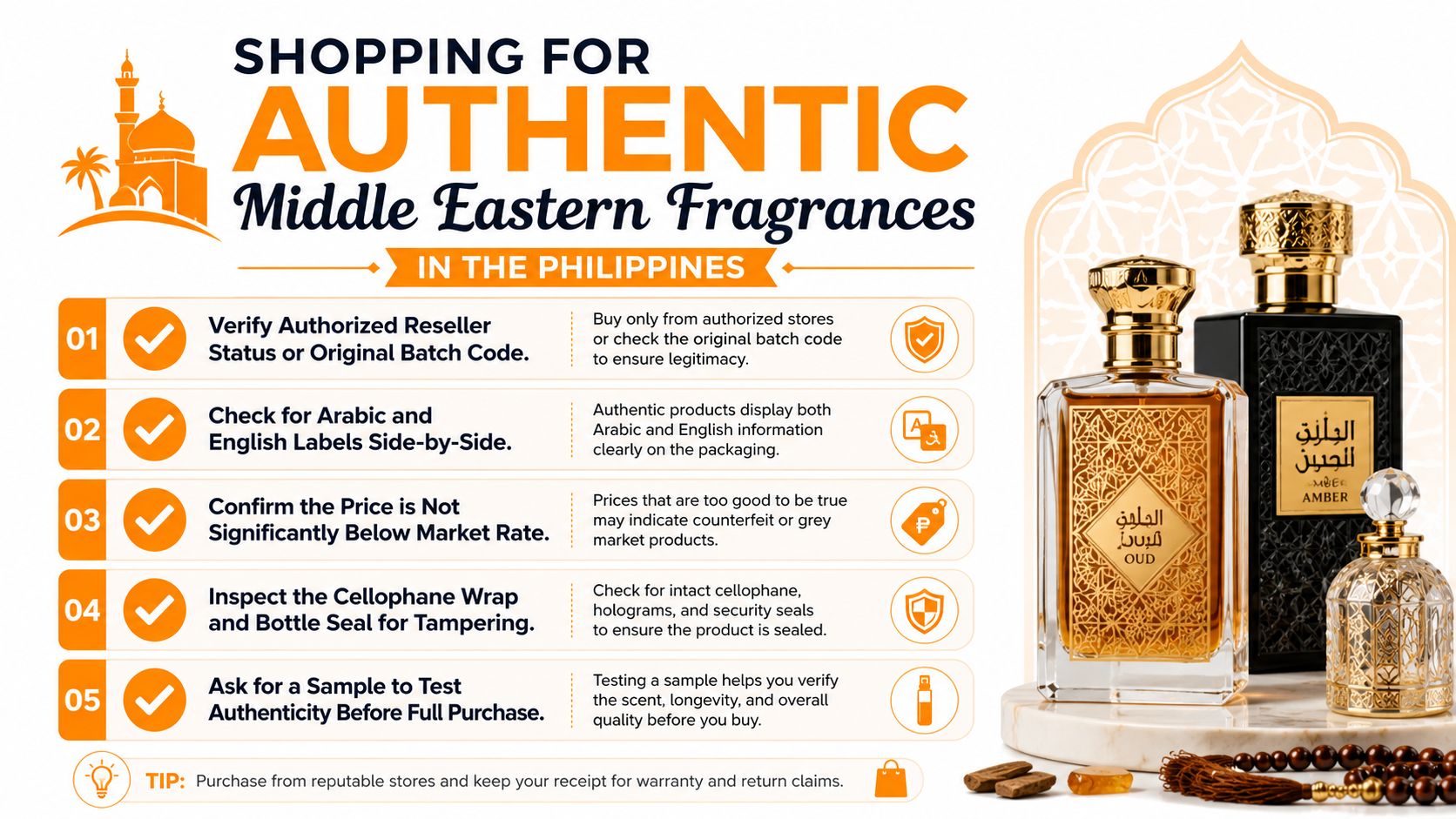
Buying Middle Eastern EDPs online requires more than comparing bottle photos. Counterfeits, unclear sourcing, damaged packaging, and incomplete landed-cost information can turn a seemingly good purchase into an expensive mistake. Use a checklist before paying.
Five checks worth doing
- Verify the batch details: Look for a batch code and compare available brand information or recognised batch-checking services. A missing or suspicious code deserves questions.
- Inspect the labels: Arabic and English labelling should look coherent, properly printed, and consistent with the brand's usual packaging.
- Review the payment process: Secure invoicing and familiar Philippine payment options, such as GCash, Maya, bank transfer, or PayPal, give you a clearer transaction trail.
- Ask about delivery: Confirm expected shipping to Metro Manila, Cebu, or Davao, and ask how the seller protects glass bottles from heat and impact during transit.
- Read the returns policy: Check whether unopened bottles can be returned and what evidence the seller requires if packaging arrives damaged.
Don't treat a very low price as proof of value. A discount that sits 60% or more below typical retail should be treated as suspicious, and you should request authentication evidence before paying. That figure is a buying rule from the brief, not a guarantee that every cheaper listing is fake.
Also calculate the full landed cost when importing. Customs treatment can change above the PHP 10,000 threshold, so a local seller may be simpler even when the sticker price isn't the lowest. Check the retailer's policies, business details, product photographs, and proof-of-transaction pages before committing to a bottle you haven't smelled.
Your Quick Decision Framework for Hot-Weather Fragrance
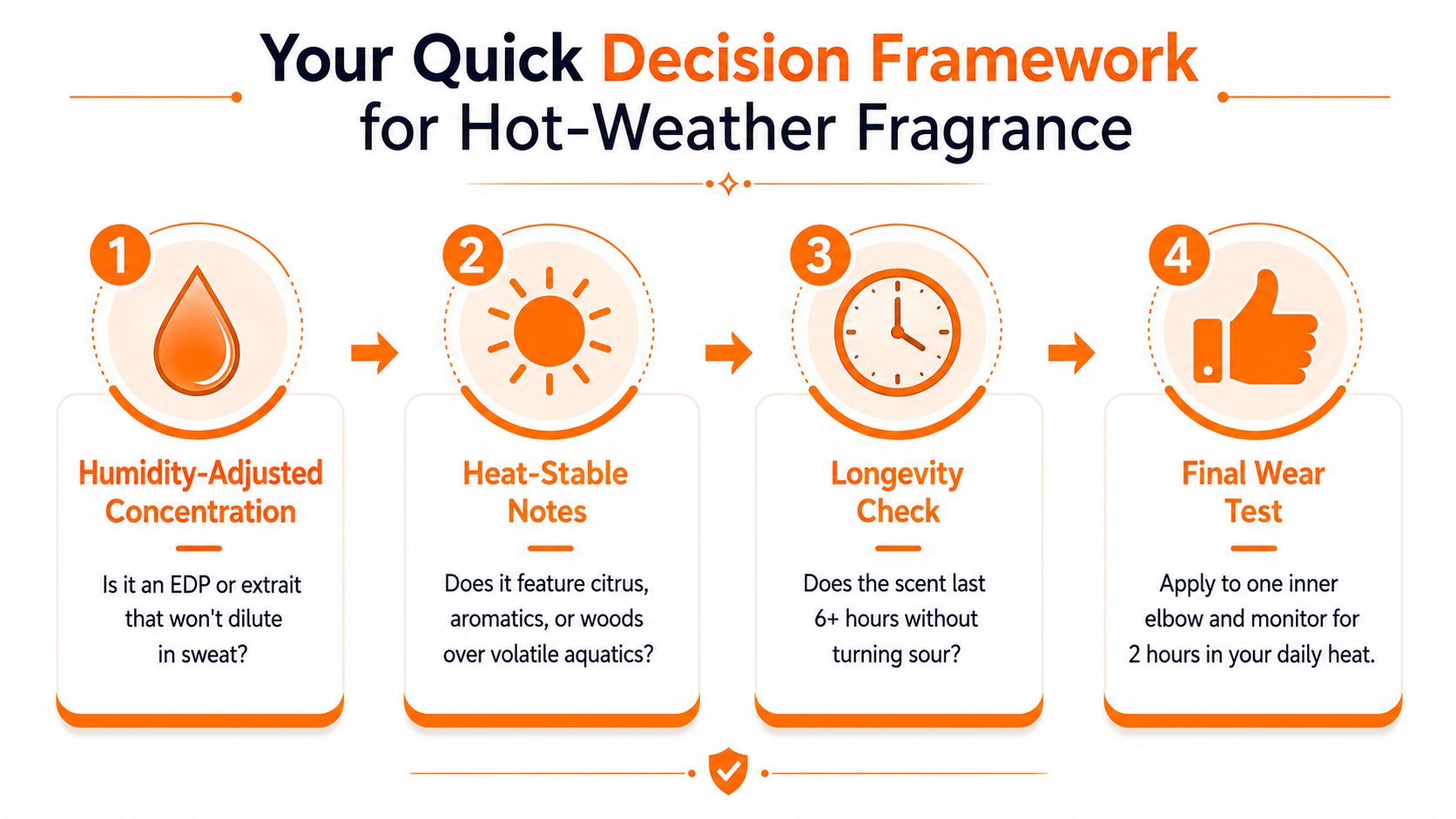
Use four filters before buying any perfume for Philippine heat. Concentration tells you how much material may remain after the opening. Notes reveal whether the dry-down is likely to stay dry, aromatic, woody, musky, or become thick and sweet. Placement controls the scent cloud. Sourcing protects you from paying for an unauthenticated bottle.
Run a short wear test
Hold the bottle in your hand briefly to bring it closer to your normal skin temperature. Spray once on the inner wrist, then move into a fan-cooled room and wait ten minutes before judging the opening. Don't decide based on the first few seconds.
Rate each point from one to five:
- Sillage: Is it noticeable without filling the room?
- Freshness: Does the scent still feel clear rather than muddy?
- Cloying risk: Does the sweetness, floral density, or resinous base remain comfortable?
A fragrance that reaches three or higher across all three ratings qualifies for a real hot-weather trial, but you should still wear it during a normal day before buying a full bottle. Test it on one inner elbow and observe it through your actual commute, office, errands, or evening plans.
The mindset shift is straightforward. The Philippines doesn't require you to avoid bold fragrances. It requires you to control boldness with concentration, composition, placement, and spray count. That's how a Middle Eastern EDP becomes wearable in humidity instead of becoming the scent everyone remembers for the wrong reason.
Dubai Fragrance Shop PH offers Middle Eastern EDPs from houses including Lattafa, Afnan, Armaf, Rasasi, Arabiyat, Rayhaan, and French Avenue, with collections for men and women and nationwide fulfilment in the Philippines. Visit Dubai Fragrance Shop PH to compare options, check product details, and choose a fragrance you can test with a humidity-adjusted spray strategy.