

What Is Paypal Express Checkout Shopify
PayPal Express Checkout is an accelerated third-party payment option in Shopify that sends customers to PayPal to pay with saved balance, bank, or card details instead of typing them into the store, then returns them to Shopify for order confirmation. For a Philippine Shopify store, that means a familiar PayPal button can sit beside other payment methods while the buyer moves through checkout a little faster.
If you've opened a Shopify checkout page and wondered what that yellow PayPal button changes, you're probably asking the right question at the right time. A shopper in Manila, Cebu, or Davao sees a quick way to pay, while the merchant sees a payment choice that may affect fees, refunds, and post-purchase work. The useful part is that both sides can understand it clearly once the flow is broken down step by step.
Table of Contents
- Why That PayPal Button Appears at Shopify Checkout
- What PayPal Express Checkout Actually Is
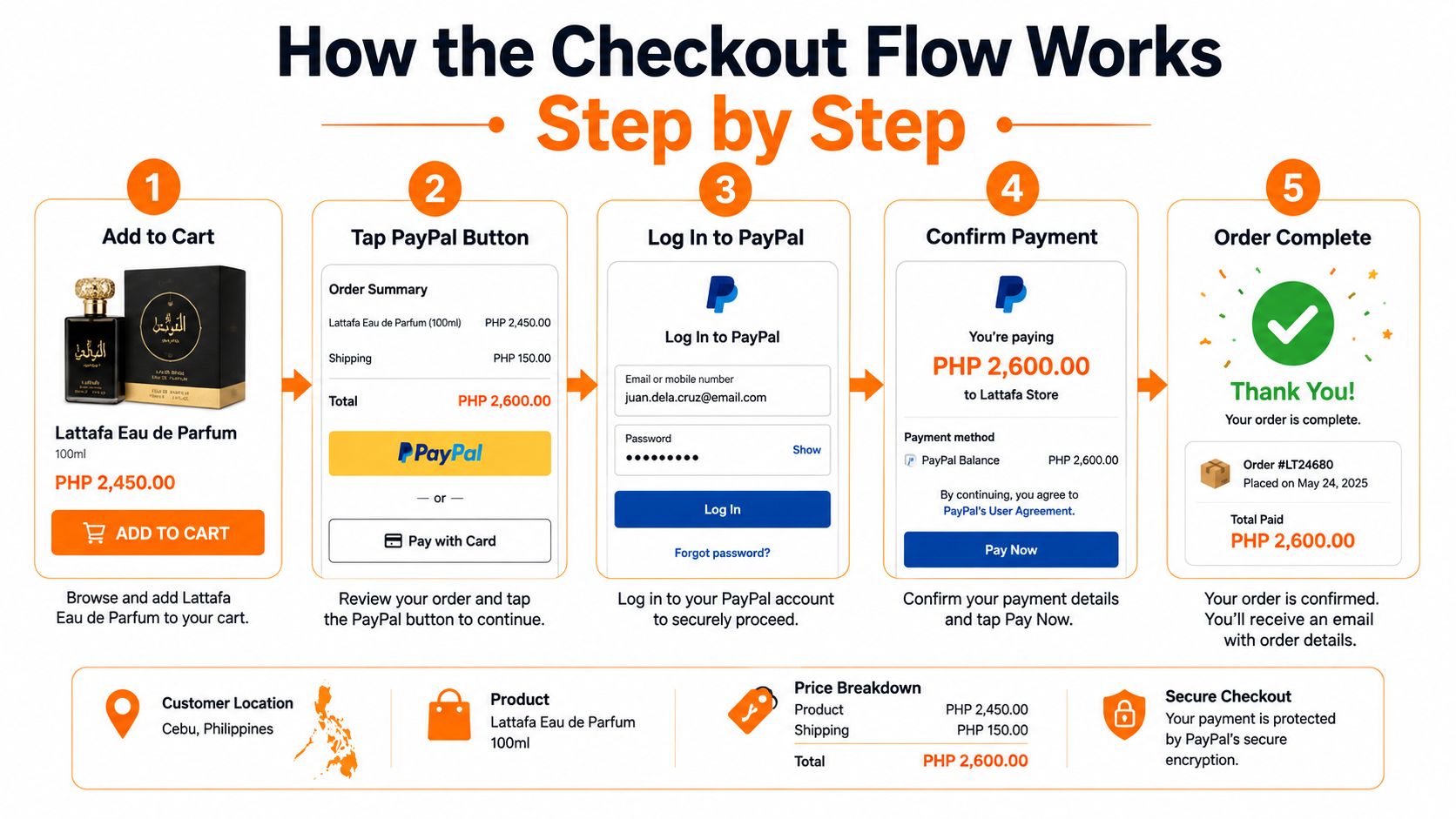
- How the Checkout Flow Works Step by Step
- PayPal Express Checkout vs Standard PayPal Checkout
- Setting Up PayPal Express in Your Shopify Admin
- Fees and Costs Philippine Shopify Stores Should Expect
- What Happens After the Payment Clears
- Building a Local Payment Strategy and Final Takeaways
Why That PayPal Button Appears at Shopify Checkout
A shopper in a Philippine fragrance store adds a bottle of Lattafa to the cart, reaches checkout, and pauses at the PayPal button. They're usually asking two things at once, is this safe, and will it save time? For the merchant, the same button raises a different question, should this be turned on for customers who already trust PayPal, or should another local payment path stay front and centre?
That's why this topic needs a plain answer before anything else. PayPal Express Checkout is an external payment route inside Shopify, not a separate store and not a shipping option. It sends the buyer into PayPal's environment to approve payment, then brings them back to Shopify for the order confirmation.
The button matters because it changes where payment happens, not what the merchant sells.
This guide follows the full journey in the order most merchants need it. First comes the basic definition, then the checkout flow, then the difference between Express and standard PayPal, then setup in Shopify Admin, then the fee reality for Philippine orders, and finally the part many guides skip, refunds, disputes, currency conversion, and reconciliation. If you're a merchant, you'll know whether to enable it. If you're a shopper, you'll know what happens when you tap it.
What PayPal Express Checkout Actually Is
Think of PayPal Express Checkout as an express lane that borrows PayPal's wallet instead of making the customer pull out a card at the register. Shopify treats it as a third-party accelerated payment option, so the buyer authorises payment inside PayPal and then returns to the store once PayPal has approved the transaction. Shopify also supports more than 100 third-party payment gateways, but availability still depends on the merchant's country and the provider's configuration, so a Philippine store has to confirm what's enabled in its own setup.
What it is and what it isn't
It helps to be very strict here. It is not a separate Shopify storefront, because the customer still checks out through Shopify. It's not a shipping service, because no parcel movement happens inside PayPal. It's also not a different PayPal account type in the customer's eyes, it's the same PayPal environment they already know, used as the payment authorisation layer.
PayPal can draw on a customer's stored PayPal balance, linked bank account, or saved card details, which is why returning customers often find it easier than re-entering card numbers. For a Filipino buyer shopping at a PHP-priced fragrance store, that can feel simpler than typing details on a mobile screen. For the merchant, the benefit is mostly reduced friction at checkout, not more control over the payment screen.
Why the term causes confusion
People often say “PayPal checkout” as if it's one thing, but Shopify merchants need to separate the store, the gateway, and the payment experience. The store belongs to Shopify, the money authorisation happens in PayPal, and the final order confirmation returns to Shopify. Once you hold those three pieces in your head, the rest of the setup becomes much easier to understand.
A good mental shortcut is this, the customer leaves Shopify just long enough to approve payment, then comes back. That's the whole point of the “express” part.
How the Checkout Flow Works Step by Step
A customer in Cebu sees a Lattafa eau de parfum priced in PHP, adds it to cart, and taps the PayPal button instead of going through a longer card form. From there, the checkout becomes a simple handoff between Shopify and PayPal. The merchant never needs to pretend this is magic, because the flow is predictable once you watch it in order.
The customer journey
- Add to cart. The shopper chooses the fragrance and proceeds to checkout.
- Tap PayPal. Shopify presents the PayPal option as an accelerated route.
- Log in to PayPal. The buyer enters the hosted PayPal environment.
- Confirm payment. PayPal uses the buyer's balance, linked bank, or saved card details.
- Return to Shopify. The order confirmation appears back on the store.
That sequence matters because the payment happens outside the storefront, but the order still lands in Shopify. For a fragrance merchant, that means the shopper's experience feels short and familiar, while the store keeps the order record in the normal place.
The merchant-side view
On the back end, the order appears in Shopify and the payment status updates automatically. Shopify's PayPal Express integration also avoids dependence on PayPal Instant Payment Notifications, which helps order-status reliability between the two systems. That matters when you're trying to keep inventory, payment status, and fulfilment aligned without chasing manual updates.
If the buyer finishes in PayPal and returns to Shopify cleanly, the store can move to fulfilment faster.
A Philippine storefront selling perfumes needs that clean handoff because mobile checkout errors and status mismatches create unnecessary support work. The simpler the payment flow feels to the buyer, the easier it is for the merchant to keep the order process organised.
PayPal Express Checkout vs Standard PayPal Checkout
The difference isn't just a button label. It changes when the PayPal option appears, how much friction the shopper feels, and how much control the merchant keeps over the checkout experience. For a Philippine Shopify store, those differences matter because a customer buying a fragrance on mobile often decides fast, and the route to payment can shape whether they finish the order at all.
Side by side in plain language
With Express Checkout, the PayPal button appears earlier in the checkout journey, so the buyer can commit before filling out every detail manually. With a more standard PayPal flow, the payment experience tends to show up later and can feel less direct. Shopify's guidance also makes clear that PayPal controls the payment choices shown inside its hosted checkout, so merchants can't fully customise that environment from Shopify alone.
The payment sources are broadly familiar in both cases, but Express is built around speed for returning users. It can use PayPal balance, buyer credit, bank accounts, and credit cards. That makes it useful for customers who already have PayPal set up and don't want to hunt for a wallet or card.
What each option suits
- Express for repeat buyers: It's more useful when the shopper already trusts PayPal and wants fewer steps.
- Standard for broader comparison: It may suit merchants who want shoppers to stay longer inside the main checkout flow.
- Hosted control stays with PayPal: The merchant can't fully redesign the payment choices shown in PayPal's own environment.
- Reliability depends on the integration: Express is designed to keep order status in sync without extra manual checking.
For a fragrance store, neither path is automatically perfect in every case. A buyer with an active PayPal account may prefer Express, while another buyer may want a local wallet or bank-based option that feels more natural. The right choice depends on the store's audience, not on a generic preference for one button over another.
Setting Up PayPal Express in Your Shopify Admin
The activation path is short, but the testing matters more than the clicks. In Shopify Admin, you go to Settings, then Payments, activate PayPal, connect the business account, and run a test transaction before you accept live orders. That's the part many guides compress too quickly, yet it's the part that saves the most support headaches later.
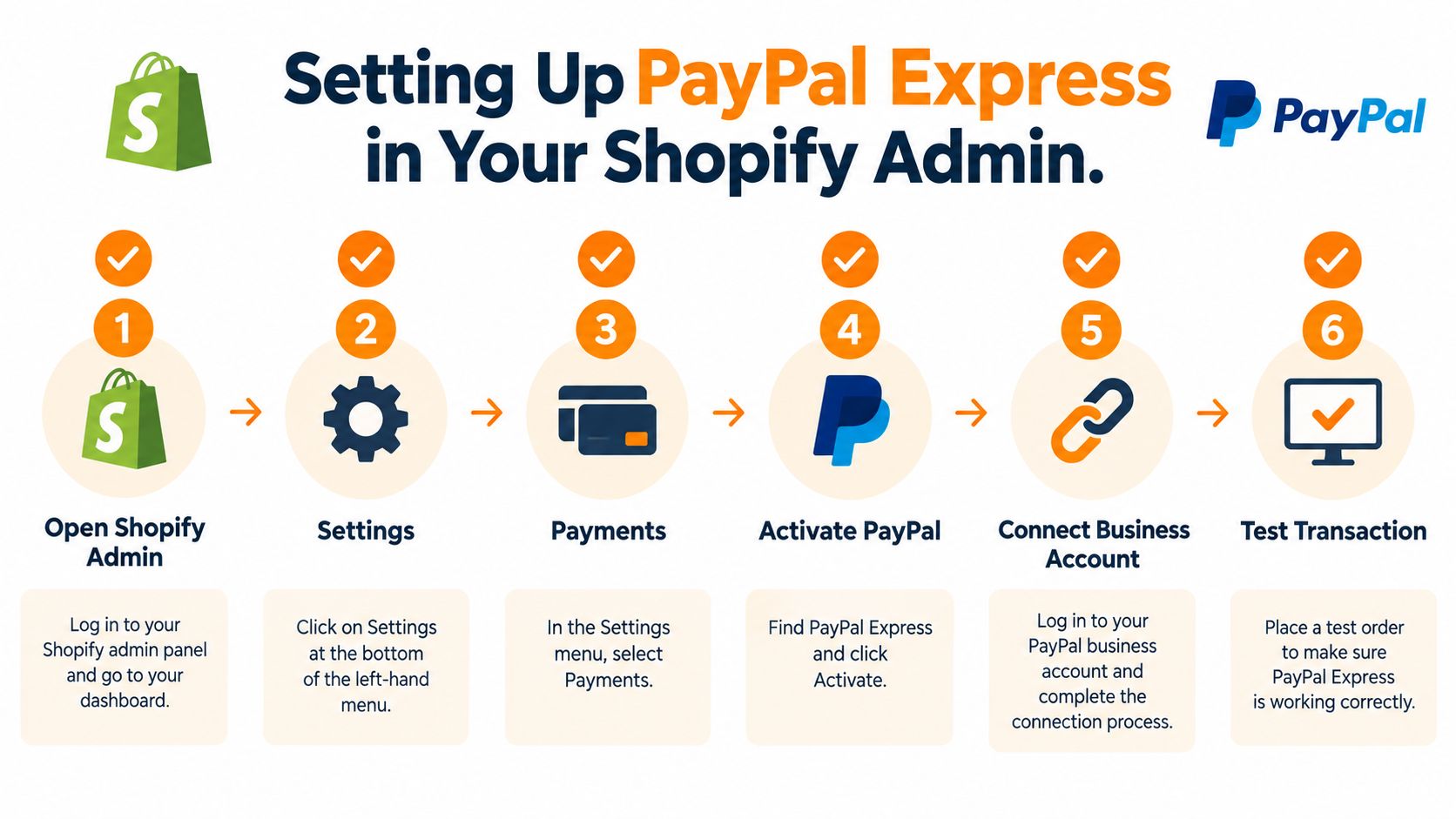
What to verify before going live
Because PayPal controls the hosted screen, a Philippine merchant should test the parts customers use. That includes PHP pricing display, mobile layout, successful-payment callbacks, cancellations, refunds, and inventory reservation using Philippine customer accounts. If the display looks fine on desktop but messy on mobile, the store can still lose orders at the exact point where intent was highest.
Shopify's standard PayPal connection also avoids the need to build a custom payment API, even though PayPal says its checkout APIs and JavaScript SDK can be customised. PayPal also states that it's PCI compliant for card-data processing and has no monthly or setup fee, but the normal Shopify connection doesn't require a merchant to engineer that route from scratch. For most stores, the goal is practical activation, not custom development.
A simple pre-launch checklist
- Check the product total in PHP: Confirm the customer sees the correct local price.
- Test on mobile: Many fragrance shoppers will complete the order on a phone.
- Run a cancellation: Make sure the order status behaves as expected.
- Run a refund test: Confirm the refund process is understandable internally.
- Verify inventory reservation: The stock count should update the way you expect.
If you want a store-specific walkthrough of the buyer side, Dubai Fragrance Shop PH has a useful internal guide on Shopify PayPal guest checkout. That kind of practical reference matters because the key question isn't whether PayPal exists, it's whether your checkout works cleanly for the people who buy.
Fees and Costs Philippine Shopify Stores Should Expect
PayPal's fee structure only becomes useful when you place it against a real PHP order. On the published Philippines business-fee table, the relevant Asia-Pacific merchant-fee tier shows a 4.0% rate, and PayPal also lists a 3.0% Asia-Pacific currency-conversion rate. Because the applicable fee can vary by transaction type and buyer market, the current schedule should always be checked before pricing products.
For a fragrance store, that matters because a fee is not abstract. On a ₱2,000 order, a 4.0% processing fee equals ₱80 before any fixed fee, currency conversion, refund exposure, or Shopify-related charges. If your store offers free shipping above ₱2,000, the fee is hitting exactly at the order size where shipping has already been subsidised.
PayPal Processing Cost on PHP Orders
| Order value (PHP) | Fee at 4.0% (PHP) | Remaining before other costs (PHP) |
|---|---|---|
| ₱2,000 | ₱80 | ₱1,920 |
| ₱3,000 | ₱120 | ₱2,880 |
| ₱5,000 | ₱200 | ₱4,800 |
That table doesn't include fixed fees, conversion costs, or refund effects, so the net can be lower. But it gives a better starting point than guessing. It also shows why merchants shouldn't treat PayPal as a free convenience layer, even when the checkout feels smooth to the buyer.
A payment method can improve convenience and still shrink margin if the store doesn't model it properly.
For a Philippine fragrance store, the takeaway is simple. Keep PayPal as one checkout route, not the whole pricing strategy, and measure whether it fits your average order size, shipping threshold, and margin cushion.
What Happens After the Payment Clears
The hard part often starts after the customer has paid. A Philippine merchant then has to answer questions about whether a refund returns the full amount, who absorbs the original processing fee, how the PayPal transaction matches the Shopify order, and how a foreign-currency payment behaves if the order later gets refunded in PHP. Those questions are easy to ignore during setup and expensive to ignore later.
Why fragrance orders need extra care
Perfume stores deal with realities that can squeeze margin quickly, partial refunds, damaged parcels, authenticity disputes, and shipping promises that were made before the payment cleared. A printed price on the product page doesn't tell you whether a dispute, a return, or a refund will leave the order still profitable. That's why the after-payment process needs a procedure, not just confidence.
Shopify's guidance also notes that when Shopify Payments is used with PayPal Express Checkout, merchants are charged according to the payment method used rather than being billed twice for the same transaction. That helps clarify the payment route, but it doesn't remove the need to reconcile the transaction carefully.
A practical reconciliation routine
Before going live, record each Shopify order total in PHP, verify the PayPal settlement currency and net amount, and document proof for refunds and disputes. Then model the cost of a full refund before advertising free shipping as if every order will remain intact. Your internal records matter more than the button on the checkout page.
Use your proof pages and order records together, and keep a clear trail for each shipment. If you want to see how a store can organise transaction evidence, the internal page on proof of transactions is a good reminder that post-purchase admin is part of payment strategy, not an optional extra.
Building a Local Payment Strategy and Final Takeaways
A Manila fragrance shop may receive one order from a local cardholder, another from an overseas Filipino, and a third from a buyer without PayPal. PayPal Express Checkout should serve as one recognisable route in that mix, not replace every payment option. In the Philippines, the Bangko Sentral ng Pilipinas reported that digital payments represented 64.69% of retail-payment volume in 2025, while they represented 53.32% of retail-payment value, down from 58.98% in 2024. High digital-payment activity does not mean every shopper wants PayPal for every purchase. BSP 2025 e-payments report
The right question to ask
Check whether customers recognise PayPal, have a usable balance or linked card, and trust it more than local wallet or bank-based choices. A PHP-priced store also needs to show the full cost clearly. For a ₱2,000 fragrance order, a 4.0% PayPal fee can affect the margin behind a free-shipping offer, especially if currency conversion or a later refund enters the calculation.
Use this decision view:
- PHP-priced orders: Show the amount and payment route clearly for local buyers.
- Mobile shoppers: Choose a checkout that limits repeated form entry.
- Overseas Filipino buyers: PayPal may feel familiar if they already use it abroad.
- Customers without PayPal accounts: Keep other payment methods visible and usable.
- Post-payment cases: Record how you will handle refunds, disputes, and currency conversion before launch.
For more on choosing scents with confidence, see this guide to authentic perfume online in the Philippines.
Final takeaways
PayPal Express Checkout is an accelerated third-party payment method inside Shopify. It sends the buyer to PayPal for authorisation, then returns them to Shopify for confirmation. For a Philippine fragrance merchant, it can reduce typing and support mobile sales, while requiring a plan for the 4.0% fee, refunds, disputes, and currency conversion.
If you run a fragrance store, keep PayPal as one part of a broader payment strategy. If you want authentic Middle Eastern fragrances priced in PHP, nationwide fulfilment, and a free-shipping threshold over ₱2,000, browse the Dubai Fragrance Shop PH catalogue, compare the available payment choices, and review how the store presents shipping and product trust information before placing an order.