

Eau De Parfum Price in the Philippines Explained
The cheapest bottle on the shelf isn't the best deal. In the Philippines, eau de parfum price only makes sense when you look at what the bottle gives you, how often you'll reach for it, and what it costs to land that bottle in your hand. A scent that survives the day in Metro Manila heat can beat a cheaper bottle that disappears after lunch.
That's why smart buyers stop asking, “How much is this bottle?” and start asking, “How much does each wear cost me?” A higher-priced EDP can make more sense if it lasts longer, needs fewer sprays, and saves you from reapplying all day. In a humid climate, that difference matters more than pretty packaging or a nice discount tag.
Table of Contents
- Rethinking the True Cost of Fragrance
- The Philippine Fragrance Market Landscape
- Import Taxes and Landed Cost Realities
- Designer Labels Versus Middle Eastern Houses
- Calculating Your Cost Per Wear
- Navigating Online Channels and Authenticity
- Building a Versatile Fragrance Wardrobe
Rethinking the True Cost of Fragrance
A low shelf price can fool you. A fragrance that looks affordable at checkout can become the pricier choice if it fades fast, needs constant spraying, or turns into a bottle you only use on special occasions.
Stop judging by the checkout total
The better question is simple, how much scent do you get per wear? That's the true measure for fragrance value, especially when you wear something to commute, sit in an office, or move through heat and humidity all day. A stronger EDP often earns its price because you use less of it to get the same effect.
Eau de parfum also carries a different expectation from lighter fragrance formats. If you want a bottle that does the job in one or two sprays, you're paying for concentration, not just liquid. For a clear primer on the category itself, this eau de parfum guide is a useful starting point.
Practical rule: if a cheaper scent makes you re-spray twice or three times a day, it can lose to a more expensive bottle very quickly.
Longevity changes the math
In tropical weather, weak performance is expensive. You burn through the bottle faster, you spend more time reapplying, and you end up buying again sooner than you planned. That's why fragrance value in the Philippines should be judged on wear time, not just the label on the box.
Middle Eastern EDPs often enter this conversation because buyers want richer base notes and stronger presence without paying luxury-designer money. If a bottle holds up through the day, it's not just “stronger”, it's often the more disciplined purchase. The goal isn't to buy the most expensive scent, it's to buy the one that earns its place in your rotation.
The Philippine Fragrance Market Landscape
The local fragrance market rewards affordability, but it's not a pure race to the bottom. A 2025 estimate valued the Philippine perfume market at about USD 191.01 million, and it's projected to reach USD 348.30 million by 2034 with a 6.90% CAGR from 2026 to 2034. At the same time, mass-market perfume products accounted for 62% of the market in 2025, which tells you where most shoppers still place their money. Indexbox market analysis
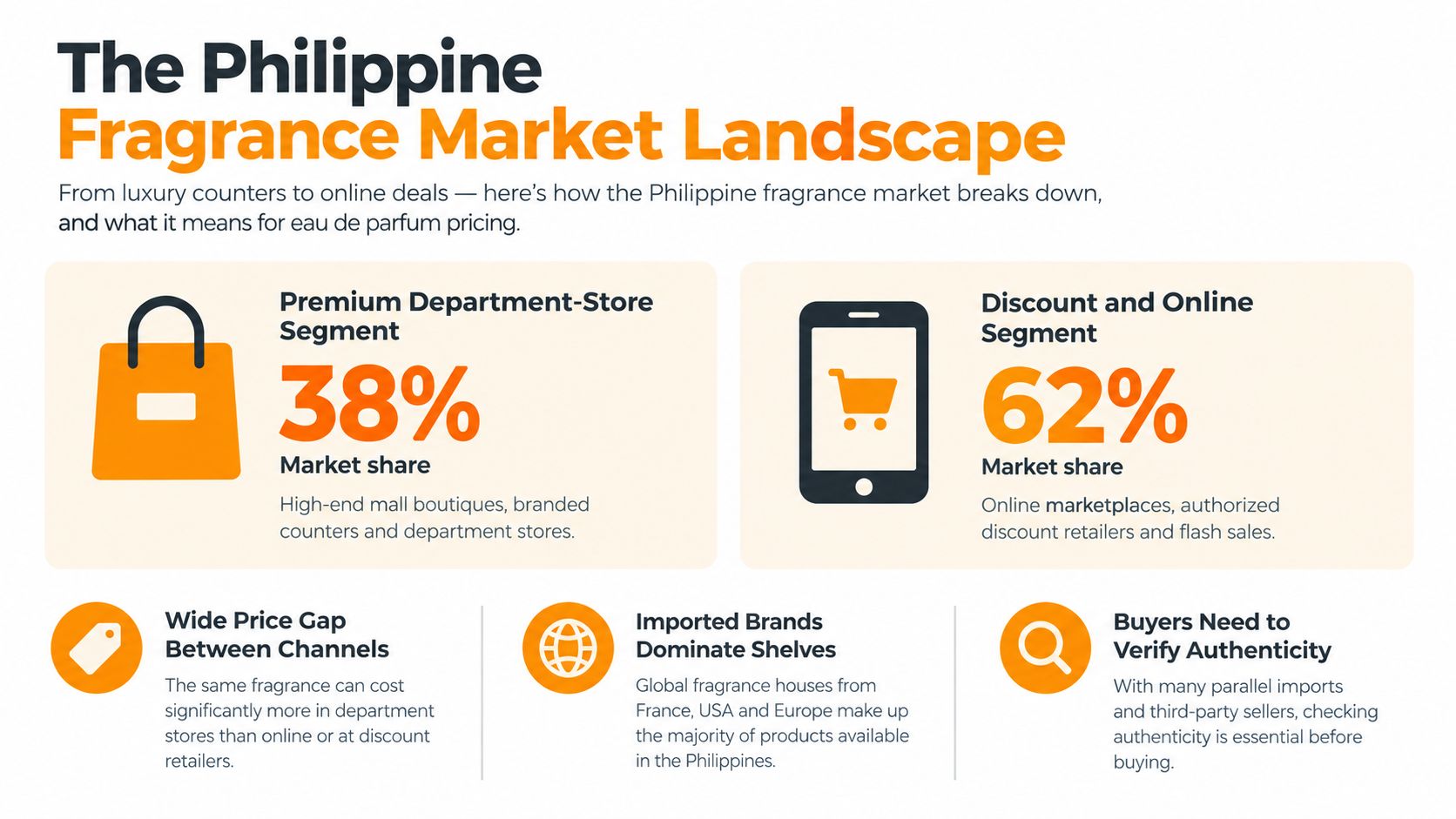
Mass market still dominates, premium still grows
That split matters. It means a lot of buyers are still shopping with a tight budget, but it also shows there's room for premiumisation and for bottles that justify a higher price through concentration, longevity, and gifting value. In other words, the market has space for both a practical daily scent and a more expensive bottle that feels like an upgrade.
This is why middle-ground pricing is so crowded. Typical masstige EDP and EDT prices around PHP 1,500 to 3,000 fit the accessible side of the market, while prestige designer and niche fragrances around PHP 5,000 to 12,000 or more sit in a very different comparison set. Those bands give Philippine buyers a useful benchmark for Middle Eastern EDPs, especially when a bottle starts competing on performance instead of logo value. The range is broad because buyer expectations are broad.
Buying behaviour is not just about women's scents
Female fragrances represented 49% of the 2025 market in the same market estimate, which is a reminder that pricing isn't a women-only topic or a men-only topic. It cuts across both assortments because the central question is still the same: what feels worth paying for? If a scent is strong, wearable, and giftable, shoppers across segments will consider it.
For more context on how Middle Eastern bottles fit into local buying habits, the store's own Middle Eastern perfume guide is worth a look. The point is not that every imported scent should be expensive, but that value in the Philippines is judged against a local price ladder, not against an overseas sticker alone.
Import Taxes and Landed Cost Realities
Imported fragrance prices in the Philippines don't start and end with the foreign retail tag. Perfumes and toilet waters, whether locally made or imported, are subject to a 20% excise tax. For locally manufactured products, the tax base uses the wholesale price net of excise tax and VAT. For imported products, the tax base uses the import value determined by the Bureau of Customs, also net of excise tax and VAT. Philippine excise tax guidance
The landed cost stack is the real price
That tax setup means the final retail price is built in layers. Start with the customs-assessed import value, then add excise, then VAT, then distributor and retailer margins, then logistics and local handling. A bottle that looks cheap overseas can land in Manila at a very different peso price once every layer is added.
The practical lesson is blunt. Don't compare foreign sticker prices to local mall prices as if they're the same thing. They're not. If you want to understand why some EDPs look expensive in PHP, you have to model landed cost, not just conversion.
Why discounts need margin discipline
A discount only helps if it doesn't wipe out the margin you already paid through taxes and fulfilment. Since the excise layer comes first, a markdown doesn't undo the earlier tax burden. That's why serious sellers watch contribution margin, not just tag price.
Lattafa Yara Elixir is a good example of how a 100ML Middle Eastern EDP can be positioned as a full-size bottle with a distinct scent profile, but its final Philippine price still depends on import structure, not just brand origin. That's the point buyers should remember. A well-priced imported bottle is one that has already survived the tax stack and still makes sense in pesos.
For sellers and buyers who want the shipment side explained clearly, the shipping guide for the Philippines is a practical reference.
Designer Labels Versus Middle Eastern Houses
A designer bottle often carries more than scent. You're paying for brand equity, global marketing, packaging polish, and the prestige tax that comes with a familiar logo. Middle Eastern houses usually ask you to pay for the smell first, and that's why they can look like sharper buys for people who care more about performance than status.
| Feature | Western Designer EDP | Middle Eastern EDP |
|---|---|---|
| Price logic | Includes brand premium, campaign costs, and prestige positioning | Focuses more on scent profile and bottle value |
| Buyer appeal | Familiar, giftable, status-driven | Value-led, performance-led, discovery-friendly |
| Scent style | Often built for broad global taste | Often richer, denser, more assertive |
| Tropical wear | Can work well, but some styles feel softer | Often better suited to heat when the formula is strong |
| Value perception | Higher markup is normal | Better chance of feeling over-delivered for the peso |
What you're really paying for
Designer pricing makes sense if the label matters to you. If the bottle is a gift, or you want the name on the dresser, that premium is part of the purchase. But if your main goal is to smell good for longer, the logo is often the least useful part of the product.
Middle Eastern houses like Lattafa, Afnan, and Rasasi tend to attract buyers who want density, warmth, and stronger presence without walking into prestige pricing. That's especially useful in Metro Manila, where a fragrance needs enough backbone to survive heat, transport, and a full workday. The better bottle is the one you'll keep reaching for.
Why “inspired” doesn't automatically mean lower quality
An inspired fragrance is not automatically a compromise. If the structure is well made, it can give you a familiar scent direction at a much saner peso cost. The key is buying from a shop that discloses origin, brand, and fulfillment details properly, because the scent can be good while the sourcing still needs verification.
A local buyer should be practical. If a Middle Eastern EDP gives you stronger wear, better value, and less regret than a designer bottle, the designer label loses the comparison. You're not collecting logos, you're building a usable wardrobe.
Calculating Your Cost Per Wear
Bottle size changes value fast. A PHP 1,500 50 mL EDP costs PHP 30 per mL, while a PHP 2,000 100 mL EDP costs PHP 20 per mL. The larger bottle is 33.3% cheaper per millilitre even though it costs more at checkout. DTI pricing rules
Build the number the right way
Cost per wear starts with three things, bottle size, sprays used, and how often you wear it. If a bottle sits on the shelf because it feels too precious to use, the per-wear value is poor no matter how nice it smells. A bottle you use regularly always beats a “special” bottle you barely open.
For practical shopping, use a simple mental formula. Divide the total price by the number of wears you expect, then think about how many sprays you need per wear. A stronger scent that needs fewer sprays can save more than a cheaper bottle that demands constant top-ups.
Useful rule of thumb: the bottle that lasts longer on your skin can be the cheaper bottle in real life.
Match the bottle to the occasion
Office wear should be calm and repeatable. Outdoor commuting needs something that can survive heat without collapsing. Evening wear can handle richer profiles, which is where many Middle Eastern EDPs make more sense than lighter, cheaper alternatives.
For shoppers comparing online listings, DTI rules require the consumer-product price per unit in Philippine pesos and centavos, including VAT and other charges, plus the brand, product description, and net quantity. That's not just legal housekeeping, it's how you stop yourself from comparing a 50 mL bottle with a 100 mL bottle as if they were the same deal. Use the label, the volume, and the price together, then decide.
Navigating Online Channels and Authenticity
Online fragrance shopping in the Philippines is convenient, but convenience alone does not make a listing worth paying for. Care-products e-commerce generated an estimated US$1.978 billion in 2025 and grew 15–20% year over year, while beauty and personal care made up 14% of Shopee GMV in FY2025, down from 17% in FY2023 as TikTok Shop's live-selling model pulled some purchases elsewhere. Philippine care-products e-commerce data

What to check before you pay
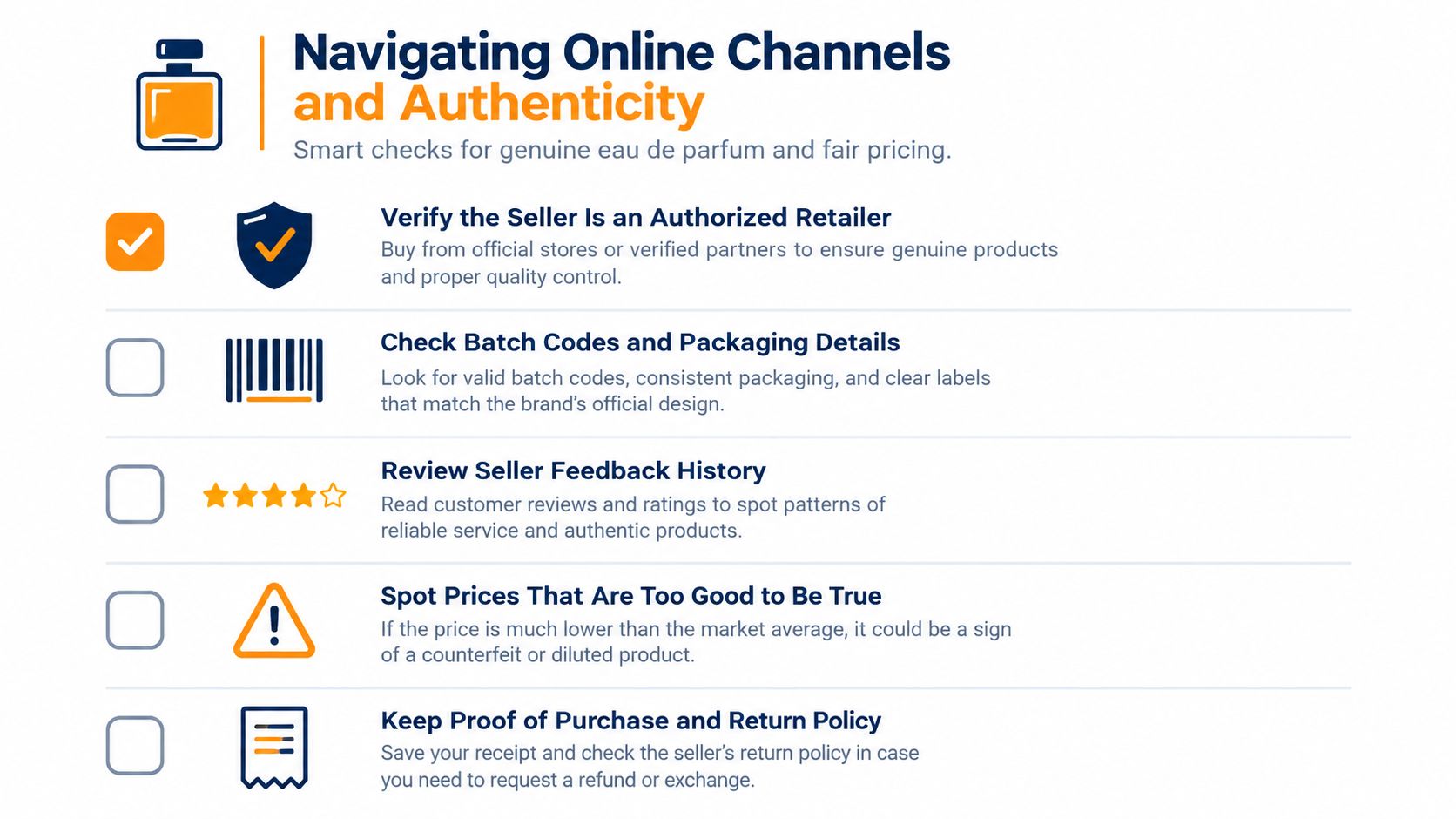
A lower listing price is not automatically the better deal. Check the seller, the fulfillment location, the return terms, and whether the listing gives clear product identity details. If the price sits far below the normal local range, ask why before you buy.
Use a tight checklist:
- Seller identity: confirm the store name, location, and contact details are visible.
- Product proof: inspect batch details, packaging photos, and the stated origin.
- Return policy: read what happens if the item arrives damaged or suspicious.
- Delivery cost: compare shipping and handling, not just the item price.
- Proof of purchase: keep the order record in case you need to verify legitimacy later.
Local fulfilment can still be the cheaper choice
A Makati-based domestic seller can list higher than an overseas shop and still be the smarter purchase. You may pay more at checkout, but you avoid shipping uncertainty, long waits, and the risk of getting stuck with no easy recourse if the bottle looks off. That matters when you are buying a gift or a daily signature.
Rasasi Hawas Ice is listed as a 100ML EDP, and that kind of local detail helps buyers compare style without guessing. The main goal is not chasing the lowest number on the screen. It is choosing the listing that gives you the clearest path from checkout to actual wear.
Building a Versatile Fragrance Wardrobe
A smart fragrance wardrobe doesn't need ten bottles. It needs the right bottles for the way you live. In Metro Manila, that usually means one scent that stays fresh in daytime heat, one that feels polished in an office, and one richer bottle for dinners, events, or colder spaces with air-conditioning.
A practical mix might look like this. Use a brighter scent for errands and commuting, a smoother woody or amber style for work, and a sweeter or denser EDP for nights out. That setup gives you range without forcing you to overspend on one prestige bottle that does only one job.
If you want the honest version, that's the whole game. Buy for wear frequency, not for fantasy. Buy for performance, not for packaging. Buy for the climate you really live in, not the one shown in the ad.
If you want a tighter way to shop Middle Eastern EDPs in the Philippines, browse the selection at Dubai Fragrance Shop PH. You'll find locally fulfilled options, clear PHP pricing, and bottles that make more sense when you judge them by cost per wear instead of sticker shock.