

Can I Carry Perfume on Plane: Philippines Travel Guide 2026
Yes, you can carry perfume on plane, but containers must not exceed 100ml in carry-on, and all liquids must fit in one transparent 1-liter bag at Philippine airports. A larger bottle may travel in checked baggage, but a partly empty bottle still counts according to the bottle's full capacity.
You've just bought a beautiful Middle Eastern eau de parfum in Makati, perhaps a 100ml Lattafa bottle, or picked up a smaller scent at the duty-free shop before your flight from NAIA. The box is safely in your hand, the fragrance is a gift or a personal favourite, and then the question comes up at security: can I carry perfume on plane travel without losing it at the checkpoint?
For Filipino fragrance buyers, this confusion is especially common because Middle Eastern EDPs often come in full-size bottles, while airport security focuses on how the container is packaged. The good news is that perfume isn't automatically prohibited. You need to match the bottle size and packing method to whether it's travelling in your cabin bag or checked luggage.
Table of Contents
- Understanding the Scenario and Why This Matters
- Philippine Airport Security Rules for Perfume
- Carry-On Versus Checked Baggage Strategies
- Practical Packing Techniques That Work
- Regional and Airline Nuances to Consider
- Common Misconceptions About Partially Filled Bottles
- Your Quick Reference Checklist
Understanding the Scenario and Why This Matters
A traveller buying a 100ml Lattafa Ameerat Al Arab Red from a fragrance shop in Makati may reasonably assume the bottle is safe in hand-carry baggage. A 50ml Maison Alhambra Delilah Blanc seems even easier to manage. But a 150ml bottle containing only a small amount of fragrance can create a problem because airport officers assess the container's capacity, not only the liquid visible inside.
That distinction matters when you're shopping for Middle Eastern perfumes. Many bottles have substantial packaging, decorative designs, and sizes selected for value at home rather than convenience during air travel. The bottle may look nearly empty after regular use, yet its printed or stated capacity remains above the cabin limit.
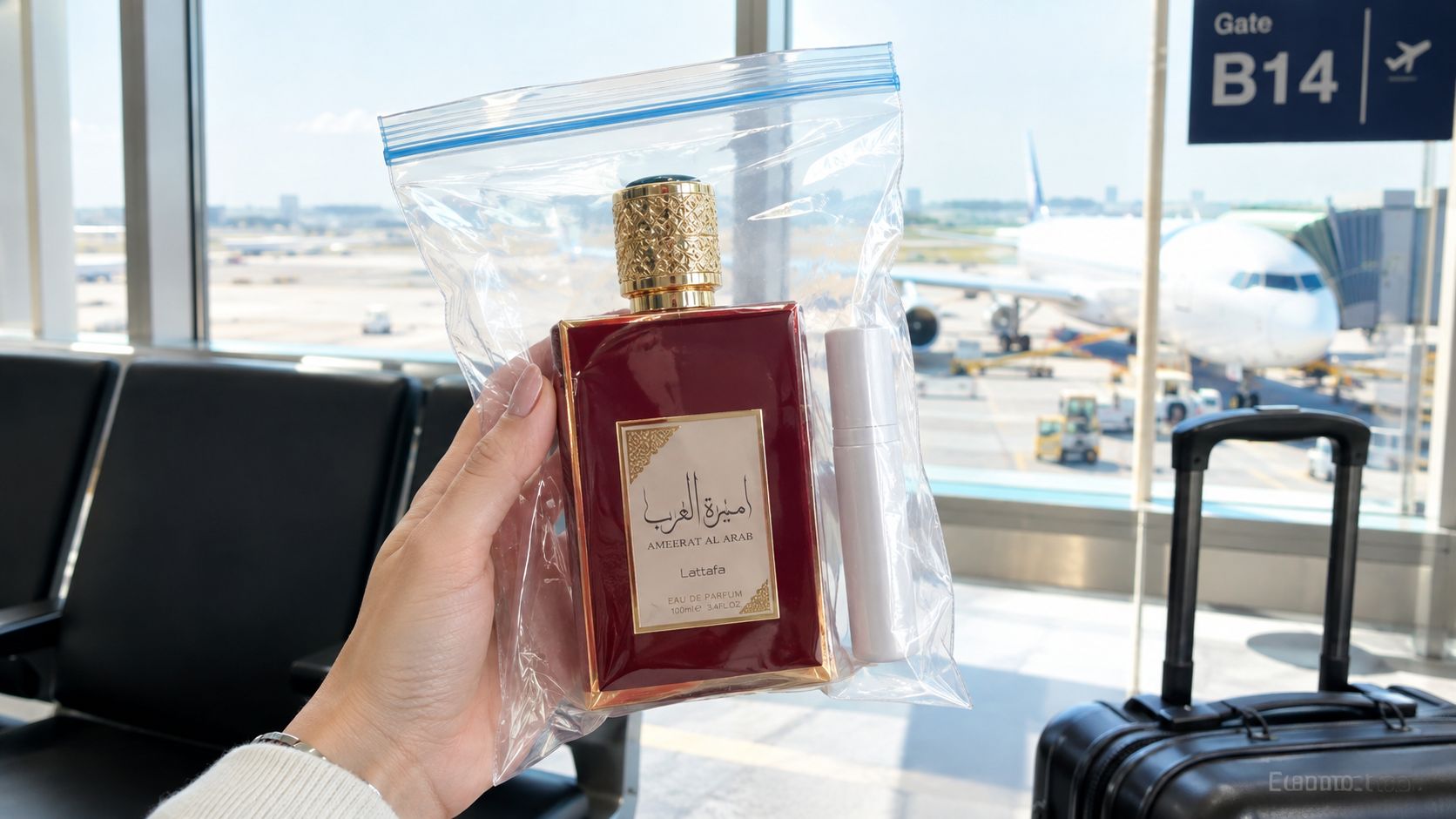
The question Filipino shoppers need to ask
Before leaving for the airport, check three things:
- Bottle capacity: Is the individual container 100ml or smaller?
- Liquid bag: Can it fit comfortably with your other liquids in the required transparent, resealable bag?
- Baggage choice: Should it stay with you in the cabin, or should it be protected inside checked luggage?
A 50ml bottle can generally go in your carry-on when packed correctly. A 100ml bottle is at the maximum individual limit, so it must also fit in the liquid bag. A 150ml bottle belongs in checked baggage unless a specific duty-free procedure and screening arrangement applies.
Practical rule: Treat the bottle's labelled capacity like the size of a container at a restaurant. Security checks the container you're bringing, not how much remains in it.
The safest habit is to decide before you shop or pack. If you're buying a full-size fragrance as a pasalubong, ask yourself whether you'll have checked baggage available. If not, choose a travel-sized bottle or a compliant atomiser instead of relying on the liquid level.
Philippine Airport Security Rules for Perfume
Philippine airport screening treats perfume the same way it treats other liquids, aerosols, and gels. Under the Office for Transportation Security's prohibited-items guidance, perfumes and sprays in cabin baggage must be in containers no larger than 100 millilitres each. The key point is the bottle's stated capacity, not how much juice is left inside.
That matters a lot for Filipino buyers who like full-size Middle Eastern EDPs. A 50ml bottle usually fits the cabin rule without trouble. A 100ml bottle sits right at the limit. A 150ml bottle is still treated as a 150ml container even if you used half of it before your flight. Airport security reads the container like a measuring cup label. The printed size is what counts.
Your allowed liquid containers also need to go into one transparent, resealable plastic bag. That bag may measure no more than 20 × 20 centimetres or 25 × 15 centimetres, and the total bag capacity must not exceed 1 litre. It also has to close properly, with all your qualifying liquid items inside, and each passenger gets only one bag.
Read the rule in the right order
- Start with the bottle size. A 50ml perfume qualifies by container size. A 100ml perfume also qualifies. A 150ml bottle does not qualify for cabin baggage, even when partly used.
- Then check the liquid bag. Perfume shares space with your other liquid items, so everything must fit inside the single transparent bag.
- Keep it ready for screening. Place the bag where you can remove it quickly if security asks to inspect your liquids.
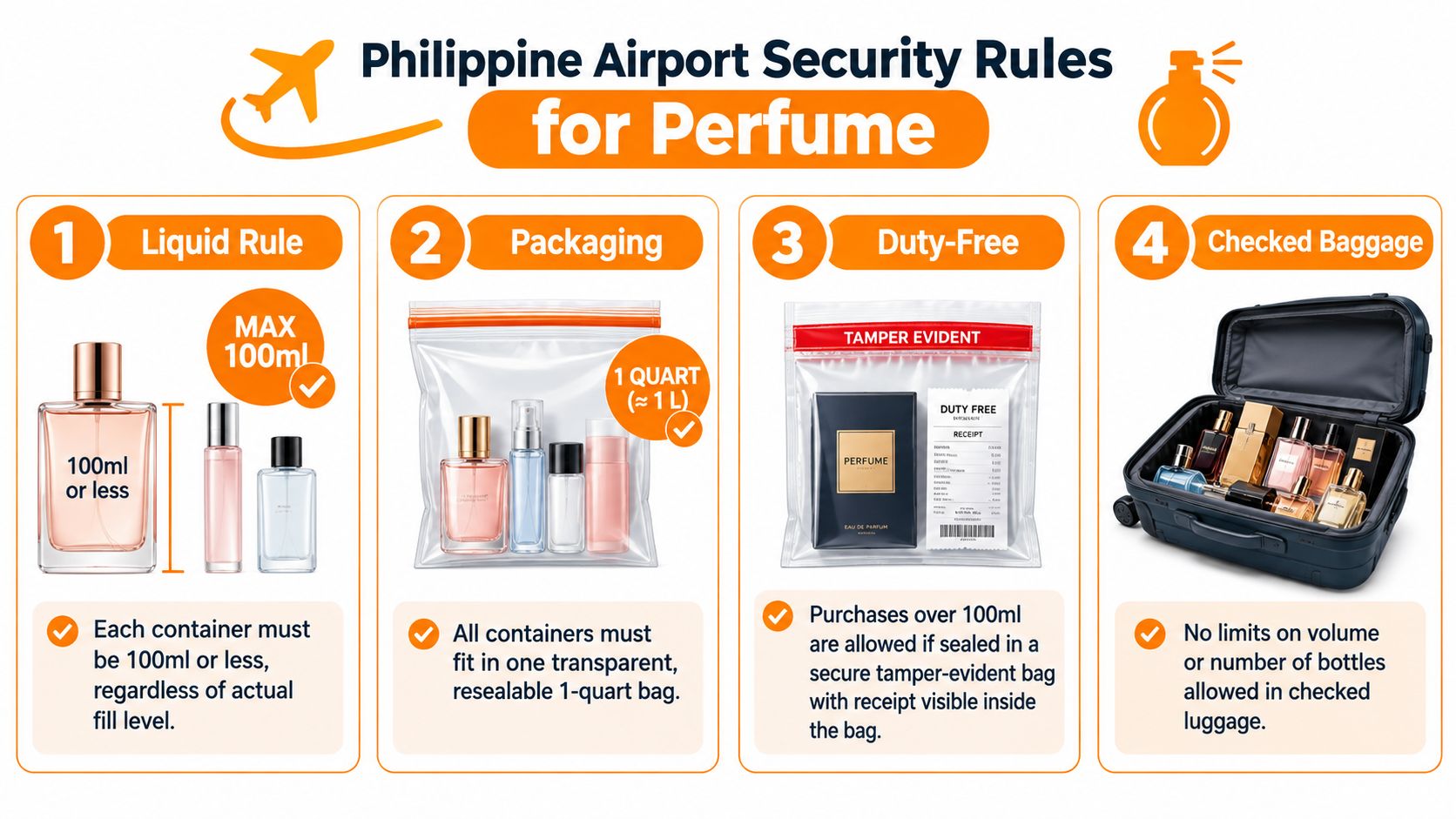
The easiest way to remember this is by separating the limits. 100ml applies to each bottle. 1 litre applies to the whole plastic bag. You need to match the bottle size and packing method to whether it's travelling in your cabin bag or checked luggage.
Carry-On Versus Checked Baggage Strategies
The right baggage choice depends mainly on the bottle size and how much handling you're prepared to manage. Carry-on baggage keeps the perfume with you, but the bottle must meet the cabin-liquid requirements. Checked baggage gives you more flexibility for full-size bottles, but it requires stronger protection against leaks and breakage.
| Option | Container Size | Bag Requirement | Best For |
|---|---|---|---|
| Carry-on perfume | 50ml | One transparent, resealable liquid bag | Travel sizes and smaller EDPs |
| Carry-on perfume | 100ml | One transparent, resealable liquid bag | Bottles at the maximum cabin size |
| Checked perfume | 150ml | Secure protective packing inside checked luggage | Full-size Middle Eastern EDPs |
| Checked perfume | Larger full-size bottle | Secure protective packing inside checked luggage | Gifts and bottles intended for use at home |
A 50ml bottle is the simplest carry-on choice. It leaves more room in the liquid bag for other permitted items, though it still needs to be packed with care. A 100ml bottle is allowed by size but gives you no margin if the stated capacity is higher than 100ml.
A 150ml bottle should be placed in checked luggage rather than forced into the cabin bag. Pack it where clothing can cushion the glass, not against the suitcase edge. This is particularly sensible for ornate Middle Eastern bottles, which may have heavy caps or unusual shapes that make them awkward to protect in a small liquid bag.
Choose before you reach the airport
If you're travelling with only cabin baggage, select a miniature, sample, decant, or compact EDP that meets the individual limit. If you've bought a 150ml bottle, organise checked baggage before leaving for the airport.
The easiest airport decision is made at home: small bottle in the liquid bag, large bottle in protected checked luggage.
For a checked bottle, close the sprayer firmly and place the fragrance inside a sealed plastic bag. Then cushion it with clothing. The goal is not just compliance. It's preventing a broken bottle from turning your luggage into a scented, stained mess.
Practical Packing Techniques That Work
Good packing protects both the fragrance and your travel plans. Start with the sprayer and cap. Make sure the atomiser is seated securely, the cap is fully attached, and the bottle doesn't move freely inside its box.
For checked luggage, use a simple containment system:
- Secure the bottle. Press the cap or atomiser into place and check that it doesn't wobble.
- Add a first barrier. Wrap the bottle in plastic wrap or place it in a sealed bag.
- Create cushioning. Surround it with soft clothing rather than leaving it against a hard suitcase wall.
- Keep it central. Place the protected bottle between clothes, where it has less exposure to impact.
- Separate fragile pieces. If the cap or decorative cover is removable, cushion it so it won't strike the glass.
For carry-on luggage, place the bottle upright inside the transparent resealable bag where possible. Don't overfill the bag. It must close completely, and the contents should fit comfortably rather than being forced into position.
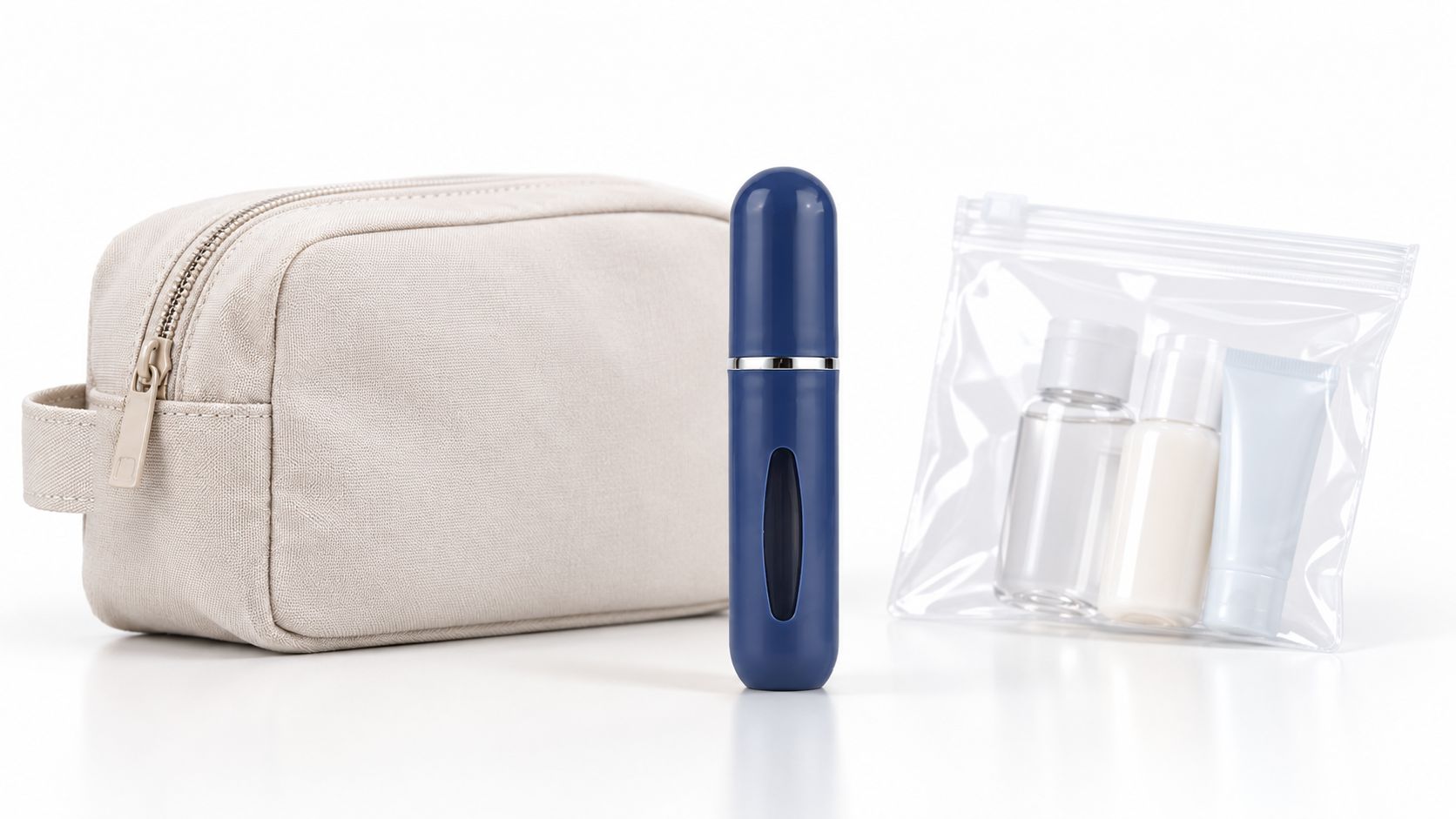
A small travel atomiser can be useful when you don't need to bring the original bottle. The Free Gift Travel Spray Atomizer 5ML is listed with eight variants across its options, although the catalogue snapshot doesn't provide a short description or confirm availability. You can also learn more about perfume sample bottles before deciding how to carry a scent.
Duty-free needs separate attention
Perfume bought after security may be handled through a sealed security bag supplied by the retailer. Keep the receipt visible inside that bag and don't open the seal before completing your journey. However, a connecting airport may apply its own screening process, so a duty-free purchase above the cabin limit can still require extra care during transit.
When in doubt, ask the duty-free shop how the purchase is sealed and check the rules for every airport where you'll be screened. A retailer's bag can support the process, but it doesn't remove the need to follow the next checkpoint's instructions.
Regional and Airline Nuances to Consider
Philippine airport security rules provide the starting point, but your whole itinerary may involve more than one screening environment. A direct departure from a Philippine airport is different from a journey where you transfer through another country, collect your luggage, and pass through security again.
The operating airline may also publish requirements that sit alongside airport-security rules. Check the airline named on the relevant flight segment, not only the airline that sold the ticket. This matters for travellers using different carriers on the same booking or changing airlines during a regional journey.
Build a route-specific check
Before flying, confirm:
- Departure airport: Review the current liquid-screening instructions for the airport where you'll enter security.
- Operating carrier: Check the baggage and restricted-items guidance for the airline operating your flight.
- Connection airport: Find out whether you'll be screened again during the transfer.
- Duty-free handling: Keep any sealed bag and receipt intact until you reach your final destination.
- Checked-bag access: Know whether you can place a larger purchase in checked luggage before another security checkpoint.
A sealed duty-free bag may be accepted at one airport and examined differently at another. If your route includes a transfer, don't assume that the first airport's decision guarantees the second checkpoint's decision.
Route thinking prevents surprises: the strictest checkpoint on your journey may determine how you should pack.
Travellers bringing fragrances home from abroad should also review any applicable Philippine arrival and import requirements, including guidance from relevant government agencies. For shoppers comparing delivery and purchase options rather than carrying bottles through multiple airports, information about shipping to the Philippines may help you plan before buying.
The practical lesson is simple. Check the entire route, protect receipts, and treat airport-specific instructions as more important than assumptions based on a previous flight.
Common Misconceptions About Partially Filled Bottles
The most persistent misunderstanding is that a partly empty perfume bottle becomes acceptable once the remaining liquid drops below 100ml. That isn't how the rule works.
Philippine Airlines' restricted-items guidance explains that container capacity controls the decision. A 150ml bottle containing 50ml of perfume is still a 150ml container, so it doesn't meet the cabin requirement.
Three bottles, three outcomes
- 50ml bottle with 50ml inside: Generally suitable for carry-on when packed in the required liquid bag.
- 100ml bottle with 50ml inside: Still within the individual container limit, provided it fits in the transparent resealable bag.
- 150ml bottle with 50ml inside: Not suitable for carry-on because the bottle's capacity exceeds the permitted maximum.
The bottle is treated like a measuring cup. Pouring out some of the contents doesn't change the size printed on the cup. Security officers need a clear, consistent rule that can be checked quickly, so they assess the container rather than estimating the remaining level.
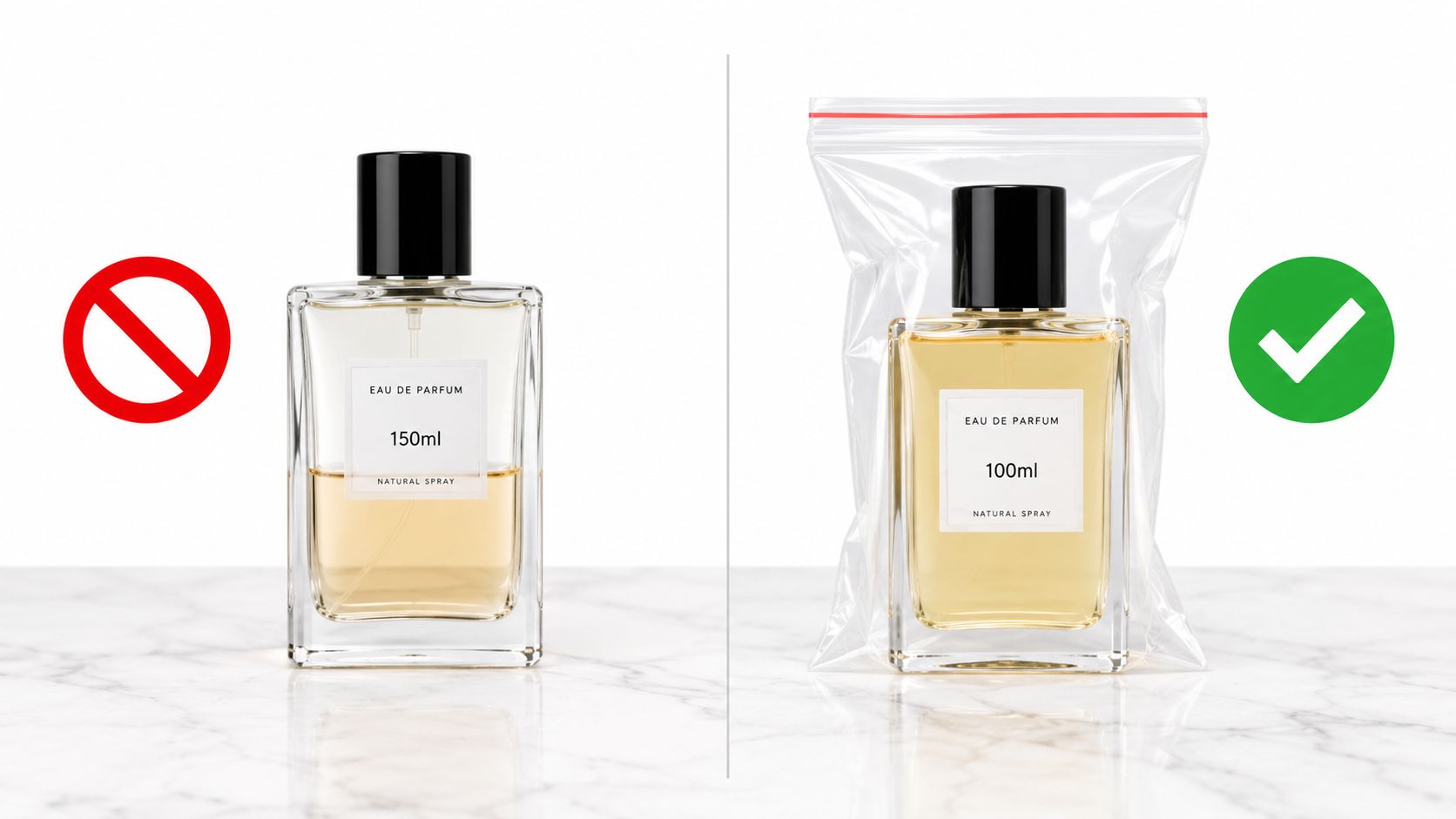
Decanting changes the container
If you want a fragrance from a 150ml bottle in the cabin, transfer only the amount you need into a clearly suitable container that does not exceed the individual limit. The original bottle should then remain in checked baggage, provided it's packed securely.
Read about what decanting perfume means before transferring a scent. Use a clean, secure atomiser and label it sensibly so you can identify the fragrance later. Decanting can solve the container-size issue, but it doesn't remove the need to place the smaller container in the required liquid bag.
Your Quick Reference Checklist
A quick check at home can save a long conversation at the screening table, especially if your trip starts with a new full-size Middle Eastern EDP in your bag. A 50ml travel spray is usually the easy case. A 100ml bottle can also work in cabin baggage if it is packed properly. A 150ml full-size bottle belongs in checked baggage, even if you used only a little.
Before you leave, run through this list:
- Read the bottle, not the fill line: Check the printed container size before anything else.
- Do a bag test at home: Put your perfume together with your other liquids, then close the transparent resealable bag fully without forcing it.
- Keep one backup plan: If your cabin bag is already crowded with skincare or toiletries, move the fragrance to checked baggage instead of hoping it will fit at the airport.
- Choose the right bottle for the day: A 50ml Lattafa-style travel option is easier for short trips. A 100ml bottle suits cabin travel only if the rest of your liquids leave enough room. A 150ml bottle is better treated as checked luggage from the start.
- Prevent leaks before security: Tighten the cap, tape the sprayer if needed, and place the bottle in a small plastic pouch so one leak does not soak your clothes.
- Make screening easy: Place the liquid bag where you can remove it quickly, not under shoes, chargers, or pasalubong.
- Protect shop purchases: Keep duty-free receipts handy and leave sealed airport retail packaging unopened during the journey.
- Check your route again the night before: Connection airports and airlines may apply rules a little differently.
Dubai Fragrance Shop PH offers Middle Eastern fragrances from houses including Lattafa, Afnan, Armaf, Rasasi, Arabiyat, Rayhaan, and French Avenue, with online ordering and nationwide Philippine fulfilment. If you're choosing a travel-friendly size or a full bottle for checked luggage, visit Dubai Fragrance Shop PH and review the product details before your next trip.