

Bath and Body Perfume: What It Is and How to Wear It
Two bottles sit in your cart. One says eau de parfum, the other says body mist. A third is a scented lotion that promises to layer with both. You want the one that will still be detectable at 4pm in Metro Manila heat, without smelling like you bathed in it.
The confusion is fair. The words on the front of a fragrance bottle describe concentration and format, not quality. A light mist and a heavy extrait can both smell excellent. They behave differently on skin, in humidity, and over a long working day.
So treat bath and body perfume as a system rather than a single bottle. Decide the format, understand what your climate does to it, then check the label. Everything after that gets easier.
Table of Contents
- What Bath and Body Perfume Really Means
- How It Compares to EDP, EDT and Body Mists
- What Shapes Longevity and Ingredients
- How to Apply and Layer Bath and Body Perfume
- Middle Eastern Scents and Who They Suit
- Checking Labels and Buying Safely
- Pick Your First Bath and Body Perfume
What Bath and Body Perfume Really Means
Bath and body perfume is the everyday name for the lighter scented sprays, mists and body fragrances sold alongside shower gels, body washes and body lotions. It's built to be worn through an ordinary day, not saved for an occasion.
A traditional eau de parfum behaves like a structured blazer. You reach for it on days that matter, you use it sparingly, and it holds its shape for hours. Bath and body perfume is the soft cotton shirt you grab every morning. Same idea, less fabric, softer structure, and you don't think twice about wearing it to buy groceries.
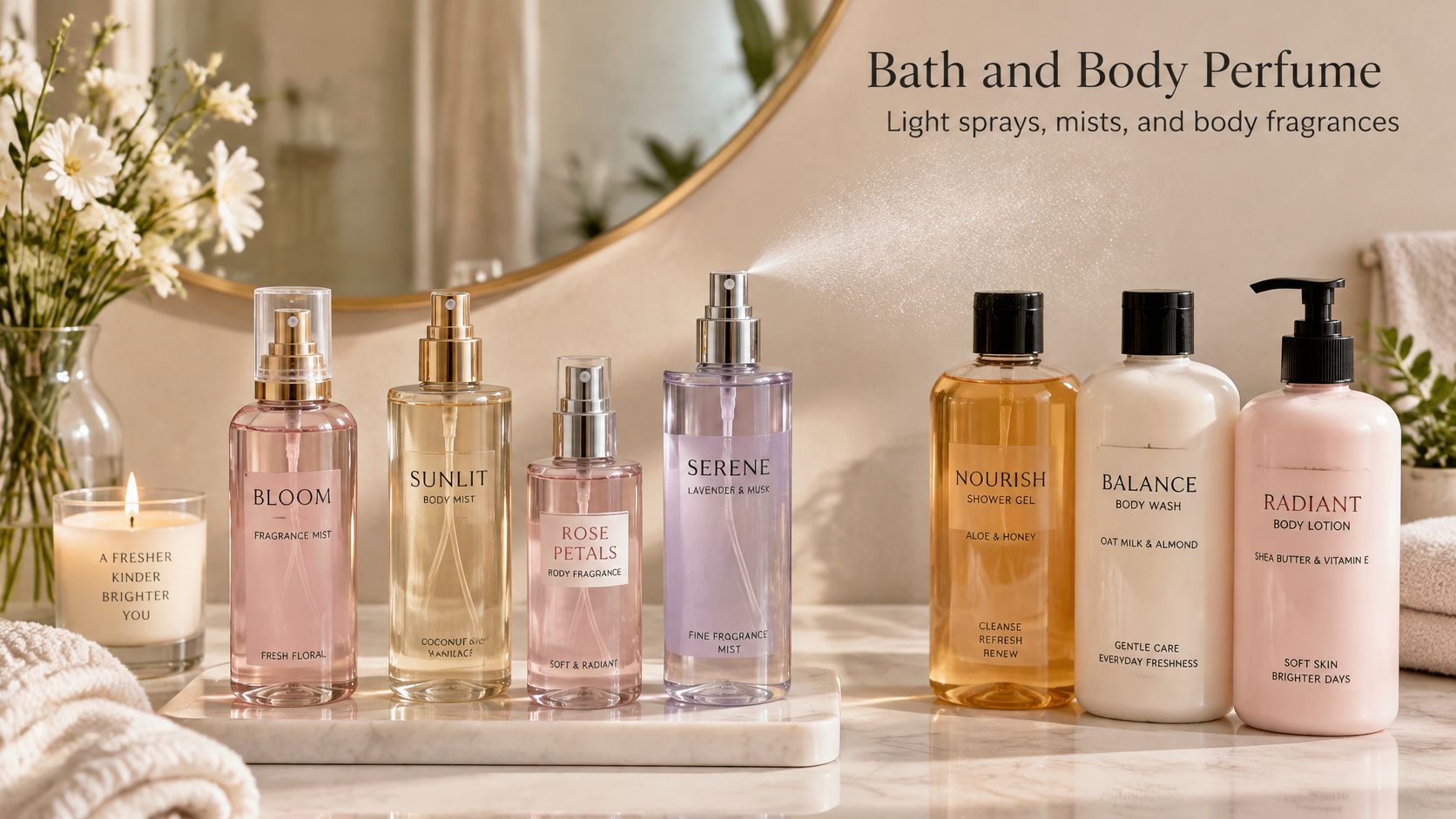
Three features usually separate it from a classic perfume bottle:
- A lighter fragrance concentration: less fragrance oil in the liquid, so it sits closer to the skin and needs a top-up later in the day.
- Smaller, more affordable bottles: sized for daily use, which is why you see so many 50ml to 100ml sprays and matching lotions on the same shelf.
- Designed to layer: the matching body wash and lotion in the same range exist so the scent builds in stages rather than arriving in one blast.
The label decides everything. One brand's bath and body perfume is an alcohol spray. Another's is a fragrance oil. Another sells a scented lotion and calls the whole line bath and body. Compare those three by advertised longevity and you'll get a misleading answer, because a lotion and a fine fragrance spray don't behave the same way in warm air.
Practical takeaway: read the format line before anything else. A mist, an eau de parfum and a scented lotion can share a scent name and still wear completely differently.
How It Compares to EDP, EDT and Body Mists
Fragrance formats are sorted by concentration, meaning how much fragrance oil sits in the liquid. Higher concentration usually means slower evaporation and a longer stay.
| Format | Typical fragrance concentration | Typical longevity on skin | Best use |
|---|---|---|---|
| Parfum or extrait | 20-30% | 8 hours or more | Evenings and special occasions |
| Eau de parfum (EDP) | 15-20% | 6-8 hours | Daily wear and dressy days |
| Eau de toilette (EDT) | 5-15% | 3-5 hours | Warm weather and office days |
| Eau de cologne (EDC) | 2-5% | 1-2 hours | Quick refresh during the day |
| Body mist | 1-3% | 1-3 hours | Light all-day refresh and layering |
| Bath and body perfume | Set by the format on the label | 2-5 hours, longer when layered | Everyday wear and layering with matching body products |
Read it from the top down. Parfum or extrait carries the most oil at roughly 20-30%, so a small amount on the wrists and throat can run 8 hours or more. That's why it's an occasion purchase rather than a daily habit. Eau de parfum sits at 15-20% with 6-8 hours of typical wear, the workhorse concentration commonly meant when people say perfume. Eau de toilette drops to 5-15% and 3-5 hours, which suits hot afternoons and shared offices where a strong trail becomes a nuisance.
Below that, eau de cologne at 2-5% gives you 1-2 hours, a refresh rather than a wear. Body mist at 1-3% is lighter still, 1-3 hours, and is the format many picture when they hear bath and body spray.
Bath and body perfume doesn't sit at a fixed point on that scale. The term describes a product family, not a concentration. A mist and an eau de parfum from the same line are both sold under the same bath and body label, and only the packaging tells you which one is in your hand.
Treat those numbers as typical values rather than promises. They describe a scent on an average wearer in mild conditions, so a humid afternoon outdoors in Metro Manila will shorten them and a cool air-conditioned office will stretch them.
How to choose: go lighter for the office, the gym and daytime layering, and step up a concentration for evenings or any day that runs past eight hours.
The last variable is you. Two people wearing the same bottle can report very different wear times, and that gap comes from skin, climate, carrier and notes.
What Shapes Longevity and Ingredients
Concentration sets the ceiling for how long a scent can last, but it never guarantees the result. Four variables decide where you land under that ceiling, and you control three of them.
Skin, climate, carrier and notes
Skin moisture. Dry skin releases fragrance faster than moisturised skin, while oilier skin holds it longer. If scent disappears on you by lunch, a plain unscented lotion applied first often does more than switching bottles.
Heat and humidity. Warm air speeds evaporation, so the same spray behaves like two different products across one day. A composition that carries you through a cool morning can fade within a few hours once the afternoon heat peaks. That gap is the main reason people over-spray and then blame the fragrance.
The carrier. Alcohol-based sprays flash off quickly and project loudly in the first hour. Oil-based fragrances sit closer to the skin and release more slowly, so they last longer with a smaller scent cloud. This explanation of oil-based perfume covers the mechanics behind that difference.
The note pyramid. Citrus, bergamot and fresh herbs are the lightest molecules and leave first. Musk, amber, vanilla, woods and oud are heavier and stay longest, which is why a scent smells different at hour five than it did at minute one.
A fragrance that seems to vanish hasn't necessarily failed. It may have settled into its base notes, which sit close to the skin and resurface when you move.
Reading the ingredient panel
Ingredients are declared either by chemical name or grouped under the word Fragrance with a CAS number, and known allergens may appear separately, as the FDA's guidance on fragrances and colourants sets out. Safety documentation for those materials belongs in the product information file that the responsible company keeps.
A shorter list doesn't automatically mean a safer one. Regulatory limits for fragrance materials differ by product category and format, so the same substance can sit within the allowed level in one product type and exceed it in another. The label's job is to show you what is inside, not to rank the formula.
That leaves two kinds of information worth separating. Performance claims are personal and climate-dependent, so treat them as estimates. Label details are fixed and checkable before you pay, which makes them the more reliable half of the decision.
How to Apply and Layer Bath and Body Perfume
How you apply changes the result more than the price tag does. Six steps, in order.
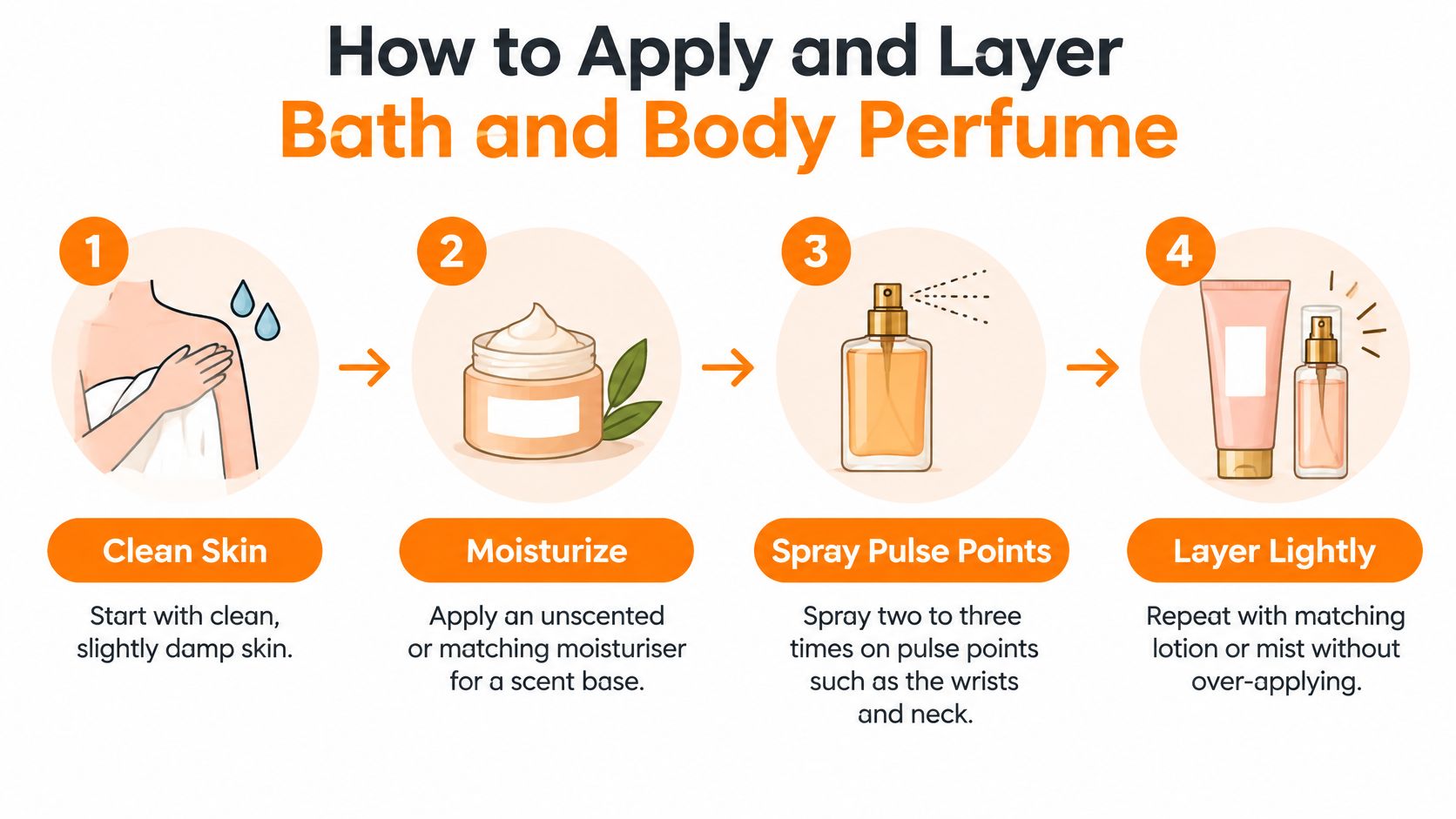
- Start on clean, slightly damp skin. Fragrance clings to moisture, so applying straight out of the shower gives it something to hold. On bone-dry skin the alcohol flashes off and takes the opening notes with it.
- Add a base layer of moisturiser. An unscented lotion, or the matching lotion from the same range, gives the spray a surface to sit on. Skip this and you're spraying onto a dry sponge.
- Spray two or three times on pulse points. Wrists, inner elbows and the base of the throat are warm spots where scent rises gently through the day. A fourth and fifth spray doesn't extend the wear, it just enlarges the cloud.
- Don't rub your wrists together. Friction heats the oils and flattens the top notes, which is why a scent can smell wrong two minutes after you applied it. Let it dry where it lands.
- Wait about 30 seconds before dressing. Alcohol and oils can mark light fabrics, particularly silk and pale cotton. A short pause prevents a stain that won't wash out.
- Reapply once, mid-day, on the same spots. One controlled re-spray at lunchtime beats a heavy morning application. The usual mistake is spraying again and again until two scents fight each other.
Layering is where bath and body perfume earns its place. A matching body wash, then lotion, then mist builds the same scent in three stages, and that combination outlasts any single spray. The rule that keeps it wearable is to layer one scent family across formats rather than two unrelated fragrances, which is how people end up with an afternoon cloud nobody wants to sit inside.
If you like a slow-release base, an attar perfume on one pulse point under a lighter spray gives you depth underneath and freshness on top.
Test before you commit
Spray once on one wrist, wear it for six hours without topping up, and judge the drydown before buying a full bottle. The first fifteen minutes are the least useful part of that test, because it's the phase nearly every fragrance handles well.
A word on reactions. Redness or irritation after using a fragrance isn't normal. Stop using the product and seek medical advice if it appears.
Middle Eastern Scents and Who They Suit
The Middle Eastern shelf can feel like a big jump from a body mist. It isn't, if you start with the family that already matches what you reach for.
Fragrance has deep roots here. Ylang-ylang oil from the Philippines was regarded as among the world's best in the late nineteenth and early twentieth centuries, and the country was once called the "Queen of Perfumes in the Orient", according to a history of the Philippine bath products market. A documented milestone for the local industry came in 1926, and observers have since discussed marking a centennial in 2026.
Demand for imported scent keeps growing on top of that base. The Philippines fragrance and perfume import market grew 14.27% from 2023 to 2024, according to 6Wresearch's fragrance and perfume market report.
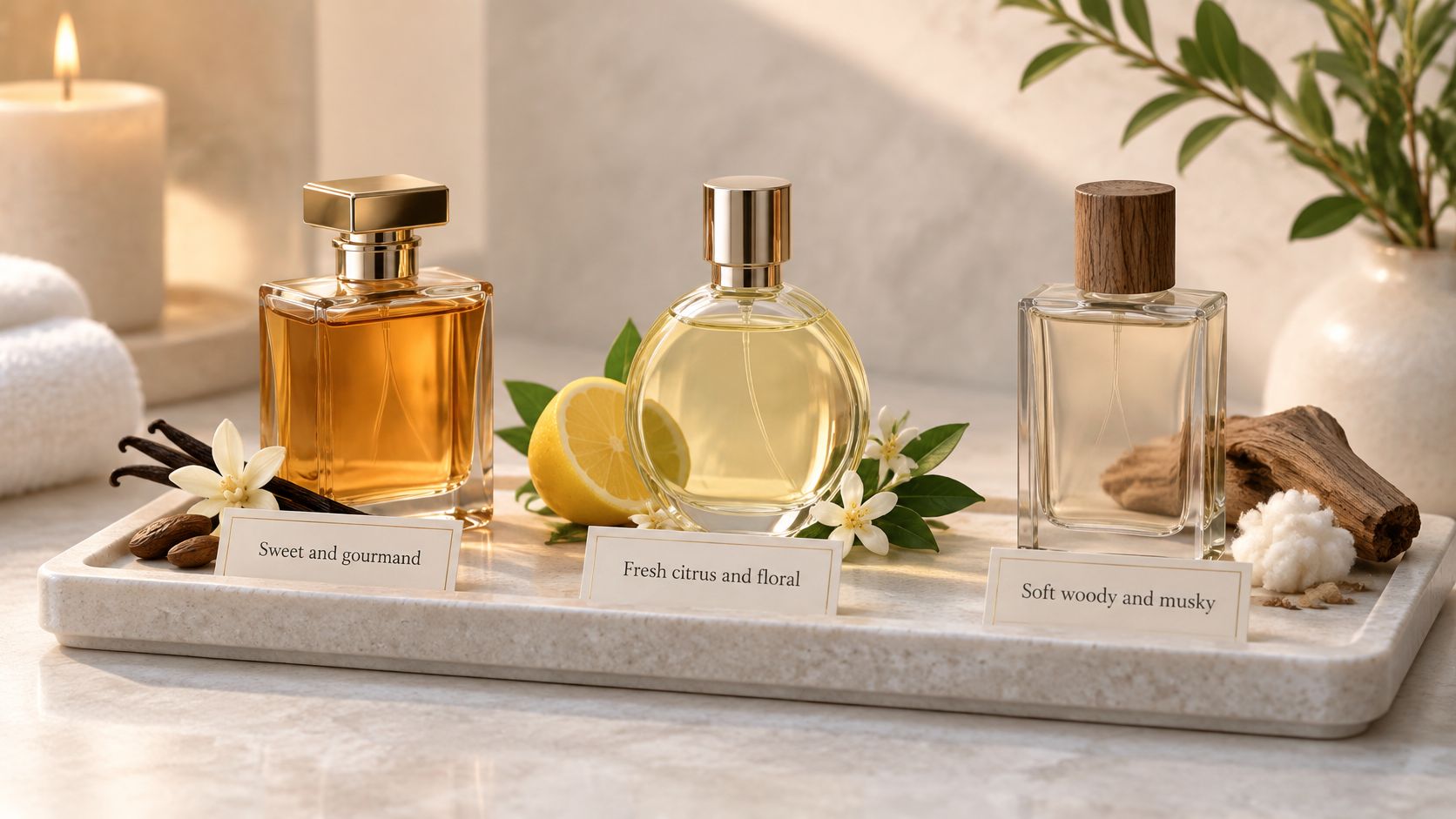
Sweet, gourmand and warm
Vanilla, amber and tonka sit at the base of most gourmand compositions. They suit cooler evenings, air-conditioned rooms, and anyone who likes catching their own scent on a scarf hours later. In Manila heat, apply less than you think you need, because warmth amplifies sweetness fast and two sprays can read as four by mid-afternoon.
Oud and incense
Oud, incense and smoky woods are the deepest family and the longest lasting. They suit someone who wants a signature rather than a mood, and they're best tested in small amounts first, since oud is the note people either love immediately or find medicinal. One spray on the wrist, worn for a full day, settles the question.
Fresh spice, citrus and rose
Citrus with cardamom, or rose with a green edge, performs best in heat and layers easily under a lighter mist. This is the gentlest bridge from a bath and body routine into Arabian perfumery, and the family most likely to survive a commute plus an afternoon outdoors.
A practical starting path: choose a lighter eau de parfum or a body mist from the house you're curious about, wear it over an unscented lotion for a week, then move to a heavier concentration once you know the scent works on your skin in this climate. An oil-based attar or extrait applied under a spray gives projection on top and depth underneath without doubling the strength.
Here's how those three families differ once they're on skin:
Checking Labels and Buying Safely
A fragrance wardrobe works like a small system: concentration decides strength, climate decides wear time, and the label decides whether a bottle deserves a place in that system. The bottle photo shows the packaging. The label shows what you are buying.
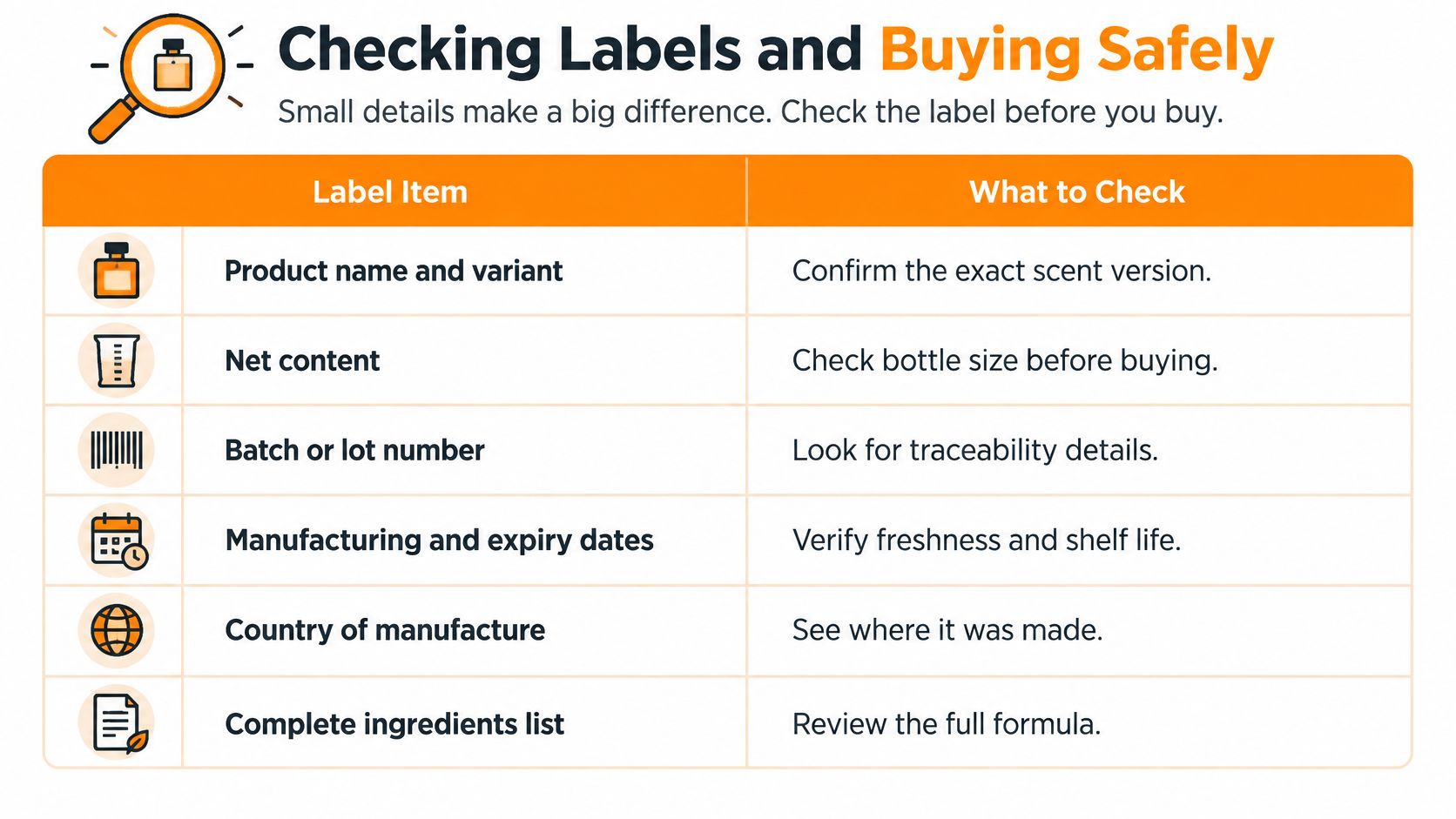
Seven items on the packaging carry most of the weight:
| Label item | Why it matters | Where to look |
|---|---|---|
| Product name and variant | Confirms whether it is an EDP, body mist or fragrance oil | Front label |
| Net content | Lets you compare price per millilitre fairly | Front or side label |
| Batch or lot number | Traces the bottle back to a supplier | Base or side of bottle and box |
| Manufacturing and expiry date | Shows freshness; citrus top notes fade fastest | Box or base |
| Country of manufacture | Shows where the product was made | Back label |
| Complete ingredient list | Shows fragrance declarations and listed allergens | Back label or box |
| Responsible company and FDA notification | Confirms a local party answers for the product | Back label or the seller's product page |
The checklist has a regulatory backbone. In the Philippines, bath and body perfumes are regulated as cosmetic products under the ASEAN Cosmetic Directive, administered locally through the FDA circular on Product Information Files for cosmetics. A product has to be notified before it goes on the market, and the responsible company keeps a Product Information File holding the technical, safety, quality and claims documentation.
What notification does and doesn't prove
A proof of transaction page shows commercial history. It isn't the same thing as an FDA notification, and it isn't a Product Information File. When you buy online, ask for the batch or lot number, the supplier details and the notification information. A seller who answers those questions quickly is showing you how they'll handle the rest of the order.
Because the FDA applies the directive to businesses that import, sell, offer for sale, distribute, advertise and promote cosmetics, marketing language has limits too. Claims should stay cosmetic, meaning fragrance, freshness or skin-conditioning benefits, and shouldn't imply treatment or prevention of disease.
Where to buy and what to weigh
Department stores, malls, pharmacies, brand boutiques and online shops all stock the category, and the sensible comparison is price per millilitre rather than bottle size. A 50ml at one price and a 100ml at another can look like a bargain until you divide.
Two things matter for online orders: delivery time to Metro Manila versus the provinces, and the return rule. Opened or used fragrances can't be returned for hygiene reasons, which is the strongest argument for testing on skin or buying a sample first. Purchases from Dubai Fragrance Shop PH are for your own personal or household use and not for commercial resale or export, which is worth knowing if you're buying gifts in bulk or stocking a shelf.
If a listing is priced far below every comparable bottle, checking how to tell fake from original perfume is a faster sanity check than counting reviews.
The sensitivity question
Words like natural, Arabian or alcohol-free don't guarantee that a product won't irritate your skin. Individual sensitivity and complete product documentation matter more than the marketing line, and the FDA's advisory on cosmetic products and adverse reactions is blunt on one point: redness or irritation after using something like perfume isn't normal and should be reported. Patch test on your inner forearm, leave it 24 hours, and don't treat a sting as proof of strength.
Price isn't a reliable guide to quality either. Accessible, mass-market perfumes make up most of the category, so a low price on its own tells you little about whether the juice inside is well made, properly notified or right for your skin. The label, the batch number and the seller's answers carry more information than the figure on the tag.
Pick Your First Bath and Body Perfume
Three questions decide the purchase.
How long does the scent need to last? That answer sets the format. A mist or light spray covers a day at a desk; an eau de parfum covers the dinner that follows it.
What will the climate do to it? Heat and humidity cut wear time here, so make the lighter concentration your daily default and keep the heavier one for evenings and air-conditioned rooms.
Does the label hold up? Name and variant, net content, batch number, dates, country of manufacture, full ingredient list and the responsible company. If a seller can't answer a question about any of them, that silence is the answer.
Then act. Write a shortlist of three bottles that match your format and climate, run the six-hour wrist test on each, and buy the one whose label passes every check from a seller who answers batch and notification questions without hesitation.
Choice gets easier with a curated shelf. Our All Perfumes collection lists 159 products, of which 126 are in stock, so browsing by family and concentration narrows the field quickly. Keep the shortlist to bottles you can verify, and the decision stops resting on viral reviews or a similar-sounding note list.
Dubai Fragrance Shop PH stocks Middle Eastern eau de parfum, attars and designer-inspired scents from houses such as Lattafa, Armaf, Afnan, Rasasi and French Avenue, all 100% authentic, with nationwide delivery in Philippine pesos and free shipping on orders over ₱2,000. If you're building from a bath and body routine, start with the lighter concentrations, then move up to an oil-based eau de parfum once you know how a scent behaves on your skin in this climate. Visit Dubai Fragrance Shop PH to browse the Men and Women collections and place your first order.