

Attar Perfume Explained: History, Making and Buying
If attar lasts longer because it's oil, why does it sometimes seem to disappear faster than a spray on a hot commute? That question catches many first-time buyers out. Attar perfume behaves differently from the alcohol sprays many people know, and Philippine heat and humidity change the result again. Once you understand the base, the making, and how to test it on your own skin, the choice becomes much clearer.
Table of Contents
- What Attar Is and How It Differs from Perfume
- How Attar Is Made from Distillation to CO2 Extraction
- A Short History of Attar and Its Trade Routes
- Scent Families and Notes in Attar
- How to Apply Attar and Make It Last in Humid Weather
- How to Check an Attar Label Before You Buy
- Choose Your First Attar with Confidence
What Attar Is and How It Differs from Perfume
Attar, also spelled itar or ittar, is a concentrated perfume oil with no alcohol. Makers traditionally draw it from flowers, woods and resins, then blend it into a carrier oil. You dab or roll a small amount onto skin, where it sits as an oil rather than misting into the air.
That base is the main difference. An eau de parfum (EDP) or eau de toilette (EDT) uses alcohol and water to carry fragrance. Alcohol evaporates quickly and lifts the scent outward, which is why a spray often opens bright and noticeable. Oil evaporates slowly, so attar tends to stay closer and unfold in a quieter way.
Attar, EDP and EDT Compared
| Format | Base | Projection | Typical wear on skin |
|---|---|---|---|
| Attar (itar) | Oil, no alcohol | Soft, close to skin | 8-12 hours |
| Eau de parfum (EDP) | Alcohol and water | Moderate | 6-8 hours |
| Eau de toilette (EDT) | Alcohol and water | Light, brighter at first | 3-5 hours |
Read those wear times as typical ranges, not guarantees. Labels vary by brand, and your skin, the amount you apply, and the weather all shift the result. A rich attar may remain detectable for many hours while projecting so softly that a colleague across a desk barely notices it. An EDP may fade sooner on skin yet announce itself more clearly during its first hours.
Readers often mix up two ideas. Longevity asks how long you can still detect a scent. Projection asks how far other people can detect it. Attar often wins the first and loses the second, so calling it stronger without saying which quality you mean leads to disappointment.
Think about your normal setting before you choose. For a close, personal scent during office hours, family gatherings or prayer, attar's small scent bubble can be an advantage. For an entrance, a party, or a room where you want people to notice your fragrance at a distance, an EDP or EDT usually suits better. Our guide to what oil-based perfume means in practice explains the carrier difference in more detail.
Simple test: If you'd be pleased when only you and someone leaning close can smell it, choose attar. If you'd feel it's failed unless it fills the space around you, choose a spray.
Neither format is automatically more natural or better quality. Some attars use mainly botanical materials, others use modern aroma ingredients in oil, and sprays can also contain natural extracts. Judge the individual product by its ingredient list, how it develops on skin, and whether its projection matches the job you want it to do.
How Attar Is Made from Distillation to CO2 Extraction
Most traditional attar still begins with steam distillation, and the idea is simpler than the name suggests. A maker loads sandalwood, rose petals, jasmine, oud wood or another aromatic material into a still, then pushes steam through it. The vapour picks up fragrant compounds the way steam from a hot shower carries the smell of soap through a bathroom. Once it cools and condenses, the collected liquid separates into scented water with essential oil floating on top.
The whole journey, from raw material to finished oil, fits into four stages.
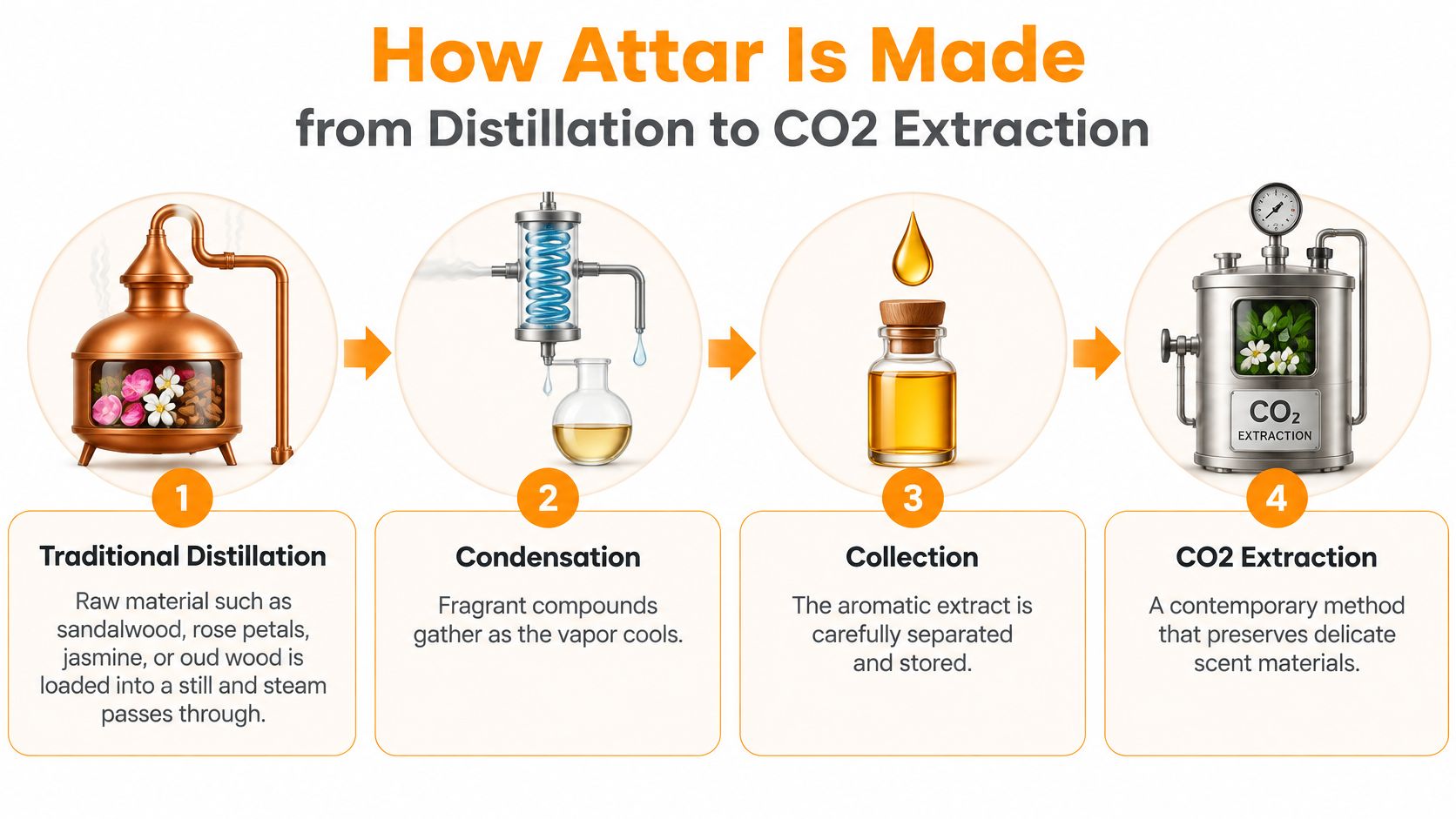
Indian distillation is closely associated with traditional attar, often using sandalwood oil as the base that receives a floral distillate. Philippine trade figures show why imported aromatic materials matter locally: the World Bank WITS record for Philippine essential oil imports in 2023 reports US$4.49584 million and 397,261 kilograms imported, with India supplying US$731,210 and 169,901 kilograms. That category reaches well beyond attar, yet it shows how dependent the local perfume trade is on overseas aromatic inputs.
Extraction Methods and What They Produce
| Method | How it works | Typical materials | Trade-off |
|---|---|---|---|
| Hydro-distillation | Raw material boiled in water, oil condensed off the surface | Sandalwood, rose, traditional attars | Rich result, can dull delicate top notes |
| Enfleurage | Flowers laid on fat that absorbs their scent over several days | Jasmine, tuberose | Very labour-intensive and costly |
| CO2 extraction | Pressurised carbon dioxide pulls aromatic compounds at low temperature | Delicate florals, resins | Clean profile, higher cost |
CO2 extraction is the modern option in that table. Pressurised carbon dioxide behaves like a solvent at relatively low temperature, so it can preserve delicate notes that heat would flatten or damage. The equipment costs more, which is one reason these extracts often carry a higher price. The material decides the better method. Woody inputs can come through distillation beautifully, while a fragile flower benefits from the cooler process.
Those preserved top notes matter in Philippine heat, where warm skin makes a scent bloom faster and lighter facets burn off first. A CO2 extract may open brighter on a humid afternoon, then hand over to the heavier base notes that both methods share.
The Making Steps in Order
- Harvest and clean the raw material, because dirt and damaged petals add off-notes.
- Load it into the still evenly, so steam can pass through rather than finding one easy channel.
- Distil with steam and collect the condensate, which carries the aromatic oil out of the material.
- Separate the oil from the water, since leftover water can cloud the product and shorten its useful life.
- Blend into a carrier such as sandalwood or a neutral oil, giving the concentrate a skin-ready strength and texture.
- Rest for weeks to months, then filter, so the notes merge and sediment doesn't leave the oil looking muddy.
A finished attar should look clear or evenly coloured for its style, free of gritty particles or separated layers. Colour alone doesn't prove quality, because oud and resins can be naturally dark. Consistency is the reliable signal. Doubts should rise when an oil looks cloudy, smells sharply sour, or changes between bottles from the same batch.
One home check ties this all together. Put a drop of attar on one wrist and your usual spray on the other before a humid afternoon out. Watch how each one develops in the heat rather than assuming the oil wins by default: the attar may stay smooth and close while the spray does the louder early work, and either can fade first depending on the blend.
A Short History of Attar and Its Trade Routes
Attar travelled much like a spice, moving with merchants who valued materials that were light, precious and slow to spoil. In the ancient Near East and Persia, scented oils and waters already had roles in ritual, grooming and hospitality. An oil base made practical sense in hot climates because it held fragrance on skin without needing a spray mechanism, a logic that still applies when alcohol sprays evaporate fast in humid Philippine weather.
During the medieval Islamic period, makers improved distillation and rose water became widely produced. Tradition credits the physician and philosopher Ibn Sina, known in Europe as Avicenna, with refining the steam distillation of rose. Whatever the precise origin, better stills let makers capture a flower's scent more reliably and carry it far from the garden where it grew.
The bottle below shows how a modern Gulf fragrance can package that older oriental style for today's spray buyer.
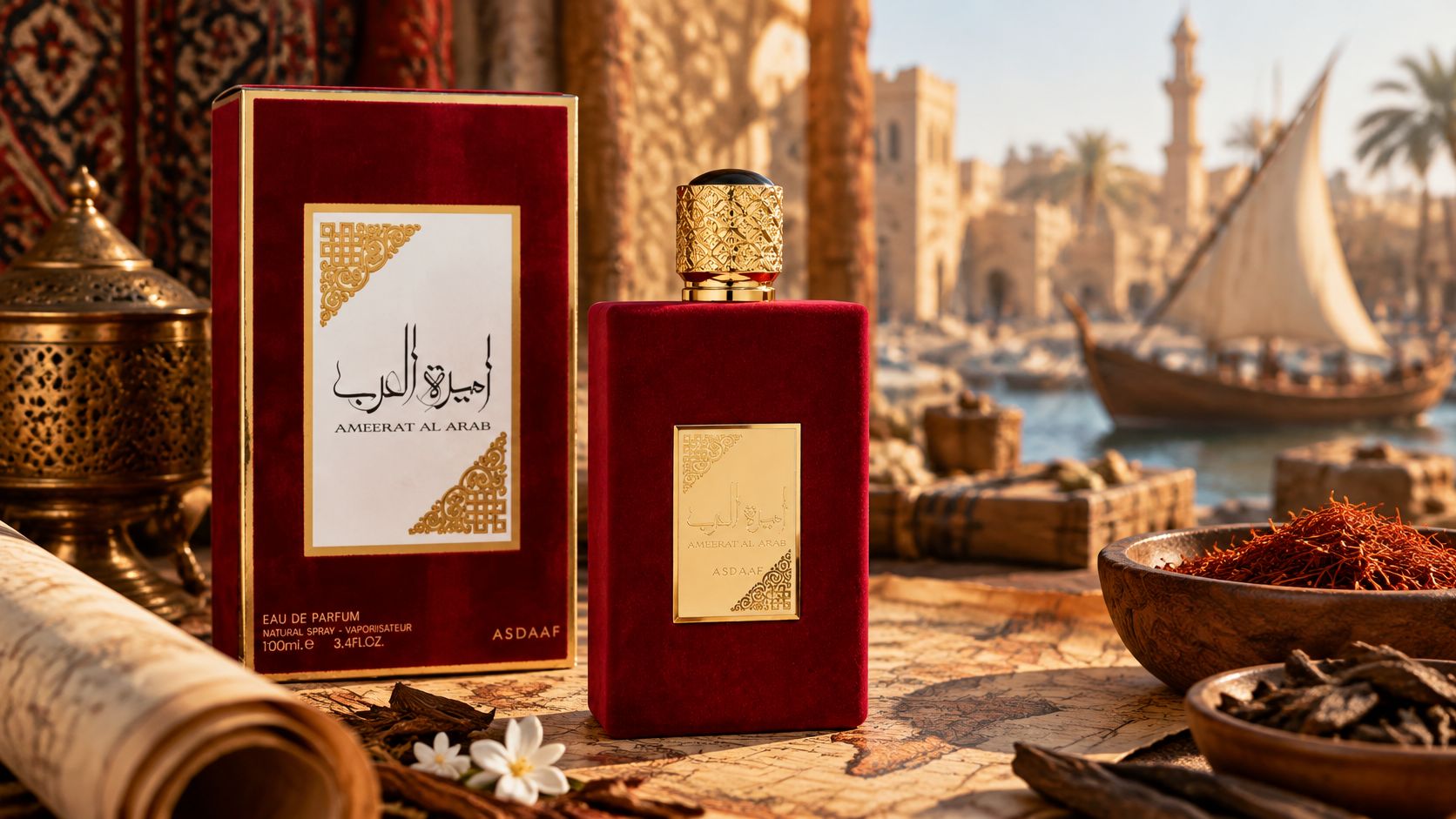
Trade routes then carried perfume materials across the Silk Road and the Indian Ocean. Kannauj in northern India became known for attar making, with sandalwood prized as a base. In the Gulf, traders valued oud, the fragrant resin formed in infected agarwood trees, both as chips for burning and as an oil for skin and cloth at important gatherings.
Modern Gulf houses now combine those traditions with commercial bottling and EDP formats. For example, Ameerat Al Arab Red Eau de Parfum is a 100ML Eau de Parfum described as opening with spice and floral notes before a warm, woody base, and it's presented for evening wear and special occasions. Its rich oriental direction carries the same regional taste into spray form.
That history explains what you see on a shelf today. A small oil bottle, a dab applicator and a scent that warms gradually on skin all follow methods built for concentration and closeness, not for filling a room in the first minute.
Scent Families and Notes in Attar
A useful way to hear a fragrance is through music. Top notes are the opening chords you smell first. Heart notes carry the middle of the song, and base notes linger like a closing bass line after the brighter parts fade. In attar, that progression can feel slower because oil releases each stage gradually.
The graphic below groups common attar materials by family so you can connect ingredient names with the mood they usually create.
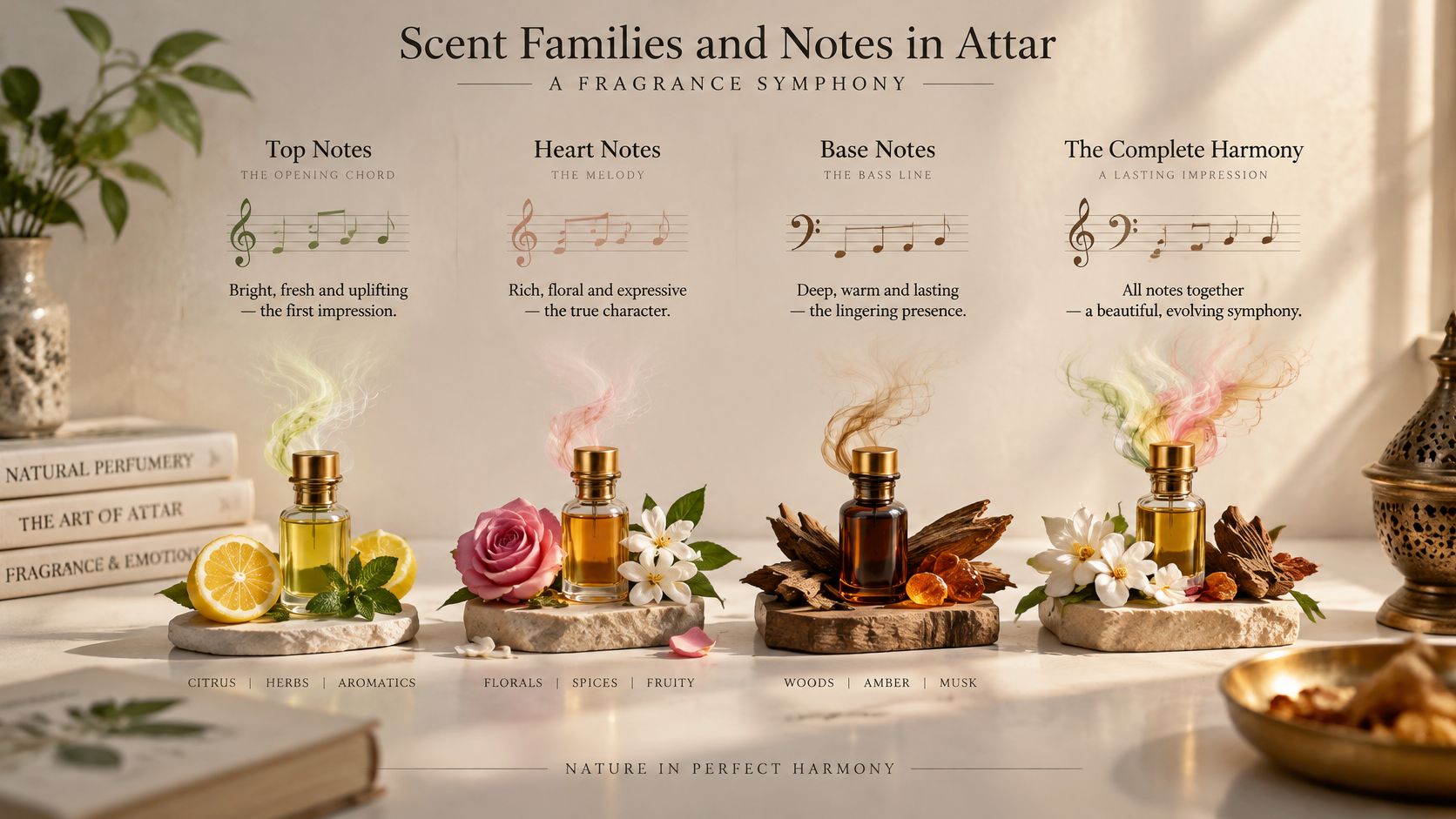
Attar Scent Families, Notes and Best Occasions
| Scent family | Common notes | Mood | Best occasion |
|---|---|---|---|
| Floral | Rose, jasmine, orange blossom | Soft and romantic | Daytime and office |
| Woody | Sandalwood, cedar, oud | Warm and grounded | Cooler evenings |
| Oriental or amber | Amber, vanilla, musk, incense | Rich and enveloping | Evenings and events |
| Fresh | Bergamot, mandarin, green notes | Light and bright | Hot days and commuting |
A floral attar can feel polished without being loud, which suits daytime and office wear. Woody blends feel grounded and often become more comfortable as the evening cools. Oriental or amber attars bring warmth and sweetness, so they're popular for events and gifts, while fresh blends give a cleaner lift that many people prefer before a commute. If oud is the note you're trying to understand first, our explainer on what oud fragrance smells like and where it comes from breaks down its woody, resinous character.
Many attars aren't strongly gendered by design. Rose can read elegant on one wearer and sharp on another, while oud may smell smoky on dry skin and sweeter on warm, moisturised skin. Treat the listed notes as directions, not a promise. The same bottle can legitimately give two people different experiences.
The short video below is a useful visual refresher on how notes develop before you compare bottles side by side.
When comparing two attars, smell them at the same time of day. Heat and sweat can make citrus feel sharper and amber feel heavier, so a morning test and an afternoon test aren't a fair match. Give each oil several hours before you decide, because a first sniff mostly tells you about the opening. The base you'll live with longest may be the part you like most, or the part that finally rules a bottle out.
How to Apply Attar and Make It Last in Humid Weather
Heat makes fragrance molecules lift faster. Humidity and sweat then dilute what's sitting on your skin and can push rich notes to feel heavier. Attar's oil base usually slows evaporation, but it isn't a guarantee in Metro Manila weather. Concentration, skin moisture, sweating, storage temperature, application amount and scent profile all change the result.
Start with less than you think you need. A dense amber or oud attar can become tiring in a crowded train even when it doesn't project far, because warm air keeps releasing it near your face. A fresh floral, by contrast, may need a planned reapplication after outdoor walking.
Application Amounts by Setting in Metro Manila
| Setting | Amount | Where to apply | Reapply |
|---|---|---|---|
| Commute and office | 1 to 2 dabs | Inner wrists | Once after about 6 hours |
| Hot outdoor day | 1 dab | Inner elbow, lower on the body | After about 4 hours |
| Evening event or dinner | 2 to 3 dabs | Neck, collarbone, behind ears | Once midway through |
| Air-conditioned venue | 2 dabs | Chest and wrists | Once after about 8 hours |
Pulse points work because the skin is warmer there, helping scent rise from the oil. Dab, don't rub, because rubbing spreads the oil thinly and can disturb the opening notes before you've smelled them properly. Apply after moisturiser if your skin is dry, since oil on parched skin can seem to vanish into it. On very sweaty skin, wait until you've cooled down and patted dry.
Oil transfers. Let attar settle before dressing, and keep it away from silk, pale cotton and other fabrics that stain easily. If you want scent on clothing, a spray is normally the safer format, but test an inside seam first because EDP can also mark delicate material.
Store the bottle below about 25°C, away from direct sunlight, bathroom steam and car dashboards. Seal the cap tightly after each use. A bottle left in a hot delivery area or a sunny bag can lose its brighter notes, and that storage damage may be blamed unfairly on the formula.
Don't ask which format lasts longer in general. Ask which one still smells right on your skin, in your weather, at the hour you care about.
Run a Side-by-Side Wrist Test
Apply attar to one wrist and an EDP to the other, using a modest, roughly equal amount. Write down what you notice at 1 hour, 4 hours and 8 hours, including strength, sweetness, freshness and whether someone nearby can smell it. Repeat on a cooler or more active day if your routine changes a lot.
Judge the result against your actual need. Office wear may favour the quieter wrist, an evening event may favour projection, and a gift recipient may prefer the format they already know how to use. Your test replaces the common claim that oil always wins. It gives you evidence from your own commute, skin and storage conditions.
How to Check an Attar Label Before You Buy
A small bottle can hide a lot of uncertainty. Run these checks in shopper order, before price or scent descriptions persuade you. The purpose is traceability: knowing who made the product, what is in it, and whom to contact if your skin reacts.
Eight checks can feel like a lot to hold in your head, so the infographic below condenses the first three into a quick visual you can run through in seconds at a listing or stall.
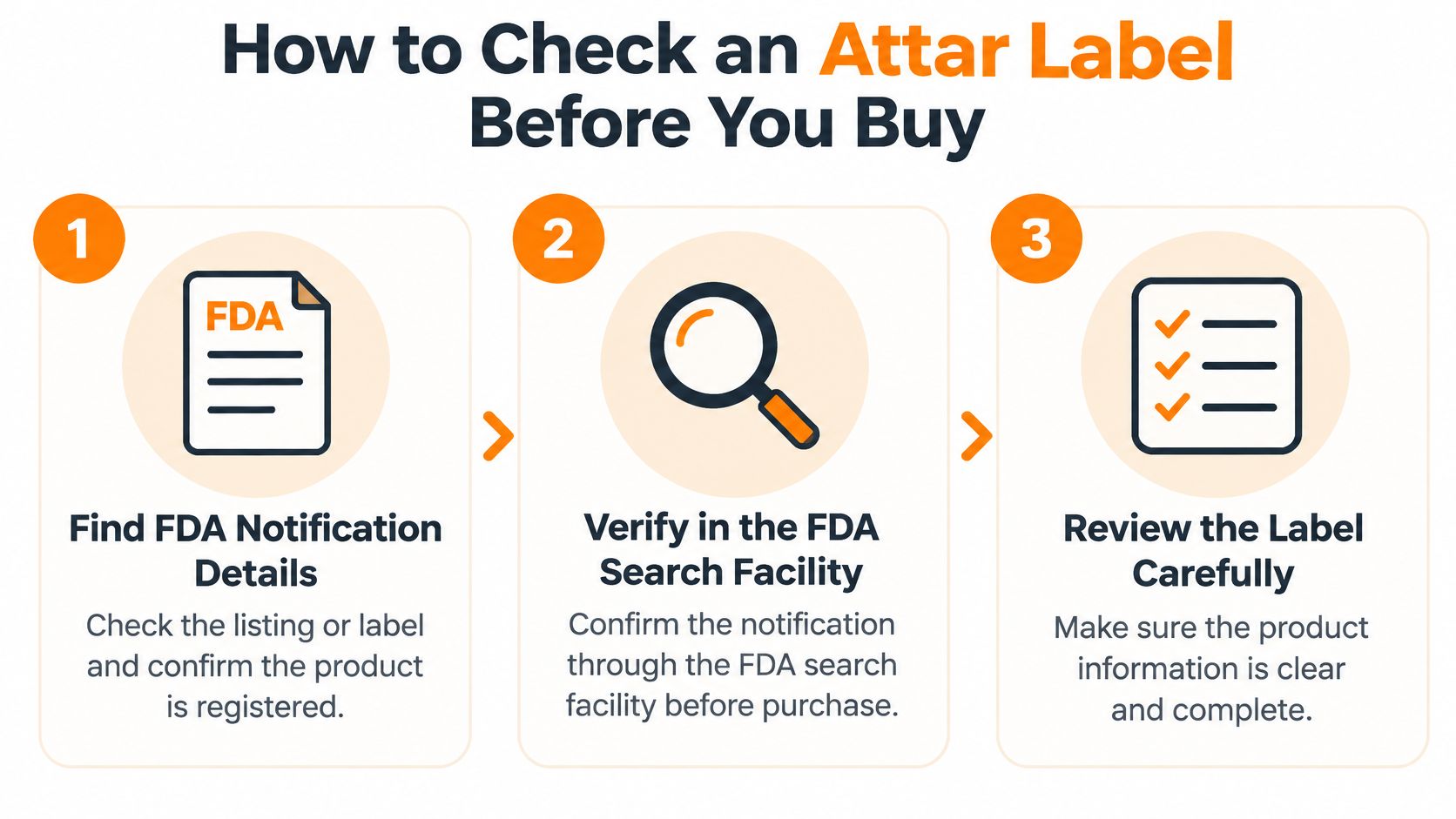
The Eight Checks in Order
- Find the FDA notification details on the listing or label, because a body perfume sold in the Philippines should be traceable as a cosmetic product.
- Verify them through the FDA search facility before buying or reselling, since a printed number is only useful when it matches the product.
- Read the full ingredient list, because named materials let you check allergens, while vague terms such as "natural oil" or "Arabic essence" hide what is on your skin.
- Check botanical names, which should identify genus and species, so rose, sandalwood or another plant material can be recognised precisely.
- Confirm the standard label details, including net content, lot or batch number, manufacturing or expiry information, country of manufacture, precautions and the responsible company.
- Check the seller's contact details and return policy, because a seller you can't reach leaves you with no remedy for leakage, damage or the wrong item.
- Compare price per millilitre, not only the total price, so a large bottle and a small roll-on are judged on the same basis.
- Test a drop on your skin before committing to the full bottle, because even a properly labelled attar can smell different on you or irritate sensitive skin.
That sequence follows Philippine FDA guidance on cosmetic ingredient labelling, which requires accepted cosmetic nomenclature, states that botanicals and botanical extracts should identify genus and species, and requires restricted substances to disclose functions and percentages when required under the ASEAN Cosmetic Directive. A batch number works like a receipt: it ties one specific bottle to one production run, which is why checks two and five matter as a pair.
Registration is a useful starting point, but it does not prove a bottle is authentic on its own. An FDA notification shows a product passed through the notification system. Packaging can still be copied, and old listing photos can be reused for a different batch. Match the notification, label, batch details and seller information together before you pay. Our guide to spotting fake versus original perfume adds packaging checks to support that judgement.
Pay special attention to concentrated botanical oils if you have sensitive skin. A clear ingredient list helps you avoid a material you already know troubles you. Patch test a tiny amount on the inner elbow and wait before applying widely. Stop using it if you develop itching, burning or a rash, and keep the label details so you can identify the product later.
Step away when you see these red flags:
- No batch or lot number: The bottle can't be traced if there's a quality problem.
- No country of manufacture or responsible company: You can't establish who stands behind it.
- Missing seller contact details: Returns and safety questions become difficult.
- A price far below comparable products: A bargain is possible, but an extreme gap needs an explanation other than a sales slogan.
Choose Your First Attar with Confidence
Match the format to your day first. For hot commutes and workplace wear in Metro Manila, a lighter EDP or EDT may feel cleaner, with attar kept to one careful dab. For an evening event, cooler weather or a deeper scent that stays close to the skin, attar often fits better. A scent that fades by mid-afternoon in humidity can still be the right purchase if your plan for it is dinner, not the daily commute.
Before you pay, run the label checks on the exact listing and ask for FDA notification and batch information if they are not visible. If you already did the side-by-side wrist test, let those notes settle the format question.
Once the bottle arrives, keep a short wear log for the first few outings. Note the date, the weather, how much you applied and where, and the hour the scent faded. Three or four entries will show you a pattern: whether the oil holds through humid afternoons, whether one dab is enough, and whether the scent family suits your routine at all. Let that record guide your second bottle.
If you want an online shortlist to compare, we sell oud-based perfumes, Arabic attars, and designer-inspired scents, and we carry Lattafa, Rasasi, Armaf, Afnan, Maison Alhambra, French Avenue, Rayhaan, Khadlaj and Arabiyat Prestige. Browse the current bottles at Dubai Fragrance Shop PH, and treat us like any other seller: ask for the notification and batch details before ordering.
Pick one scent family, one format and one bottle to try this month. Wear it in your normal conditions and write down what happens.